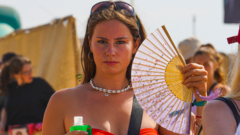
The bass doesn’t just hit your ears at three in the afternoon; it vibrates through the soles of your melting sneakers and echoes inside your breastbone. Around you, eighty thousand people are moving in a collective, sun-drenched trance. The energy is electric. It is exactly what you paid six hundred dollars to experience.
But look closer at the crowd.
There is a young man near the barrier. Let’s call him Marcus. Marcus spent six months counting down the days to this weekend. Right now, his favorite electronic duo is playing a legendary daytime set. But Marcus isn’t dancing anymore. His skin is the color of a bruised plum, a sheen of cold sweat covers his forehead, and his eyes are fixed on a point somewhere in the middle distance. He feels a strange, heavy confusion creeping into his mind. He thinks he just needs to push through. He thinks everyone else is feeling this exact same crushing weight.
They aren’t. Marcus is quietly sliding into the first stages of severe heat exhaustion.
Every summer, millions of people pack their bags for multi-day music festivals. We plan our outfits, we map out our schedules, and we obsess over the lineup. Yet we almost completely ignore the single most dangerous element of the weekend: the unrelenting, ambient hostility of the environment itself. A festival grounds in July is not just a venue. It is a microclimate of concrete, dust, packed human bodies, and radiant heat.
Staying alive and thriving in that environment requires more than just buying a bottle of water at the gate. It requires a fundamental shift in how we understand our own biology under pressure.
The Architecture of the Heat Trap
To understand why festivals become so dangerous, you have to look at the physics of a crowd. When tens of thousands of people gather in front of a stage, they form a human heat engine.
Each individual human body at rest generates roughly 100 watts of heat. When you add dancing, jumping, and the emotional high of live music, that output spikes dramatically. Now multiply that by fifty thousand people packed shoulder-to-shoulder. The ambient temperature inside a dense crowd can easily sit ten to fifteen degrees higher than the surrounding area.
Then there is the ground beneath your feet. Most major festivals take place on massive racetracks, dusty airfields, or cleared parklands. Sun hitting asphalt or dry, compacted dirt creates an oven effect. The ground absorbs thermal energy all morning and radiates it back upward long after the sun begins to dip. You are trapped in a vice of heat, squeezed from the sky above and the ground below.
Consider what happens inside your body when these conditions collide. Your brain’s hypothalamus acts as a thermostat. When it senses the internal core temperature rising above 98.6°F, it triggers two primary cooling mechanisms: vasodilation and sweating.
Vasodilation pushes your blood toward the surface of your skin to radiate heat away from your vital organs. This is why you get flushed. But this process demands an immense amount of cardiovascular work. Your heart rate increases just to keep up with the cooling demand, even if you are just standing still.
Sweating is your body’s true superpower. The physical evaporation of moisture off your skin pulls heat away from the body. It is an incredibly elegant system. But it has a massive design flaw: it requires a constant, aggressive supply of raw materials to function.
The Hydration Lie We All Believe
Most festival survival guides offer the same generic advice: Drink plenty of water. This is not just incomplete advice; it can actually be dangerous.
When you sweat, you aren't just losing water. You are losing essential salts and minerals, primarily sodium, potassium, and magnesium. These electrolytes are the electrical wiring of your nervous system. They allow your brain to communicate with your muscles and your heart to beat in a steady rhythm.
If you spend eight hours sweating profusely under a midday sun and drink nothing but pure, distilled water, you commit a critical biological error. You dilute the remaining sodium in your bloodstream. This triggers a medical condition called hyponatremia. The symptoms look deceptively like dehydration: nausea, headaches, confusion, and fatigue.
If Marcus responds to his growing confusion by chugging another two liters of plain water, he makes the problem worse. His cells will begin to swell with excess water, leading to a dangerous medical emergency.
The solution requires a tactical approach to intake. You need a one-to-one strategy. For every hydration pack or bottle of plain water you consume, your next drink needs to contain dedicated electrolytes. This doesn't mean colorful, sugar-laden sports drinks that cause insulin spikes and subsequent crashes. Look for targeted electrolyte powders containing high ratios of sodium chloride and potassium, or traditional remedies like coconut water.
True hydration is a slow game. It begins three days before you ever step foot on the festival shuttle. If you arrive at the gates already running a fluid deficit, you are trying to extinguish a house fire with a squirt gun.
The Tactical Wardrobe
Festival fashion is a massive industry. It is about self-expression, escapism, and identity. But the human skin is an organ that needs to breathe, and the fabrics we choose can either act as a personal air conditioner or a greenhouse.
Synthetic materials like polyester, nylon, and heavy acrylic sequins are essentially wearable plastic. They trap a layer of humid, stagnant air directly against your skin, completely blocking the evaporation of sweat. Without evaporation, your sweat is useless. You are just wet and boiling.
The veteran festival-goer approaches clothing as equipment.
- Natural and Technical Weaves: Linen, lightweight cotton, and specialized moisture-wicking merino wool or engineered athletic fabrics allow air to circulate freely.
- The Power of the Wet Bandana: This is the single most effective piece of low-tech gear you can own. Soaking a cotton bandana in ice water and wrapping it around your neck works wonders. The carotid arteries run close to the skin surface in your neck. Cooling this specific area tricks the brain into reducing the perception of heat stress, lowering your perceived exertion and keeping you calm.
- The Wide-Brim Strategy: A baseball cap protects your eyes, but it leaves your ears and the back of your neck exposed to direct UV radiation. A wide-brimmed hat creates a portable perimeter of shade, lowering the ambient temperature around your face by several degrees.
The Anatomy of a Festival Day
The secret to surviving a three-day marathon isn't sheer willpower. It is rhythm. It is knowing when to push and when to retreat.
The dangerous hours are between 11:00 AM and 4:00 PM. This is when the sun sits directly overhead, piercing through the atmosphere with the highest UV index. This is also when set times feature rising artists who play with incredible energy, tempting you to dance in the direct sunlight.
But the real problem lies elsewhere: the lack of shade.
Most festival maps feature massive, open plazas with very few trees. To survive, you must budget your energy like currency. If there is an act you absolutely must see at 1:00 PM, your morning must be entirely passive. Find the shade structures, the art installations, or the indoor activation tents. Sit down. Do not stand if you can sit; do not sit if you can lie down.
[Image diagram showing the strategic pacing of a festival day from morning shade to night sets]
Consider what happens next as the sun begins to set. The temperature drops, the headliners prepare to take the stage, and a second wind sweeps through the venue. This is the golden hour. But it is also a trap.
Because the air feels cooler, your brain stops sending intense thirst signals. Yet your body is still recovering from the massive thermal stress of the afternoon. Alcohol consumption typically rises sharply during these hours. Alcohol is a potent diuretic; it blocks the production of anti-diuretic hormone, forcing your kidneys to excrete water at an accelerated rate.
If you replace your afternoon hydration routine entirely with alcohol once the sun goes down, you set yourself up for a catastrophic crash by midnight. The most seasoned attendees use a strict pacing system: a full drink of water between every single alcoholic beverage. No exceptions.
Recognizing the Turning Point
We like to think we are invulnerable when the music is loud and our friends are near. We ignore the subtle warning signs our bodies send us because we don't want to be the person who ruins the group's night.
We need to break that mindset. Heat illnesses progress along a predictable, dangerous continuum.
| Stage | Symptoms to Watch For | Immediate Action Required |
|---|---|---|
| Heat Cramps | Sharp muscle spasms in calves, abdomen, or arms; heavy sweating. | Stop moving. Move to shade. Drink an electrolyte-heavy beverage immediately. |
| Heat Exhaustion | Dizziness, headache, cold and clammy skin, rapid pulse, nausea, dark urine. | Leave the crowd. Seek medical tent. Loosen clothing. Apply cold, wet cloths to neck and armpits. |
| Heat Stroke | Confusion, slurred speech, delirium, loss of consciousness, hot and dry skin (or profuse sweating). | Medical Emergency. Call security immediately. Rapid active cooling required to prevent organ damage. |
The transition from heat exhaustion to heat stroke can happen in a matter of minutes. Heat stroke is a medical emergency where the body's internal temperature crosses 104°F. At this point, cellular structures begin to break down. The brain can no longer regulate core temperature.
Look out for your friends. If someone in your group stops talking, starts stumbling, or responds to questions with confusion, the fun stops. They are not just tired. They are in trouble.
Every major festival features clearly marked medical tents. These tents are staffed by professionals who are not there to get anyone in trouble or ruin anyone's weekend. They are there to save lives. They possess IV fluids, industrial cooling fans, and ice baths. If you feel dizzy, walking into a medical tent for twenty minutes of air conditioning and a cold drink is the smartest move you can make. It is the difference between enjoying the headliner at midnight or spending the night in a regional hospital.
The Final Chord
The sun finally slips behind the horizon, leaving a bruised purple trail across the desert sky. The main stage erupts in a wall of laser light and blinding pyrotechnics. The air is cool now, carrying the scent of crushed grass, dust, and sweet sweat.
Marcus is there, right in the middle of the crowd.
But he isn't staring blankly into space. Three hours ago, his friends noticed his silence. They pulled him out of the dense throng before the stage, led him to a shaded grove of trees, and forced him to drink an electrolyte packet mixed into cold water. They soaked his bandana at a water station and laid it across his neck. He rested while the sun did its worst.
Now, Marcus is back. His skin is cool, his mind is sharp, and he is dancing. He isn't pushing through the environment anymore; he is navigating it.
The festival experience is a beautiful, chaotic celebration of human connection and art. It is a space where memories are forged that last a lifetime. But the magic only works if you respect the reality of the machine you inhabit. Your body is a finely tuned system of water, salt, and pressure. Take care of the system, and the weekend belongs to you.