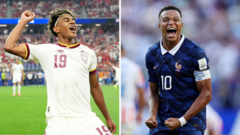
The grass at the Stade de France does not care about legacies. It is just turf, cold and damp under the floodlights, bruised by the studs of millionaires and teenagers alike. But when Kylian Mbappé steps onto it, the air itself seems to tighten. A few yards away, Lamine Yamal bounces on his toes, looking impossibly young, his limbs still carrying the slight, loose-jointed gangliness of a boy who grew up playing on concrete cages in Rocafonda.
This is not just a football match. It is a collision of timelines. You might also find this similar story useful: The Operational Asymmetry of Spain vs France.
On one side stands the established king, a man who has spent his entire twenties operating under a suffocating level of expectation, his face plastered on giant billboards from Paris to Doha. On the other is the challenger, a kid who legally needed his parents’ signature on his contract not long ago, carrying the hopes of a nation before he is even old enough to drive a car.
We love to treat football like a video game. We look at the statistics, the transfer values, the theoretical tactical setups, and we assume the outcome is a simple math problem. But the pitch is a theater of human nerves. When the whistle blows, those numbers melt away. What remains is the sheer, terrifying weight of the moment. As highlighted in latest reports by Sky Sports, the implications are significant.
The Price of Early Perfection
Consider the burden of being Kylian Mbappé.
At nineteen, he did not just play in a World Cup final; he owned it. He ran past seasoned defenders as if they were standing in wet cement. He scored a goal that cemented his status as the heir apparent to the global throne. That kind of early peak does something to a human being. It shifts the baseline of success to an impossible height.
Now, every tournament is a trial. If he scores a brace, it is merely what was expected. If he fails to score, it is a national crisis.
During the European Championship, you could see the physical toll of this expectation. It was there in the stiff set of his shoulders, the frustrated gestures toward teammates, and the literal mask he had to wear after breaking his nose. The mask was a perfect, almost too-on-the-nose metaphor. He was a gladiator stripped of his facial expressions, forced to hunt for glory through a restricted field of vision, carrying a nation that has grown spoiled by his genius.
The human mind is not built to sustain that level of constant, unrelenting pressure. When Mbappé accelerates, he is not just trying to beat a right-back; he is running against his own myth. He is trying to prove that the peak he scaled so early was not his limit, but just the beginning of his climb.
The Beautiful Ignorance of Youth
Then there is Lamine Yamal.
If Mbappé’s story is about the struggle to maintain perfection, Yamal’s is about the sudden, dizzying ascent toward it.
There is a distinct kind of magic in a footballer who does not yet know what it feels like to fail on the biggest stage. Watch Yamal closely when he receives the ball on the right flank. There is no hesitation. There is no calculation of the critics’ reactions or the social media fallout if he loses possession. He plays with the joyous, insolent freedom of a kid trying to embarrass his older cousins in the backyard.
That freedom is a weapon.
When he cut inside against France in Munich, dropped his shoulder, and whipped a curling, impossible arc into the top corner, he did not look like a player executing a high-pressure tactical instruction. He looked like a boy playing with a toy he loved. The ball kissed the post and went in, and for a second, the entire stadium held its breath, shocked that a seventeen-year-old could make the most difficult sport in the world look like a playground game.
But that innocence is highly perishable.
Every touch, every brilliant assist, and every match-winning performance chips away at that beautiful ignorance. With every headline, the world demands more. The defenders start studying his tendencies. The tackles get harder. The spaces grow tighter. Soon, the joy of playing is replaced by the fear of losing what you have built.
The Tactical Chessboard of the Mind
When these two forces meet, the tactical battle is won or lost in the mind long before the ball is kicked.
The managers can draw their arrows on the whiteboards all day. They can instruct the defensive midfielders to double-team the wide areas and force the play inside. They can analyze heat maps until their eyes bleed. But they cannot draw a diagram for how a teenager reacts when he hears sixty thousand hostile fans screaming his name, or how a superstar handles the creeping realization that his body might not be responding the way it did five years ago.
Spain’s system is designed to nourish Yamal’s instinct. They play with a fluidity that encourages him to take risks, knowing that behind him is a structure built to recover the ball. They treat him like a prized instrument that needs the right acoustics to shine.
France, under Didier Deschamps, operates differently. They are a machine built on pragmatism. They do not mind suffering. They do not mind being ugly. They wait for the opponent to grow impatient, to make one microscopic mistake, and then they unleash Mbappé like a lightning strike. It is a style of play that requires immense discipline, but it also places a massive burden on Mbappé to make his few moments count.
When the machine is suffocating, Mbappé has to be the breath of air. When the machine is breaking, he has to be the repairman.
What We are Actually Watching
We watch sports because we want to see ourselves in the athletes. We want to believe that we, too, could rise to the occasion when the world is watching.
When we debate whether it is Yamal’s time to ignite or another Mbappé masterclass, we are not really talking about football tactics. We are talking about the two great struggles of human existence.
Yamal represents the potential of tomorrow. He is the thrill of the unknown, the hope that the future will be brighter and more exciting than the past. He is the dream we all had before life forced us to compromise.
Mbappé represents the reality of today. He is the grind of maintaining excellence under scrutiny, the struggle to stay on top when everyone is waiting for you to slip. He is the reminder that even when you achieve your wildest dreams, you still have to wake up the next day and defend them.
The referee checks his watch. The players take their positions. The stadium lights reflect off the damp grass, creating a stage that has hosted a thousand dramas before and will host a thousand more after tonight.
As the whistle blows, the boy from Rocafonda takes a deep breath, his eyes bright with the thrill of the chase. Across the halfway line, the masked king narrows his eyes, ready to remind the world why the crown belongs to him. The ball rolls, and for ninety minutes, the rest of the world fades into silence.