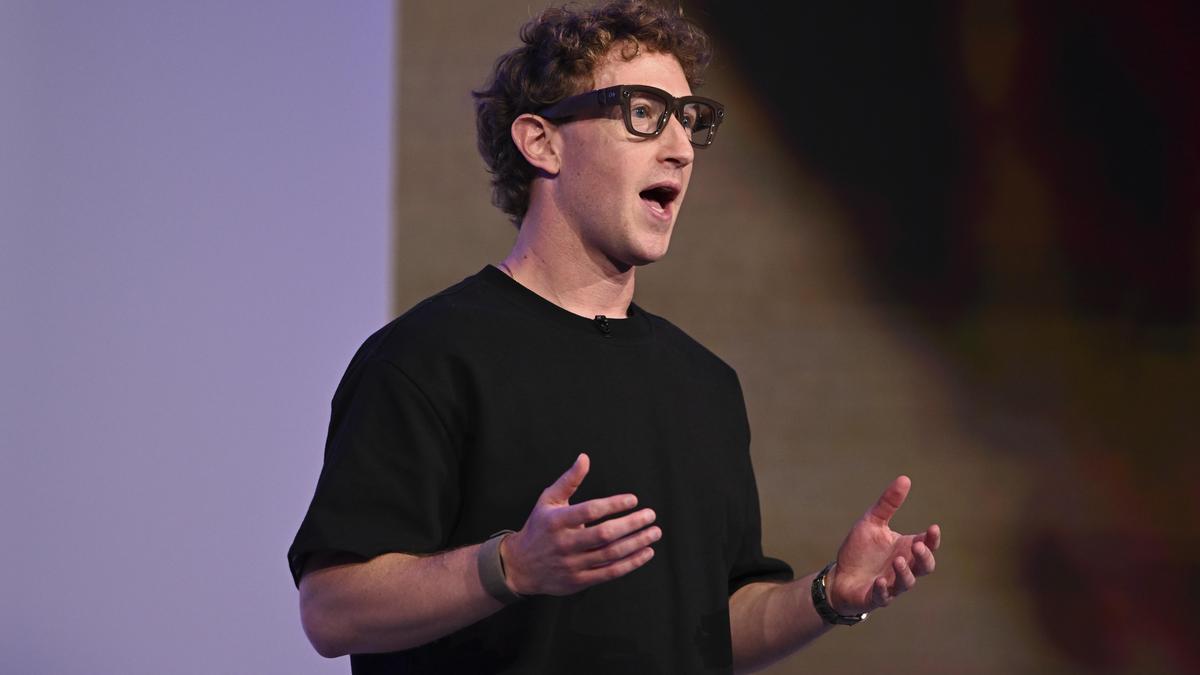
Mark Zuckerberg sat before his webcam, the blue light of the monitor washing over a face that usually projects the calculated optimism of a Silicon Valley titan. But this time, the script felt different. The "Year of Efficiency" wasn't just a slide in a deck or a mantra for shareholders anymore. It had a heartbeat. Or rather, it had the absence of thousands of them.
When Meta announced it would part ways with roughly 11,000 employees—about 13% of its workforce—the news hit the industry like a sonic boom. Then came another 10,000. For years, the sprawling campus in Menlo Park was a land of infinite snacks, laundry services, and the unwavering belief that growth was a natural law of physics. Then, the physics changed.
To understand the weight Zuckerberg says he feels, you have to look past the stock tickers and the billion-dollar buybacks. You have to look at the desk of someone like "Sarah."
Sarah wasn’t a hypothetical data point to her team. She was a senior engineer who had relocated her entire family from Ohio to the Bay Area because Meta promised her she was building the future. She spent her weekends scouting school districts and her weekdays optimizing algorithms for the Metaverse. When the email arrived at 6:00 AM, her access to the internal servers was already severed. She didn't get to say goodbye to her code, let alone her colleagues.
This is the invisible tax of a corporate pivot.
The Architect’s Miscalculation
During the pandemic, the world shifted online with a speed that felt permanent. E-commerce surged. Digital connection became the only connection. Zuckerberg, seeing this, doubled down. He hired aggressively, betting that the "new normal" was a permanent acceleration of the digital age.
He was wrong.
As the physical world reopened, the hyper-growth cooled. Inflation climbed. Apple’s privacy changes squeezed the very lifeblood of Meta’s advertising engine. Suddenly, the company wasn't just building a virtual reality; it was facing a very harsh physical one. Zuckerberg admitted he over-hired. He took full responsibility. But taking responsibility is a luxury of the person at the top; living the consequences is the burden of those in the middle.
The weight of a decision like this isn't just about the numbers. It’s about the erosion of a culture. For two decades, Meta (formerly Facebook) was the "North Star" for tech talent. It was the place where you went to move fast and break things. Now, the thing that felt broken was the psychological contract between employer and employee.
The Geometry of Loss
Consider the math of a mass layoff. It’s not just the 21,000 people who left. It’s the 60,000 who stayed, staring at empty desks, wondering if their badge will work tomorrow. This is "survivor’s guilt" codified into a corporate structure.
The efficiency drive aimed to flatten the organization. Zuckerberg noted that a manager of managers, who manages a manager, who finally manages the person doing the work, is a recipe for stagnation. He wanted to return to a leaner, meaner version of the company he started in a dorm room.
But a company with nearly 70,000 people cannot be a startup. You can’t turn a cruise ship into a speedboat just by throwing the lifeboats overboard.
The "weight" Zuckerberg describes is the realization that his personal evolution as a leader now requires a certain coldness. To save the ship, he had to be the one to push people into the dark water. For a man who has spent his entire adult life obsessed with "connecting the world," the irony of being the one to sever those connections is a heavy cloak to wear.
The Human Algorithm
While the C-suite talks about "optimizing resources" and "reallocating capital toward AI," the reality on the ground is far more visceral. It’s the sound of a Slack channel going quiet. It’s the "Hacker" signs on campus that suddenly feel like a taunt rather than an invitation.
We often think of these tech giants as monoliths, but they are actually fragile ecosystems of human ambition. When you prune 25% of a forest, the light hits the floor differently. The wind moves through the trees with a sharper whistle.
The pivot to Artificial Intelligence is now the new mandate. The capital saved from the "Year of Efficiency" is being poured into H100 chips and large language models. The irony is thick: humans were let go so that the company could build machines that simulate human intelligence.
Zuckerberg’s public contrition is a rare moment of vulnerability from a leader often accused of being robotic. He spoke about how these were some of the hardest decisions he’s ever made. He talked about the personal pain of seeing people who worked hard leave.
But for the engineers, designers, and content moderators who are now refreshing LinkedIn and calculating how many months of runway their severance provides, that empathy is a cold comfort. They are the ones carrying the physical weight of the "weight" he feels.
The tech industry used to be a place of endless frontiers. Now, it feels like a place of borders and boundaries. The era of "move fast and break things" has been replaced by "move carefully and save things."
The ghost of those 21,000 desks still haunts the glass-walled offices of Menlo Park. As Meta pursues the dream of the Metaverse and the promise of AGI, it does so with a lighter payroll but a much heavier soul. The true cost of efficiency isn't found on a balance sheet; it's found in the quiet, empty hallways of a company that used to believe it could grow forever.
The blue glow of Zuckerberg’s monitor eventually fades when he logs off, but for the thousands who no longer have a login, the screen stays dark.