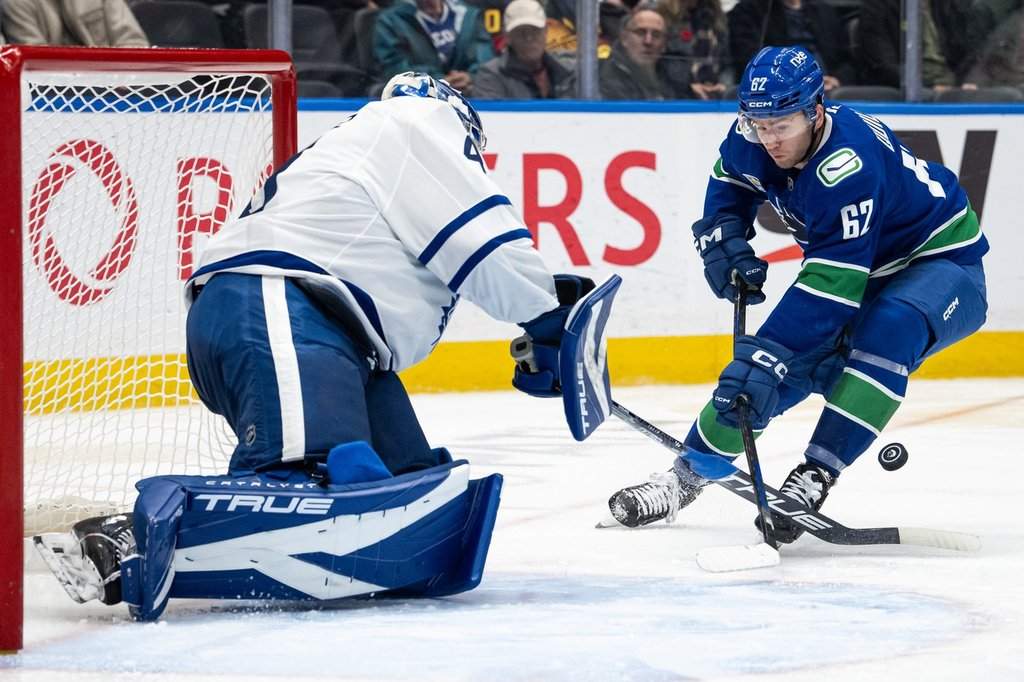
The tape on a hockey stick tells the truth long before a post-game press conference ever will.
Walk down the tunnel beneath Rogers Arena after a third consecutive home loss, and the air smells like damp wool, stale Gatorade, and quiet desperation. You do not hear the roar of eighteen thousand fans anymore. You hear the rhythmic, hollow thud of skate blades hitting rubber matting. You hear the low hum of industrial laundry machines already spinning the sweat out of blue-and-green sweaters. And if you linger near the doorway of the media scrum, you hear the exact same cadence of words repeated like a liturgical chant.
We liked our compete level.
The process is trending in the right direction.
We played well enough to win.
Exhausting.
There is a specific kind of heartbreak reserved for sports fans who watch a team lose while insisting they are actually winning. For decades, following the Vancouver Canucks has required an advanced degree in emotional endurance, an ability to squint at a dismal scoreboard and somehow find a silver lining painted into the corners of the glass. Right now, as the losses pile up in the standings like wet snow against a windshield, the organization is asking its faithful to buy into a familiar currency. They are selling progress. They are trading in underlying metrics, zone-entry percentages, and moral victories.
The problem with moral victories is that you cannot deposit them in the bank when April arrives.
The Anatomy of a Beautiful Loss
Consider a hypothetical Tuesday night in November—a composite of a dozen games this season that have left Vancouver staring at the ceiling at two in the morning.
Imagine a fan named Marcus sitting in Section 318. He spent two hundred dollars on tickets, forty dollars on parking near Chinatown, and another thirty on two lukewarm beers. By the end of the second period, his team is outshooting the opponent twenty-eight to fourteen. They are winning the puck battles along the half-wall. Their breakouts look crisp, almost rehearsed, snapping from tape to tape with a geometric precision that would make an analytics department weep with joy. Marcus leans forward, elbows on his knees, feeling that dangerous, familiar spark of hope rising in his chest.
Then comes the third period.
A missed assignment behind the net. A defensive coverage breakdown that lasts precisely one point four seconds. A weak wrist shot from the point that finds a way through traffic because nobody cleared the sightline. Suddenly, a dominant forty-five minutes evaporates into a 3-2 regulation loss.
When Marcus walks out onto Abbott Street into the cold Pacific drizzle, he does not care that the Canucks controlled fifty-eight percent of the expected goals. He does not care that their neutral-zone forecheck disrupted the opposition's top line for two periods. He feels robbed. Worse, he feels gaslit when he turns on the post-game radio show on the drive across the Cambie Bridge and hears the coaching staff praise the effort.
This is the fundamental disconnect tearing at the fabric of a hockey-mad market. Inside the dressing room, players and coaches live inside a microscope. They have to. If a twenty-three-year-old defenseman obsesses over the standings in November, he will grip his stick so tightly his knuckles turn white, and he will make the exact same turnover the following night. Coaches preach process because process is the only variable human beings can actually control on a sheet of ice two hundred feet long and eighty-five feet wide. You cannot force a puck to bounce over a defenseman's stick, and you cannot will a post to become an inch wider. You can only control your positioning, your gap control, and your willingness to block a ninety-mile-an-hour slapshot with your shin pad.
Yet outside the room, the scoreboard is the only objective reality. Hockey is a zero-sum game dressed up in poetry. When a team repeatedly loses games it supposedly deserved to win, the narrative shifts from bad luck to a structural flaw.
The Seductive Trap of Underlying Numbers
To understand why the Canucks keep pointing to progress while sinking in the standings, you have to understand how modern hockey evaluates itself.
Think of a hockey game like a kitchen remodeling project. If you walk into a house and see copper piping neatly soldered, drywall hung with laser-straight seams, and brand-new subflooring installed, you can reasonably say the contractors are making tremendous progress. Even if there are no cabinets yet and you are still washing dishes in the bathtub, the foundation is sound.
That is what coaches mean when they talk about structure. Over the past several seasons, Vancouver has cycled through eras of chaotic, run-and-gun hockey where goaltenders were left stranded like castaways on an island, facing forty shots a night and praying for miracles. Compared to those dark stretches, watching a team maintain defensive posture, support the puck carrier in layers, and generate high-danger scoring chances feels like a revelation.
Look at the numbers that fuel the optimism. In stretch after stretch of this losing skid, the Canucks have ranked near the top half of the league in five-on-five shot attempts, suppressing rush chances against, and establishing offensive zone time. On paper, they look like a team knocking aggressively on the door of contention.
Here is the catch. In the National Hockey League, knocking on the door does not get you inside the house.
When a team consistently generates thirty-five shots and scores twice, the issue stops being a statistical anomaly and becomes a question of finishing talent, net-front presence, and psychological fragility. Great teams find ways to win ugly when their legs feel like concrete. Struggling teams find ways to lose pretty when everything is clicking. I have watched enough hockey over the last twenty years—sitting in press boxes, shivering in minor-league rinks, nursing warm coffees through triple-overtime playoff heartbreaks—to recognize the difference between a team that is unlucky and a team that does not know how to close the door.
An unlucky team gets angry. A fragile team gets rational.
Listen closely to the tone in the Vancouver locker room right now. There is plenty of frustration, certainly, and nobody is accusing these athletes of apathy. NHL players are among the most fiercely competitive human beings on the planet; they do not reach the highest level of the sport by shrugging off defeat. Still, there is a subtle danger when "we played well" becomes a comfortable blanket to pull over a cold loss. Once a group accepts that effort is enough to satisfy the room, the urgency required to make the dirty, painful plays in the final five minutes begins to erode.
What Losing Actually Does to a Room
People who have never played competitive team sports often imagine a losing streak as a series of explosive arguments, trash cans being kicked across locker rooms, and coaches screaming until their veins bulge.
Reality is much quieter, and far more insidious.
Losing is a slow leak in a tire. At first, you barely notice it. The car pulls slightly to the left on the highway, so you compensate by holding the steering wheel a fraction tighter. You tell yourself you will stop at the next gas station to put some air in it. Then another mile passes. And another. Before you realize what is happening, the rim is grinding sparks into the asphalt.
In an NHL dressing room, a five- or six-game slide alters the micro-behaviors of twenty-three grown men. A winger who normally drives the middle lane with authority hesitates for a fraction of a second, looking to pass instead of shoot because he has gone twelve games without a goal and no longer trusts his hands. A defenseman who usually pinches down the wall to keep a play alive backs off toward the blue line, terrified of giving up an odd-man rush that will end up on the morning highlight reels.
Confidence is not an abstract concept in hockey; it is physical speed. When you are confident, your brain processes the geometry of the ice subconsciously, allowing your feet to move at full throttle. When doubt creeps in, you start thinking through every stride, and thinking at twenty-five miles per hour makes you slow.
This is the invisible stake behind the Canucks' public messaging. When the coaching staff stands in front of the cameras and insists that the team is making strides, they are not talking to the reporters, and they are certainly not talking to Marcus up in Section 318. They are speaking directly through the television monitors to the players sitting twenty feet away in the trainer's room. They are desperately trying to protect the fragile psychological ecosystem of their roster before doubt calcifies into paralysis.
It is a noble strategy. It is also a perilous one.
The History We Pretend to Forget
Vancouver has lived this exact movie before, and the ending rarely wins awards.
Anyone who followed this franchise through the mid-2010s remembers the rhetoric of incremental improvement. Back then, as an aging core slowly yielded to a new generation, the organization spent years celebrating small steps while the Western Conference raced past them. Fans were told to be patient, to look at the close one-goal losses as proof that the gap was closing. Yet one-goal losses have a funny habit of compounding. By the time a team figures out how to turn those narrow defeats into overtime wins, the core players are three years older, the salary cap is tangled in knots, and the window of opportunity has quietly slammed shut.
History in the NHL is merciless toward teams that confuse potential with production. Every autumn, thirty-two general managers look at their rosters and see a path to the postseason. Every spring, sixteen of them clean out their offices and wonder where the points went.
And here is the brutal arithmetic of the NHL standings: a point lost in November counts the exact same as a point lost in April, except you never get the November night back. Because of the league's three-point game structure—where overtime and shootout losses still award a single point—climbing out of an early hole is mathematically akin to swimming upstream in a wetsuit. Even if a team suddenly catches fire in January and plays at a one-hundred-point pace for the second half of the season, they often spend three months furiously treading water just to stay three points out of a wild-card spot.
Every time the Canucks leave the ice saying they deserved a better fate, they are digging that hole an inch deeper.
The Weight of a City Watching
To really feel why this matters, you have to step outside the rink and look at the geography of Vancouver itself.
Unlike massive American markets where a hockey team is tucked neatly behind football, basketball, and baseball in the daily cultural conversation, the Canucks are the undisputed civic heartbeat of British Columbia. When the team is thriving, the energy along Robson Street changes. Strangers wearing jerseys nod to each other on the SkyTrain. Morning conversations at coffee shops in Kitsilano and Burnaby revolve around power-play formations and line combinations. The city carries itself with a collective swagger.
When the team spirals, a grey heaviness settles over the region that has nothing to do with the November rain.
Fans here are sophisticated. They know the game intimately. They have watched Pavel Bure streak down the wing like lightning, they have marveled at the telepathic geometry of the Sedin twins, and they have endured the crushing finality of two Game 7 Stanley Cup Final losses. You cannot fool a market with that kind of institutional memory. When supporters look at the current roster, they see genuine talent. They see players capable of electric moments, elite goaltending stretches, and high-end skill. That is precisely why the current slide stings so sharply. Nobody gets angry when a rebuilding team loses; you expect the growing pains. People get furious when a team built to win keeps inventing new ways to fall short while asking for applause for the effort.
I remember talking to a longtime season-ticket holder outside the arena a few years ago during another bleak winter stretch. He had been coming to games since the Pacific Coliseum days in the seventies. He was not yelling or demanding anyone be fired. He just looked tired. "I don't mind if they get beat by a better team," he told me, pulling his collar up against the wind. "I just hate watching them beat themselves and call it growth."
That sentence captures the entire tension hanging over this season.
Where the Excuses Have to End
There comes a tipping point in every hockey season where the grace period expires.
You can point to injuries. You can point to a grueling early-season travel schedule that spans three time zones. You can point to a shooting percentage that is bound to regress upward toward the league average. All of those things can be factually true at the exact same time that the team is failing its fundamental mandate.
Eventually, progress has to show up in the win column, or it is not progress at all—it is just expensive exercise.
What has to change on the ice is rarely glamorous. It is not fixed by drawing up a prettier breakout on a whiteboard or tweaking the neutral-zone trap. It happens in the unglamorous, violent six feet of ice directly in front of the opposing crease. It requires a forward willingly taking a cross-check to the lower back to screen a goaltender's eyes. It demands a defenseman eating a puck with his ribs in the final thirty seconds to protect a tie rather than hoping the goalie sees it. It means valuing possession over low-percentage hope plays when the game is hanging in the balance.
Great teams possess an internal thermostat. When the game gets messy, they do not panic and abandon their structure, nor do they pat themselves on the back for playing well. They raise their temperature to match the moment. They become harder to play against as the clock winds down, not easier.
Right now, Vancouver looks like a team waiting for the game to reward them for their good intentions. Hockey never works that way. The puck does not care about your analytics, your work ethic in practice, or how well you played during the first forty minutes. It only respects the team that imposes its will when the margin for error disappears.
Later tonight, or tomorrow night, or the night after that, the Zamboni doors will swing open at Rogers Arena. The ice will be flooded to a mirror sheen, erasing every skate mark, every gouge, and every mistake from the game before. The building will fill up again with eighteen thousand people hoping that this is the night the narrative finally shifts from almost to enough.
Somewhere down in the tunnel, a trainer is already wrapping fresh white tape around the blade of a stick, waiting for someone to finally make it count.