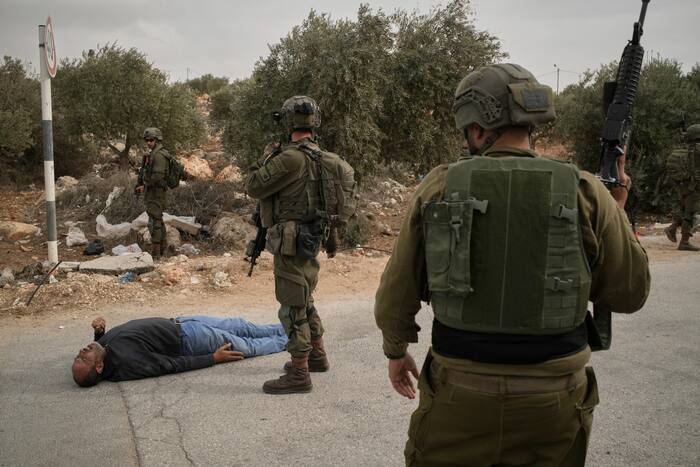
Standard roundups of Middle East developments treat West Bank olive harvest clashes and regional flashpoints as isolated dispatches pinned to a calendar. That approach misses the underlying mechanics: seasonal agricultural friction in the West Bank operates as a high-frequency pressure gauge on territorial control, enforcement capacity, and diplomatic friction, while concurrent regional incidents expose how localized shocks interact with broader geopolitical constraints.
Deconstructing the Roundup Format
Conventional wire roundups—such as dispatches pairing West Bank harvest clashes with Houthi strikes in Yemen or broader regional developments—rely on chronological adjacency rather than causal structure. When an article places masked settler assaults on olive harvesters alongside cross-border or militia hostilities elsewhere in the region, the implicit link is geographic proximity rather than shared mechanism. Learn more on a connected issue: this related article.
That structure creates three analytical blind spots:
- Event-level flattening: Treating each skirmish as a discrete news item obscures cumulative trends, such as weekly and seasonal counts of harvest-related incidents tracked by humanitarian monitors like the UN Office for the Coordination of Humanitarian Affairs (OCHA).
- Asymmetric attribution gaps: Wire reports often state that attackers dispersed before troops arrived or describe competing accounts of force deployment and access restrictions, without separating verified operational facts from contested claims or unverified assertions.
- Cross-theater conflation: Placing West Bank agricultural disruption next to Houthi operations in Yemen or macroeconomic pressures—such as energy-driven inflation—invites false equivalence unless the distinct incentives, actors, and escalation ladders of each theater are mapped explicitly.
A rigorous analysis separates known facts (documented incident tallies, reported injuries or property damage, official statements, and announced policy measures) from educated hypotheses (how actors weigh deterrence, territorial leverage, or diplomatic costs). Further journalism by NBC News explores related views on the subject.
The Olive Harvest as a Territorial and Economic Pressure System
The autumn olive harvest is not merely a cultural backdrop; it is a tightly bounded seasonal window in which Palestinian households, agricultural workers, and landowners must access groves that frequently sit near outposts, bypass roads, or areas under overlapping Israeli administrative and military control.
Three Mechanisms of Seasonal Friction
- Time-bound vulnerability: Olive trees require concentrated labor during a narrow autumn window. Delays, road closures, or physical intimidation compress harvest days, directly reducing yield quality and household income even when trees are not destroyed.
- Enforcement and access asymmetry: Humanitarian reporting on the 2026 harvest season highlights recurring access restrictions alongside dozens of harvest-related settler attacks in single reporting weeks and hundreds across the early-to-mid harvest window. When security forces arrive after incidents, disperse crowds, or impose movement limits, the operational cost falls heavily on farmers trying to reach plots.
- Asset and ecological degradation: Attacks involving arson to vehicles or groves, uprooting or damaging trees, and property destruction convert short-term clashes into multi-year capital losses. Because olive trees take years to mature to full productivity, physical damage compounds across harvest cycles.
Cause-and-Effect Chains Wire Reports Often Leave Implicit
A typical wire summary notes that settlers attacked harvesters, vehicles or trees were burned, and troops responded. Tracing the causal chain clarifies why these episodes recur:
- Spatial overlap creates friction points: Groves located adjacent to settlement expansion, outposts, or contested access routes become high-probability flashpoints once harvest activity begins.
- Low immediate deterrence lowers the threshold for repeat incidents: When perpetrators disperse quickly or face uneven accountability, the perceived cost of disruption remains low relative to the immediate tactical effect of clearing contested ground or intimidating harvesters.
- Diplomatic pressure lags behind ground dynamics: External condemnations or targeted trade measures—such as announced restrictions or sanctions on settlement products by individual governments—operate on slow political timelines and face enforcement hurdles, whereas on-the-ground friction occurs daily during peak harvest weeks.
Consider a stylized West Bank village whose groves lie along a ridge separating a Palestinian town from a nearby outpost. Even if an assault lasts under an hour and causes a handful of injuries or one burned vehicle, the downstream effect can include a multi-day halt to picking in adjacent plots, heightened security checkpoints that slow transport to presses, and heightened friction between local residents, settlers, and security forces.
Mapping Parallel Middle East Developments Without False Equivalence
When a regional roundup pairs West Bank harvest violence with developments elsewhere—such as Houthi attacks near government or coalition-linked sites in Yemen, detention of journalists or residents over security footage, or broader regional conflict spillover—the analytical task is to classify each development by actor type, objective function, and spillover channel.
Actor and Incentive Structure
- Non-state militant actors (such as the Houthis): Operate with regional signaling and asymmetric strike objectives, aiming to impose political, security, or economic costs on domestic rivals and external backers while calibrating escalation risks.
- State security institutions and administrative authorities: Balance counter-insurgency, force protection, domestic political coalitions, and international diplomatic exposure, often producing tensions between stated legal or operational mandates and field execution.
- Local civilian populations and journalists: Bear direct physical, economic, and legal risk—from property loss and movement curbs to arrest or injury while documenting events—with minimal capacity to shape strategic doctrine.
How Regional Shocks Interact
Rather than assuming one event causes another, analysts should test for four concrete spillover channels:
- Attention and diplomatic bandwidth: Major military escalations or crises elsewhere in the Middle East draw senior diplomatic and media focus, reducing external leverage over localized West Bank disputes.
- Economic and supply-chain transmission: Regional hostilities and maritime or energy disruptions can push up fuel and freight costs, tightening household budgets and complicating humanitarian logistics.
- Domestic political feedback: Security incidents and external pressures shape domestic politics in Israel, the Palestinian territories, and neighboring states, influencing coalition bargaining, policing posture, and public messaging.
- Information and verification contestedness: Fast-moving clashes generate conflicting accounts, selective video clips, and rapid claims across social media and official channels, raising the cost of establishing verifiable facts.
Analytical Framework for Evaluating Future Dispatches
To read Middle East roundups like an intelligence or strategy analyst rather than a passive news consumer, apply a four-step verification protocol to every item in a briefing:
- Anchor on institutional tallies and primary timestamps: Cross-check single-day reports against multi-week humanitarian baselines (such as OCHA situation reports) to distinguish a statistical spike from routine seasonal noise.
- Separate verified outcomes from contested intent: Record confirmed injuries, damaged assets, arrests, or official announcements separately from claims about who started a clash, why forces arrived when they did, or what long-term political plan lies behind an incident.
- Trace second-order economic and access effects: Look past the immediate altercation to see whether roads, agricultural plots, clinics, schools, or aid deliveries face new restrictions.
- Identify the binding constraint on each actor: Ask what limits each side—military manpower, political coalition survival, diplomatic alliances, economic resilience, or local organization—before inferring what comes next.
Limitations of This Framework
No analytical model can predict tactical flashpoints on a given hillside or pinpoint the exact timing of a militant strike. Open-source reporting faces structural constraints: access limits in active areas, delayed or disputed casualty and property assessments, and incentives among all parties to frame events favorably. Treating structured indicators as probabilistic signals rather than deterministic forecasts prevents overconfidence when ground conditions shift abruptly.
Strategic Play for Decision-Makers and Analysts
Briefing consumers, risk managers, and policy teams should stop reading regional roundups as a single story line and instead maintain a two-track monitoring matrix: track West Bank harvest incidents through weekly access, displacement, and property-damage indicators alongside policy actions on settlement trade and enforcement, while tracking broader regional developments through energy, shipping, and diplomatic-bandwidth indicators. Pairing granular local metrics with clear-eyed separation of verified facts from hypotheses yields far sharper risk assessment than any headline summary.
Israeli settlers attack Palestinians in West Bank during olive harvest | BBC News
This video provides on-the-ground reporting from the West Bank olive harvest that illustrates the direct physical and access dynamics analyzed above.