Subterranean Overburden and Physical Vulnerability Metrics
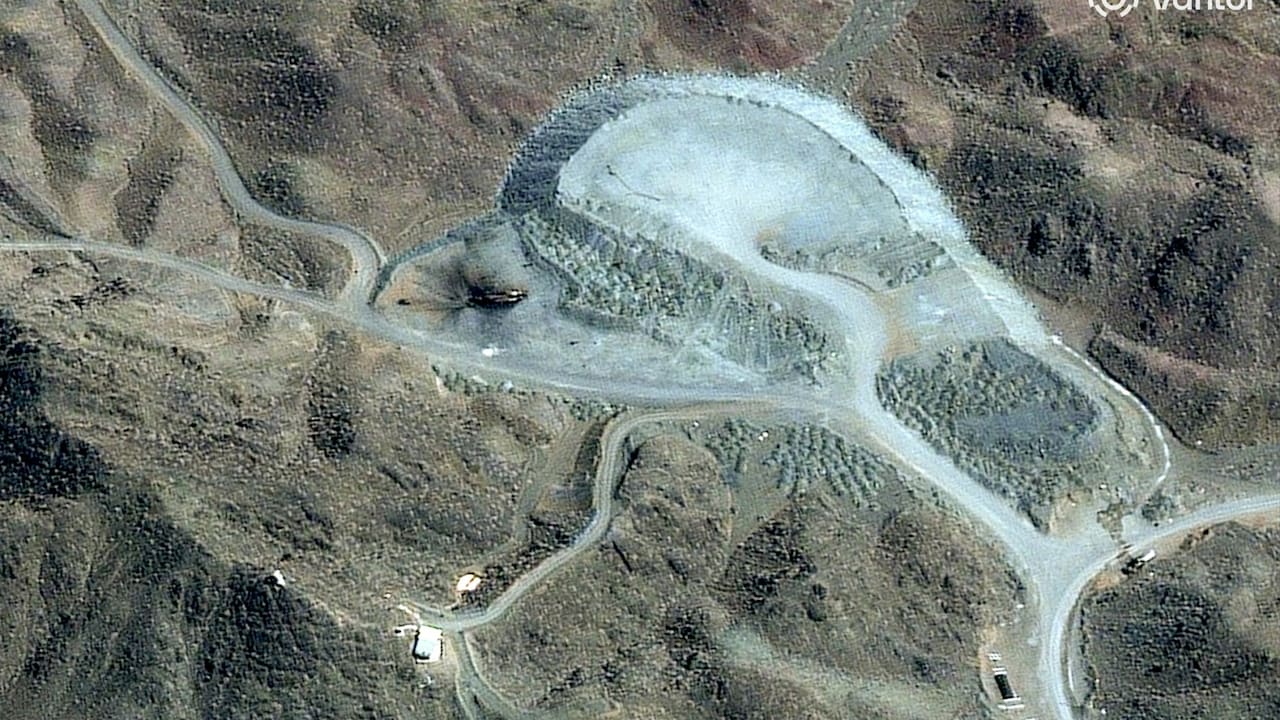
Evaluating whether conventional military forces can destroy the underground installation at Kuh-e Kolang Gaz—commonly designated as Pickaxe Mountain—requires dissecting the physical mechanics of kinetic penetration rather than relying on rhetoric. Located two kilometers south of the Natanz complex, the facility features subterranean halls situated beneath an overburden of 80 to 120 meters of granite and dense igneous rock.
Standard air-launched ordnance operates against structural thresholds defined by target depth, compressive material strength, and spatial geometry.
| Target Variable | Structural Metric | Operational Consequence |
|---|---|---|
| Overburden Depth | 80 - 120 meters | Exceeds single-pass penetration limits of GBU-57 MOP |
| Geological Composition | High-density Igneous/Granite | Attenuates kinetic energy transfer faster than reinforced concrete |
| Tunnel Entrances | 2 paired portal sets | Allows local isolation if a single access vector is compromised |
| Primary Depth Profile | >100m deep chambers | Protects centrifuge cascades from direct blast overpressure |
The fundamental limitation of kinetic penetrators is governed by Poncelet's penetration equations, where depth of penetration $z$ scales as a function of impact velocity, projectile mass, section area, and the target material's resistance coefficient $S$:
$$z = \frac{m}{2 A \rho C_d} \ln\left(1 + \frac{\rho C_d v_0^2}{S}\right)$$
For high-compressive-strength granite, the resistance coefficient $S$ scales drastically compared to soil or medium-strength concrete. Consequently, a single 30,000-pound GBU-57 Massive Ordnance Penetrator (MOP)—which achieves a maximum penetration depth of roughly 60 meters in consolidated rock—cannot directly breach a chamber positioned 100 meters below solid granite in a single strike.
The Three Vectors of Neutralization
Physical destruction of the deeply buried hall is not the sole mechanism to render a hardened nuclear site inoperable. Strategic planning divides target destruction into three primary operational vectors.
Vector 1: Sequential Penetration Bombardment
Achieving structural breach of the main underground halls via air support requires tandem precision strikes. This operational concept relies on striking the exact same impact coordinate repeatedly.
- The first projectile excavates a crater and fractures the upper rock layers, lowering the effective overburden thickness.
- The second projectile, hitting the pre-fractured crater milliseconds or minutes later, encounters significantly lower material resistance, extending kinetic penetration past the nominal 60-meter ceiling into the target vault.
This technique demands sub-meter guidance precision and immediate battle damage assessment to ensure successive warheads do not detonate prematurely against falling debris.
Vector 2: Portal Sealing and Adit Blockage
If the main overburden cannot be breached, target defeat shifts to portal collapse. The Pickaxe Mountain facility utilizes two main pairs of tunnel entrances (adits) carved into the mountain slope. Precision-guided munitions utilizing delayed-fuse penetration warheads targeted directly at the tunnel mouths cause catastrophic ceiling collapses, backfilling the adits with thousands of tons of fractured rock.
Sealing the adits does not destroy internal centrifuges, but it converts the facility into an inaccessible tomb. Without ingress for personnel, machinery, or UF6 gas transport cylinders, operational utility drops to zero.
Vector 3: Functional Severance of Support Infrastructure
Centrifuge cascades require precise environmental controls to maintain hyper-high rotational speeds. Disruption of auxiliary systems causes complete system failure without requiring a breach of the underground bunker.
[ External Grid / Power Substation ] ---> [ Transformer Vault ] ---> [ Cascades (Failure) ]
                                                                           ^
[ Surface HVAC & Filtration ] --------> [ Exhaust/Intake Shafts ] --------|
- Thermal Disruption: Advanced centrifuges spinning at extreme speeds generate substantial thermal load. Severing surface-level cooling towers and HVAC air intake shafts creates thermal runaway within subterranean halls, causing rotor deformation.
- Power Instability: Uninterrupted electrical supply is mandatory for centrifuge stability. Striking external power feeds, backup generator vaults, and step-down transformers causes catastrophic cascade crashing through sudden deceleration.
Engineering Realities and Operational Limitations
Assessing military capabilities against hardened target defeat requires acknowledging structural limits on both sides.
The primary vulnerability of a underground facility lies in its static nature; a defender cannot alter its location or deepen its overburden once excavation is complete. Conversely, an attacker faces strict limitations regarding ordnance carrying capacity. Only heavy strategic bombers (such as the B-2 Spirit or B-21 Raider) possess the payload capability to deliver super-heavy penetrators like the GBU-57.
Ground special operations or standoff kinetic disruption of key portals remain the most viable non-nuclear pathways to achieve functional destruction. By isolating the interior space from the outside world and destroying external power and ventilation infrastructure, the strategic utility of the facility is negated regardless of whether the deep granite vault remains intact.