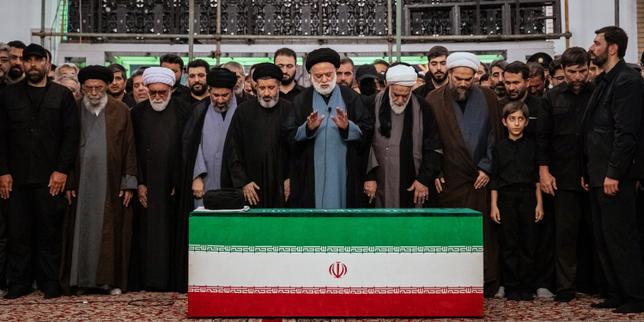
The ink of a supreme decree does not flow like ordinary ink. It carries the weight of a nation, the friction of decades of sanctions, and, occasionally, the cold burn of a son’s grief.
In Tehran, the transition of absolute power is rarely televised with the loud, chaotic fanfare of Western democracies. It happens in quiet corridors, behind heavy drapes, and through the deliberate, measured strokes of a pen. When Mojtaba Khamenei, the newly consolidated Supreme Leader of Iran, released a written message directly threatening the United States, the global foreign policy establishment scrambled to decode the syntax. They looked at troop movements. They analyzed uranium enrichment percentages.
They missed the bloodline.
To understand the shift in the Middle East, one must step away from the abstract maps of geopolitical analysts and look at a single piece of paper. This was not a standard bureaucratic press release from the Iranian Foreign Ministry. It was a vow. A promise to avenge the death of his father, Ali Khamenei. By shifting the conflict from a clash of state ideologies to an explicit matter of filial duty, the stakes have transformed. The geopolitical has become deeply, dangerously personal.
The Inheritance of Shadow and Stone
For decades, Mojtaba Khamenei existed as a whisper in the diplomacy circles of Washington, Paris, and Riyadh. He was the second son, the operator in the shadows, the man who commanded the respect of the Islamic Revolutionary Guard Corps (IRGC) without ever needing to court the public eye.
Imagine a man who has spent fifty years watching his father guide a country through wars, isolations, and internal upheavals. He did not inherit a country; he inherited a siege mentality.
When a Western analyst looks at Iran, they see a chess board. They calculate the economic impact of oil embargoes or the range of ballistic missiles. But the human element is what actually drives the hand to the trigger. Mojtaba’s first major declaration to the world was not about trade routes or regional alliances. It was about a debt of blood.
The written word holds a sacred place in Iranian political theology. A spoken statement can be walked back, attributed to the heat of the moment, or dismissed as propaganda for the domestic masses. A written manifesto, signed by the Supreme Leader, is a doctrine. By choosing to format his threat as a formal message promising vengeance for his father’s passing—a death he attributes directly to the cumulative pressure, sanctions, and covert actions of the United States—Mojtaba has backed himself into a corner of his own making. He has staked his legitimacy on retaliation.
The Strategy of the Unpredictable
The primary question echoing through the Pentagon is simple: Is this rhetoric, or is it a blueprint?
Historically, the Iranian regime has played a long, patient game. They utilize proxies. They strike through asymmetric means, avoiding a direct conventional confrontation with a superior military power. But patience is a luxury of the old guard. A new leader, especially one succeeding a titanic figure like Ali Khamenei, faces an immediate crisis of authority.
The IRGC is not a monolith. It is a collection of factions, generals, and ideologues. To command them, Mojtaba cannot merely rely on his last name. He must prove he possesses the same steel as his predecessor.
Consider the mechanics of escalation. When Iran threatens the United States in a written decree, it sets off a predictable chain reaction.
- Market Shockwaves: Oil futures fluctuate as algorithms detect the keyword variations of "revenge" and "United States."
- Defensive Realignments: Naval assets in the Persian Gulf shift their patrolling patterns, bracing for drone swarms or sea-mine deployments.
- Intelligence Surges: Satellite surveillance over Natanz and Isfahan intensifies, looking for the heat signatures of hidden movement.
But the real danger lies in the miscalculation. When a leader frames state policy around personal vengeance, the traditional guardrails of deterrence begin to fail. You cannot deter a man who believes his soul, and his father's memory, depend on a strike.
The Echo in the Streets
While Washington debates the strategic implications, the true impact of this declaration ripples through the populace of Iran itself.
Step into the shoes of an ordinary citizen in Tehran. You wake up to inflation that eats away at your savings before noon. You navigate a society where the internet is fractured, and the future feels like a room with a shrinking ceiling. You hear the state apparatus beating the drums of war, invoking the memory of a departed leader, and promising a conflict with a superpower across the ocean.
There is a profound disconnect between the high-altitude rhetoric of the ruling elite and the grounded reality of the people they govern. To the young student in Isfahan, a war of vengeance offers nothing but more scarcity, more isolation, more grief. Yet, their voices are entirely absent from the calculus of the written decree. The document speaks for them, without asking them.
The international community often treats these regime declarations as isolated incidents, separate from the domestic pressures inside Iran. That is a mistake. The threat directed outward is almost always a mechanism for control inward. By creating an atmosphere of imminent conflict, internal dissent becomes synonymous with treason. The message written by Mojtaba Khamenei is a shield against his own people as much as it is a sword pointed at his enemies.
The Cold Balance of the Horizon
We are entering an era where the old rules of engagement no longer apply. The institutional memory of the Cold War, where adversaries understood each other’s red lines and respected the unspoken limits of rhetoric, has eroded.
Mojtaba Khamenei’s message is a symptom of a much larger, more volatile reality. Power is concentrated in fewer hands, driven by intensely personal motivations, and broadcast instantly to a global audience. The danger is no longer just the deliberate launch of a missile, but the accidental spark that ignites the dry timber of mutual suspicion.
The document sits on desks in Washington, Langley, and London. Its translated words are highlighted in yellow. Analysts argue over whether the word "vengeance" implies an immediate covert operation or a generational struggle.
Meanwhile, the ink has dried. The son has taken his position on the stage, the shadow of his father stretching long behind him, waiting for the world to move first.

.webp)