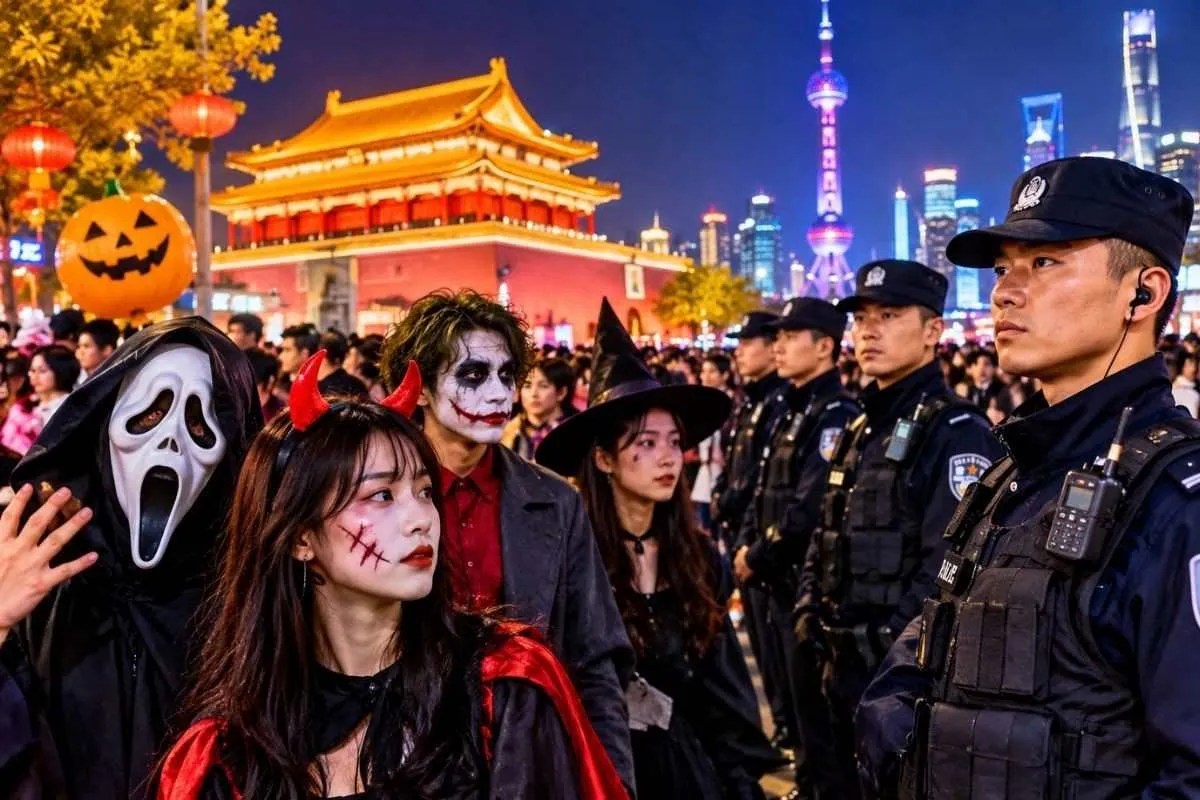
Midnight. Rain slicks the pavement outside a subway station, and the air smells faintly of damp wool, street-vendor broth, and cheap latex.
Somewhere behind a corner stall, a young woman pauses before pulling a pale painted mask over her face. Five years ago, a moment like that felt like harmless theater—a night to borrow someone else's silhouette, laugh under neon lights, and walk home with smudged eyeliner and a camera roll full of strangers. Tonight, the mask stays folded inside a tote bag. A uniformed officer stands near the turnstile, watching the crowd with quiet, practiced attention. Nobody shouts. Nobody throws anything. Yet the evening carries an unmistakable weight, the kind you feel in your ribs before a single word is spoken.
In three Chinese cities—most visibly Shanghai, alongside other major urban centers—Halloween night has shifted from a playful street gathering into a tightly managed civic flashpoint. Tightened security perimeters, crowd dispersion measures, and strict restrictions on masks and heavy costume makeup have turned a once-lighthearted autumn outing into a test of how much ambiguity public space can hold.
Why would greasepaint and plastic spook a modern metropolis?
On paper, the answer looks bureaucratic. Crowds block sidewalks. Unpermitted gatherings strain emergency corridors. Unrecognized faces complicate public-order management when thousands of people converge on the same blocks at once. Even outside politics, municipal authorities around the world worry about stampedes, blocked transit exits, and street congestion when viral trends send waves of costume-wearers toward popular districts.
Yet anyone who has stood in a crowded city square on a holiday knows that rules rarely live in a vacuum. A mask hides the face. Makeup erases everyday identity. And when young people dress up as satirical figures, office drones, anxious workers, or ghostly caricatures of modern life, laughter can slip past serious guardrails without needing a megaphone.
What happens when a joke carries too much double meaning for the street it is told on?
The Street Where Costumes Stopped Being Just Costumes
To understand why Halloween in three Chinese cities became a security story rather than a simple lifestyle trend, look at how quickly street culture can turn into a mirror.
For years, Halloween in places like Shanghai's Julu Road and surrounding lanes looked less like a traditional Western holiday and more like an improvised urban carnival. People dressed as movie characters, household memes, historical figures, and everyday archetypes. It was scrappy, funny, and distinctly local—a mashup of internet humor and late-night street life. When clips of clever, slightly cheeky costumes spread online, the appeal snowballed. Suddenly, dressing up wasn't just about looking scary or cute. It was about wit.
Satire has a special superpower. It travels light. A slogan on a sign invites immediate scrutiny, while a costume winks from the corner of the frame, leaving the viewer to connect the dots. Authorities do not need a formal protest banner to see a pattern forming when dozens of people show up in variations of the same ironic theme. From a security standpoint, unpredictable crowds paired with symbolic costumes look less like a party and more like an unscripted gathering with potential to escalate.
Consider a hypothetical scenario to see how that tension builds from the ground up. Picture Lin, a twenty-four-year-old graphic designer (a composite figure created to illustrate a common urban experience). Lin isn't trying to start a movement. After a brutal week of overtime, Lin just wants to walk down a lively street with friends wearing theatrical makeup that makes everyone laugh. Halfway to the station, Lin sees security cordons tightening, officers checking bags or discouraging loitering in costume, and crowds being kept moving rather than gathering in clusters. The mood shifts in seconds. What felt like a release valve suddenly feels like a spotlight.
That shift—from carefree spontaneity to cautious restraint—is the real story behind bans on masks and heavy makeup. When faces are covered or heavily painted, accountability feels harder to trace in a dense crowd, and symbols become harder to contain. Officials prioritize predictability and rapid crowd flow. Citizens feel the sudden narrowing of playful space.
Why Masks Make Crowds Nervous
Humans have worn masks for millennia, long before modern surveillance cameras or municipal crowd-control manuals existed. A mask does two opposite things at once: it protects the wearer's privacy and it unsettles observers who cannot read a familiar expression.
Think of a mask like a curtain dropped halfway across a shop window. You can still see movement behind the glass, maybe even recognize the shape of someone's shoulders, yet the full picture stays out of reach. In a quiet room, that mystery feels poetic or playful. In a packed street of ten thousand people at night, uncertainty makes planners twitchy.
Modern policing and urban management rely heavily on legibility—knowing who is where, how crowds are moving, and whether a gathering is staying within safe bounds. Heavy makeup and full-face masks deliberately obscure visual identity. Even when ninety-nine percent of people in costume just want photos, bubble tea, and a late-night walk, officials tend to plan around the one percent risk of sudden disruption, viral provocation, or crowd crush.
There is also a practical detail people often overlook when asking why restrictions hit specific cities hard: scale. Megacities operate on razor-thin margins when thousands of pedestrians spill into narrow streets or subway entrances simultaneously. A minor bottleneck caused by people stopping to pose for photos can ripple outward into transit delays and safety hazards. Prohibiting masks and elaborate makeup in designated areas is one blunt way to keep people moving instead of congregating.
Still, blunt tools leave marks. When rules sweep up everyone—from pranksters to harmless sightseers—the message received on the ground can feel heavier than the written notice.
The Invisible Stakes Behind a Coat of Paint
If you only look at security deployments and costume restrictions, you might miss what is actually at stake beneath the surface. This isn't just a debate over spooky accessories or late-night foot traffic. It is a quiet negotiation over mood, expression, and belonging in big cities.
Young adults in fast-moving urban centers carry heavy pressures—housing costs, grueling work schedules, fierce competition, and the constant hum of digital comparison. Humor is often how ordinary people exhale. A clever costume lets someone turn daily stress into a punchline shared with strangers on a crowded sidewalk. When that outlet gets shut down or heavily policed, the frustration doesn't vanish; it simply goes underground or turns inward.
At the same time, there is a genuine vulnerability in admitting how complicated these moments are. As someone who has watched street scenes change overnight—feeling the sudden hush when voices drop and footsteps speed up—it is easy to see both sides of the knot without pretending the answer is simple. Security planners worry about order spiraling out of control in dense crowds. Everyday residents worry about losing small, harmless freedoms that make city life feel alive.
Let's be honest: the lines between harmless fun, subtle mockery, and public disorder are blurry. When a rule says no masks and no heavy makeup, where does ordinary stage makeup end and a prohibited disguise begin? How do you enforce that cleanly on a rainy night with thousands of people walking past? Often, you don't—which is why broad deterrents and visible police presence end up doing the heavy lifting.
Historically, cities have always wrestled with carnivals, street theater, and holiday crowds. From medieval fairs to modern music festivals, authorities have swung between letting the steam blow off and clamping down whenever the energy felt too wild or too pointed. The setting changes—neon instead of torches, smartphones instead of town criers—but the push and pull between unscripted joy and structured order is old.
What People Keep Asking When the Streets Quiet Down
When news breaks that three cities have tightened Halloween security and barred masks or heavy makeup, people naturally ask practical questions right away. Was there a formal nationwide ban, or did local enforcement tighten in key spots? Usually, responses vary by city, district, and street, with local authorities stepping up patrols, crowd control, and rules against face coverings or disruptive gatherings in high-traffic areas.
Another common question is whether people can still go out and have fun without crossing a line. In practice, walking around normally, meeting friends, or wearing subtle, everyday clothing faces very different scrutiny than wearing full masks, elaborate disguises, or gathering in blocked lanes. Watching official local notices and reading the room on the street matters far more than relying on rumors circulating in group chats.
People also wonder why Halloween—a holiday with no deep traditional roots in China—became such a focal point in the first place. Precisely because it lacked rigid tradition, it became a blank canvas. Young people filled that canvas with pop culture, irony, and modern urban commentary. Once a blank canvas starts showing pictures that feel too sharp or too crowded, it stops being blank.
Reading the Room Without Losing Yourself
So what does a thoughtful person do when a festive night turns cautious?
First, pay attention to the physical space, not just the online outrage. Crowded transit hubs, narrow lanes, and heavy security cordons change how quickly a situation can shift. Keeping plans flexible—and having a clear, calm way home—protects you from getting caught in a sudden bottleneck or an awkward encounter.
Second, separate genuine safety awareness from unnecessary fear. Most nights out end quietly when people stay calm, respect barriers, and don't turn a tense corner into a stage. You don't need dramatic gestures to stay grounded; simple awareness goes a long way.
Third, hold onto your sense of perspective. A restriction on masks and makeup in specific cities during a holiday is a real signal about how public space is being managed right now, yet it doesn't erase every quiet conversation, private laugh, or ordinary kindness that happens away from the cameras.
The rain keeps falling on the pavement outside the station. A folded mask sits dry at the bottom of a bag, while footsteps echo steadily toward the train.
Even without a single word painted on a face, the night still speaks.



