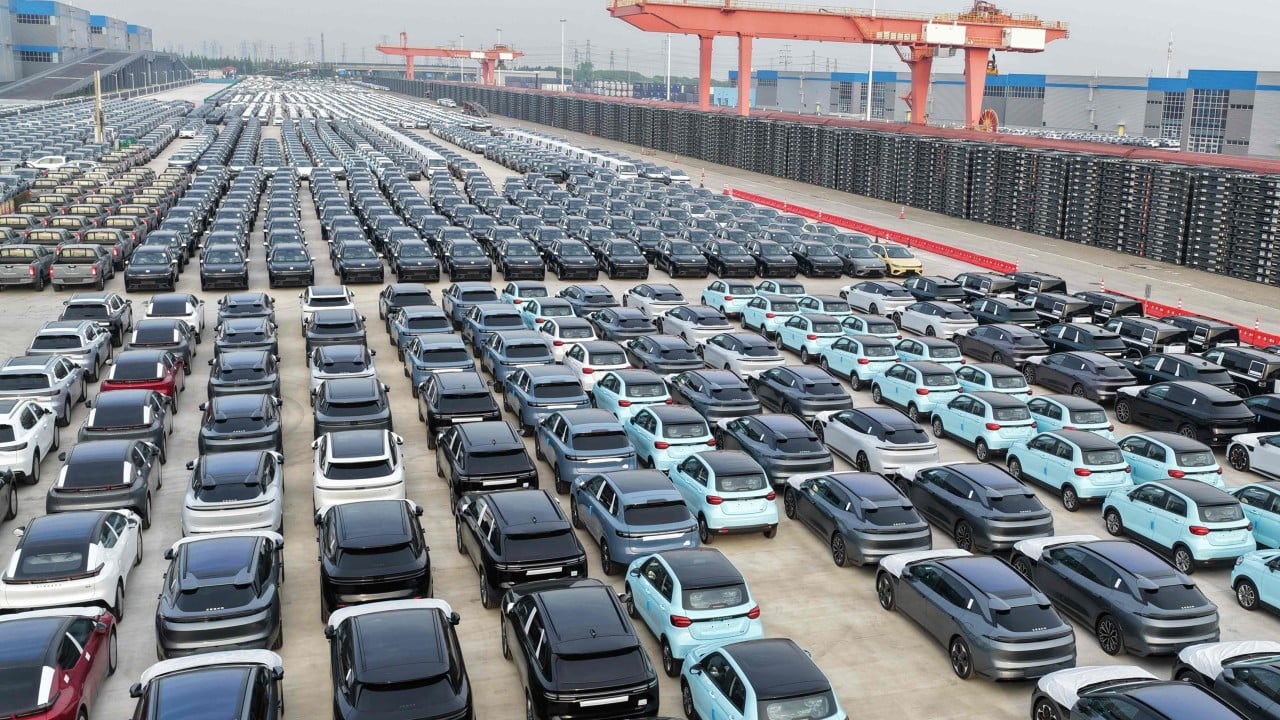
In the glass-walled boardrooms of Detroit and the hallowed halls of the Capitol, a singular fear has unified the most fractured political landscape in a generation. It is not a shadow war or a diplomatic slight, but a four-wheeled existential threat. As President Donald Trump prepares for a mid-May summit with Xi Jinping in Beijing, a bipartisan coalition of lawmakers is sounding a desperate alarm. They aren't just asking for tariffs; they are demanding a total blockade.
On April 24, 2026, a group of 74 House Democrats, led by Representative Debbie Dingell, sent a searing letter to the White House. Their message was blunt: any concession that allows Chinese automakers to plant a flag on American soil would be a "direct threat" to national security and the survival of the U.S. industrial base. This follows a similar plea from influential Senators earlier this month, all reacting to a sudden, terrifying shift in the geopolitical winds.
The panic stems from a paradox. While the U.S. has erected a 100% tariff barrier against Chinese electric vehicles (EVs), the industry is realizing that a wall is only as strong as its weakest gate.
The Backdoor in the Backyard
The immediate crisis isn't about cars arriving on container ships from Shanghai. It is about the "Trojan Horse" strategy—Chinese giants like BYD and Geely setting up massive manufacturing hubs in Mexico and Canada to exploit the loopholes of the USMCA (United States-Mexico-Canada Agreement).
By assembling vehicles in North America, Chinese firms could theoretically slash their tariff burden to a mere 2.5%, or even zero, if they meet local content requirements. This isn't a hypothetical. In Mexico, Chinese vehicle imports have surged nearly 50% since 2021. In Canada, recent policy shifts have opened the floodgates, with a quota system potentially allowing up to 70,000 Chinese-branded EVs into the market annually by 2030.
Lawmakers are now demanding that the administration treat a "Chinese car" based on its ultimate ownership, not its point of assembly. If a car is built in Ontario by a company answering to Beijing, the Democrats argue it must be treated as a foreign adversary’s product.
Surveillance on Wheels
Beyond the economic carnage lies a deeper, more technical anxiety. Modern cars are no longer just mechanical tools; they are mobile data centers equipped with LIDAR, high-resolution cameras, and constant cloud connectivity.
The Department of Commerce has already sounded the horn on "connected vehicle" risks. These cars track geolocation, record audio and video, and map the surrounding environment in real-time. In the hands of a strategic competitor, a fleet of millions of these vehicles becomes a pervasive, distributed surveillance network.
The Hardware-Software Deadlines
The Biden-era restrictions, which the current administration is being urged to accelerate, set a strict timeline for purging foreign adversary technology from American roads:
- Model Year 2027: A total ban on software developed by Chinese or Russian-controlled entities in connected vehicles.
- Model Year 2030: A prohibition on the hardware modules (Bluetooth, Wi-Fi, satellite, and cellular) that allow these vehicles to communicate with the outside world.
The logic is simple: you cannot "patch" a security risk that is baked into the silicon. Once the sensors are integrated, the data leak is permanent.
The Efficiency Gap
While Washington focuses on defense, the reality on the ground at the 2026 Beijing Auto Show tells a different story. In 17 massive exhibition halls, Chinese automakers are displaying over 1,400 vehicles, including 181 world premieres. The sheer scale of innovation is staggering.
Chinese EVs are currently averaging a value of $30,594 per unit, compared to the $49,016 average for EVs imported into the U.S. from other regions. This isn't just about cheap labor. It is the result of a decade of vertical integration. China controls the lithium, the anodes, the cathodes, and the software stacks.
American protectionism has, perversely, created a "walled garden" where Detroit’s Big Three—GM, Ford, and Stellantis—have spent billions on write-downs while retreating into the production of high-margin, gas-guzzling SUVs. By insulating the domestic market from competition, the U.S. may be inadvertently ensuring that its own manufacturers become global relics.
The Trump Card
The wildcard in this high-stakes game is the President himself. Despite the bipartisan pressure, Donald Trump has signaled a transactional openness that has many in his own party—and across the aisle—on edge. In recent speeches, he suggested he would welcome Chinese automakers building plants in the U.S., provided they use American labor. "If they want to come in and build a plant... I love that," he told the Detroit Economic Club.
This "invest in America" rhetoric clashes violently with the security-first stance of the intelligence community. Lawmakers fear that in a bid to secure a "grand bargain" with Xi Jinping, the President might trade away the auto industry’s long-term security for short-term domestic jobs.
The mid-May summit in Beijing will be the crucible. If the administration holds the line, the U.S. market remains a fortress, albeit one that may be falling behind in the global tech race. If the gates open, the American auto industry faces a competitive onslaught it is currently ill-equipped to survive.
The choice isn't just between two economic models. It is a decision on whether the American road remains a private space or becomes the latest frontier in a global data war. Detroit is watching. Beijing is waiting. And the USMCA is currently a map with a gaping hole right in the center.
The blockade must be total, or it will be irrelevant.


