The coffee in the Moscow office was lukewarm, but the silence was absolute.
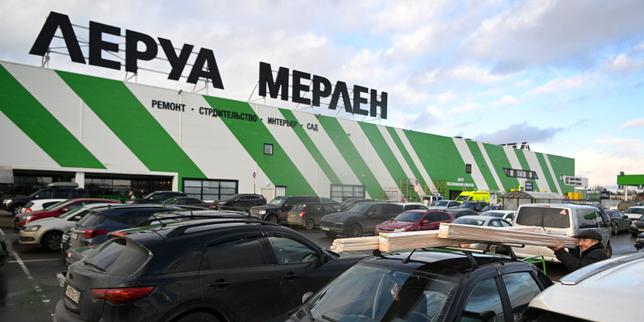
Across the city, beneath the gray concrete façades of retail parks that could belong to any suburb in Europe, the sliding glass doors of Leroy-Merlin still opened to crowds seeking paint rollers and bathroom tiles. The employees behind the cash registers did not look panicked. They wore the same green aprons they had worn for years. But the names on the tax registries had shifted. The bank accounts were routing through domestic ledgers. A quiet machinery, oiled by state directives and accelerated by corporate exhaustion, had swallowed Western commerce whole.
This was not a hostile midnight raid. It was an extraction performed with surgical paperwork.
To understand what happened to Leroy-Merlin, to Auchan, to Nestlé, and to FM Logistic, one must first let go of the cinematic image of sudden nationalization. Tanks do not roll up to corporate headquarters to seize inventory. Instead, men in tailored suits sit in quiet boardrooms in Zurich, Paris, and Moscow, signing documents that trade decades of market dominance for an exit ticket.
Consider the plight of the floor manager who spent fifteen years building a supply chain for European hypermarkets. Let us call him Dmitry, though he could be any one of a thousand logistics coordinators who watched their corporate ladders evaporate overnight. For years, Dmitry’s world was defined by efficiency metrics imported directly from northern France. Every pallet of yogurt, every box of flat-pack furniture, every automated sorting algorithm in the vast warehouses operated on a rhythm synchronized with Western capital.
Then came the spring of departure.
The corporate parents, facing immense pressure from home governments, reputational risk, and tangled sanctions, decided they could no longer stay. But walking away from a billion-dollar footprint in the world's largest landmass is not as simple as dropping keys on a desk. You cannot pack a hypermarket into a suitcase.
This is where the invisible architecture of the Kremlin’s strategy took hold.
Moscow did not simply wait for the foreigners to pack their bags. It drafted the rules of the departure lounge. A fleeing multinational was required to sell its Russian assets at steep, government-mandated discounts—often fifty percent off independent valuations—while paying a mandatory exit tax directly to the federal budget. If you wanted to leave, you had to pay for the privilege, and you had to sell to buyers approved by the state.
The buyers were rarely traditional industrial tycoons. They were domestic investment funds, local management teams backed by friendly banks, or emerging conglomerates eager to snap up turnkey infrastructure at fire-sale prices.
Auchan, the sprawling hypermarket chain that had fed millions of Russian families for a generation, found itself caught in this exact gravitational pull. For months, executives insisted they were staying to protect their employees and feed the civilian population. Yet the pressure mounted. The supply lines grew brittle. Currency controls made repatriating profits nearly impossible. The brand slowly decoupled from its Parisian mothership, morphing into an independent domestic entity running on local inertia.
Down the highway, FM Logistic warehouses—once the pristine hubs of cold-chain distribution—underwent a similar metamorphosis. The trucks still rolled. The forklift drivers still punched their timecards. But the logistics software was migrated to local servers. The ultimate beneficiary of the warehouse fees was no longer a European holding company, but a domestic network quietly aligned with state economic priorities.
Nestlé presented a different puzzle. You cannot easily replace infant formula or specialized pet food with domestic equivalents overnight without causing severe consumer friction. So, Nestlé stayed in part, maintaining a reduced footprint focused on essential nutrition, walking a tightrope between international compliance and local operational survival. Yet even here, the perimeter of their operations shrank, constrained by the gravitational pull of a domestic economy increasingly forced to look inward.
The narrative of these departures is often framed as a triumph of domestic substitution or a tragic surrender of globalized ideals. The reality is far more mundane, and far more durable. It is a process of administrative digestion.
A state cannot simply absorb hundreds of thousands of corporate square meters without a plan to keep them running. Unemployed retail workers do not make good citizens; empty shelving does not inspire confidence. Therefore, the orchestration of these handovers required immense bureaucratic dexterity. The goal was continuity without foreign ownership. The foreign capital left, but the concrete remained. The parking lots stayed full.
Step back and look at the macro picture. Globalization did not end with a sudden explosion; it fractured along national fault lines, sealed with notary stamps and notarized deeds.
When a French retailer changes hands in Moscow without a single headline on the evening news, a quiet milestone passes. The western economic bridgehead built over thirty years following the collapse of the Soviet Union was dismantled piece by piece, not by wrecking balls, but by auditors and compliance officers.
For the average consumer walking into an ex-foreign hypermarket today, the changes are cosmetic. The brand names on the receipts might be slightly altered, the corporate parentage buried beneath layers of obscure domestic holding companies, but the milk is on the shelf. The lightbulbs are in the aisle.
Yet the underlying plumbing of the economy has fundamentally warped. Value creation is no longer exported; it is trapped, recycled, and redirected within a closed circuit. The profits that once trickled back to shareholders in Western Europe now fund domestic balance sheets, reinvested in a market that has chosen autarky over integration.
Dmitry still drinks lukewarm coffee in his office near the beltway. His team still tracks inventory across sprawling regional distribution centers. But the corporate charts on the wall no longer feature logos from Paris or Zurich. The names are new. The sovereign address is singular.
The lights stay on in the hypermarket, casting a long, steady glow over a landscape that has learned to live behind closed borders.