The asphalt along US 12 used to bleed history, or at least the loud, neon-soaked version of it that defined American summer vacations in the middle of the twentieth century.
Back then, before the interstate highway system rerouted the collective pulse of the country onto the sterile, high-speed concrete of I-94, the Irish Hills of southern Michigan were a main artery of wonder. Families packed into station wagons would squint through the haze of July humidity, hunting for a reason to pull over. They found it in prehistoric forests where concrete dinosaurs peered through artificial ferns. They found it in faux Western towns where actors traded fake gunfire outside dusty saloons.
Then the concrete shifted. The travelers stopped coming. The dinosaurs cracked, the saloons boarded up their windows, and the vibrant vacation land of Jackson and Lenawee counties quieted down into ghost stories and overgrown brush.
Except for one place.
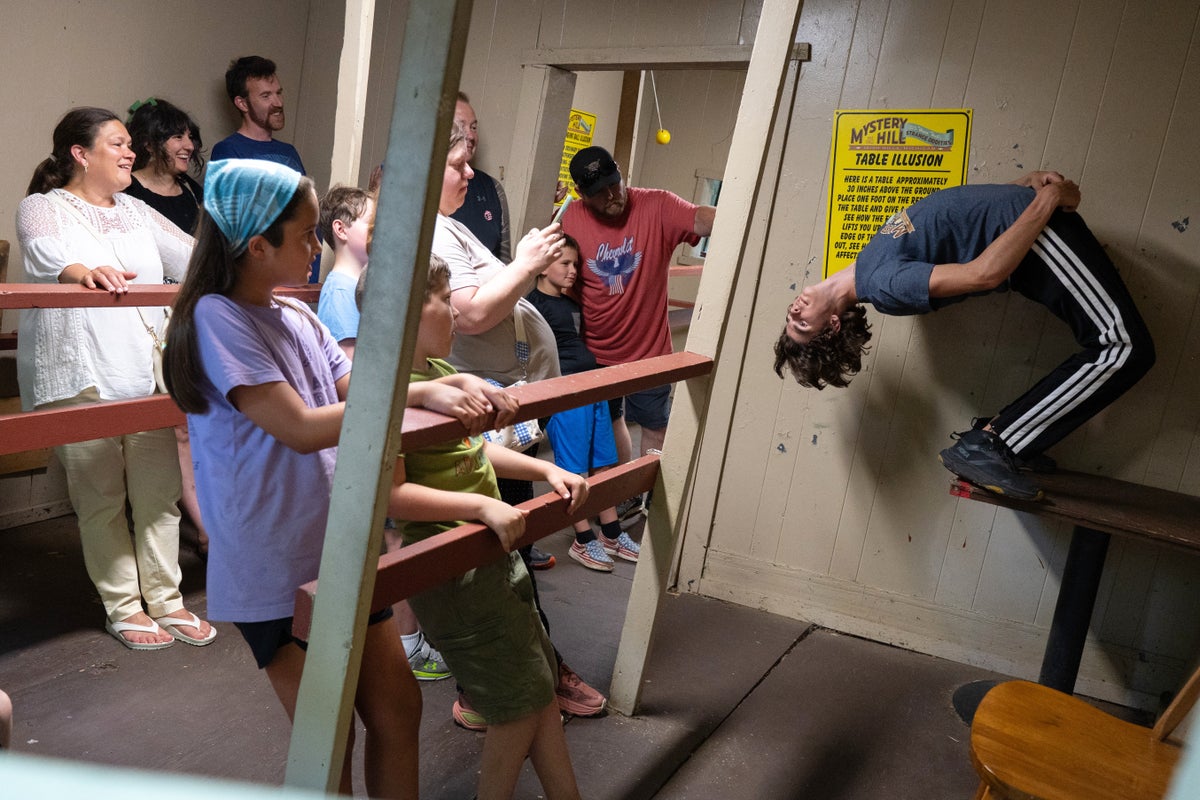
Up the road in Onsted, a modest tilt-roofed house on a three-acre patch of land kept doing something impossible. It bent the rules of physics. Inside its walls, water seemed to run uphill, visitors leaned at impossible angles without falling, and your own eyes lied to you about which way was down. This was Mystery Hill. It was weird, it was cheap to run compared to massive multi-acre amusement parks, and it survived.
It survived because places like this carry a specific kind of magic that digital screens cannot replicate. You cannot experience a gravitational illusion over fiber optics. You have to stand in the crooked room, feel your inner ear protest, and laugh out loud at the absurdity of it.
Enter Nathan Wakefield.
To understand why a grown man buys a roadside gravity house, you have to look backward. Wakefield grew up about twenty miles south of the Irish Hills, a local kid who spent his boyhood wandering through the exact brand of roadside roadside Americana that later vanished. While other children collected baseball cards, he absorbed the sensory overload of southern Michigan's quirky tourism heyday—the smell of popcorn mixed with damp cedar, the sound of carnival barkers, the sheer communal joy of rubbernecking at something bizarre.
Decades passed. Most of those childhood haunts turned into dust or commercial print shops, like the old Prehistoric Forest site which now houses the Irish Hills Print Co. But Mystery Hill endured, thanks in part to a California-based preservationist named Dirk Dole who bought the property in 2022 to inject fresh life into it with an oddities museum and gemstone mining stations.
When Wakefield walked back onto the property for a visit last year, a strange realization hit him. The place was remarkably well-preserved. It wasn't a ruin waiting for a bulldozer. It was a ticking time capsule of joy, waiting for the right custodian.
He bought it.
The acquisition is more than a real estate transaction. It is an act of defiance against the corporate homogenization of leisure. In an era where family entertainment usually means scanning a barcode at a massive, highly sanitized theme park gate, Mystery Hill represents something raw, quirky, and deeply human.
Think about the economics of these spaces. Cambridge Township historian Michelle McLemore points out that the secret to Mystery Hill's longevity has always been its low overhead. It doesn't demand a sprawling army of corporate employees or endless blocks of fast-food complexes. It relies on a guided tour, a quirky house, a box of rough stones for kids to sift through at the gemstone mining setup, and an open door. Adult admission sits at $15.95, while children can enter for $9.95, keeping the experience tethered to working-class accessibility.
Yet Wakefield isn't just maintaining a museum piece. He is bringing his own world into it.
For the past fifteen years, Wakefield has lived a double life as a professional sideshow artist. He knows how to lie on a bed of nails, how to juggle peril, how to swallow a sword. When you watch him swallow a blade during a pop-up community carnival on the grounds, you realize that he isn't just an owner. He is a practitioner of an ancient, fading trade. He understands spectacle.
He calls his vision an exercise in generational nostalgia.
It plays out on the grounds every single weekend. A grandparent walks up to the ticket counter, holding the hand of a child who looks bewildered by the strange slant of the buildings. The adult smiles a knowing, distant smile and says the phrase that keeps places like this alive: I remember coming here when I was your age.
That sentence is a bridge across decades. It collapses time. The grandparent is suddenly seven years old again, smelling cotton candy in the Michigan air, staring up at a goofy sign on US 12. The child gets to witness the exact same brand of innocent bewilderment.
The world moves fast. Highways get wider, strip malls replace forests, and algorithms dictate what we watch, where we shop, and how we vacation. Everything is optimized. Everything is efficient.
And yet, deep down, we are starved for things that don't make sense on a spreadsheet. We crave places that are a little bit crooked, a little bit dusty, and entirely sincere.
Mystery Hill stands because it refuses to conform. It leans into its own weirdness, much like the water that appears to defy gravity inside its walls. With a sideshow performer at the helm, a new generation of travelers will keep driving down US 12, stepping out of their cars, and tilt-walking into a room where up is down, the past is present, and the magic of the open road is still alive.