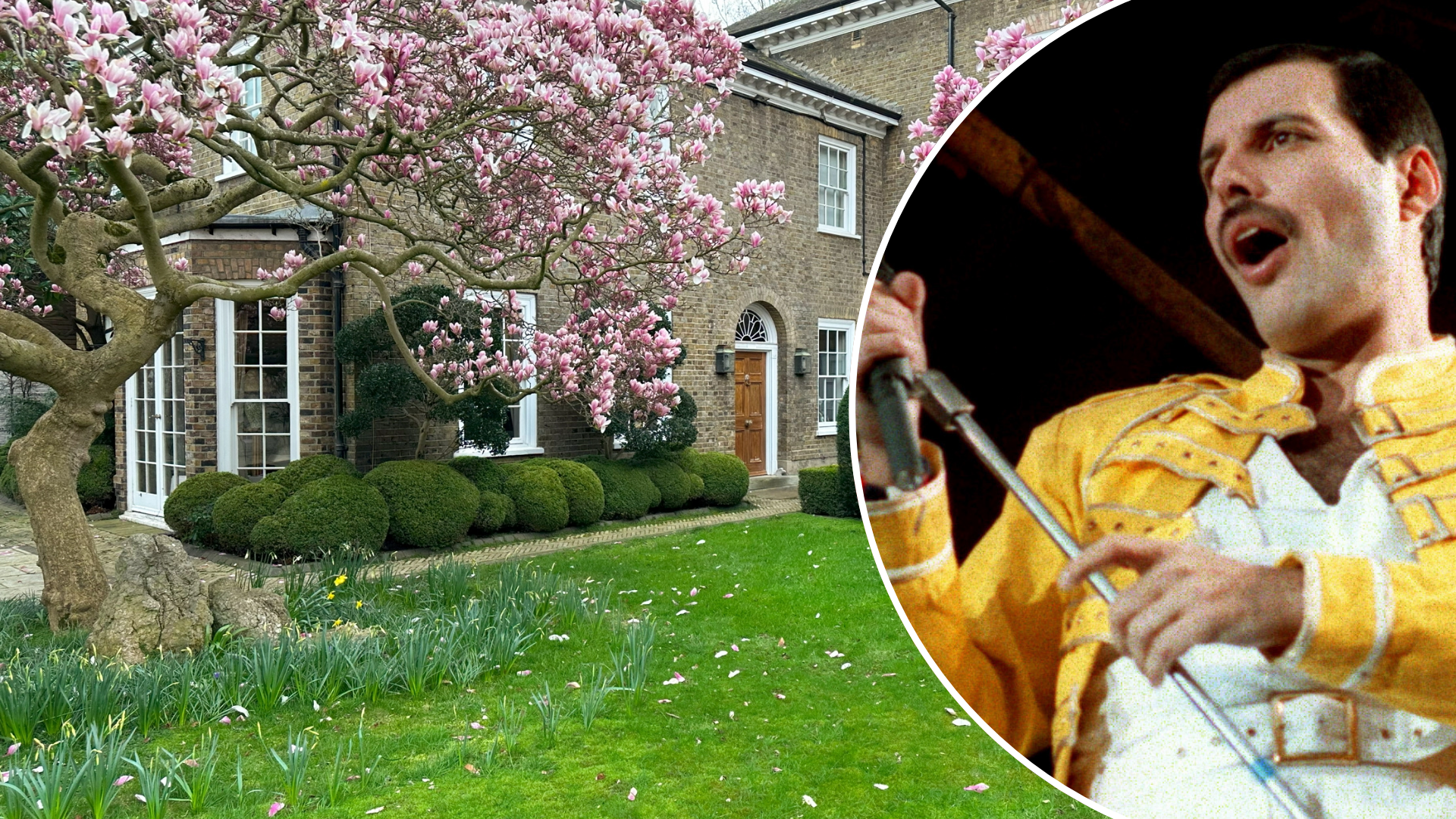
The heavy green door on Logan Place is scarred by decades of love. For thirty years, fans of Queen treated this brick wall in Kensington as a shrine, etching their grief and their gratitude into the paint with permanent markers and pocketknives. They were reaching for a ghost. Behind that wall sits Garden Lodge, a neo-Georgian manor that served as the private sanctuary for Freddie Mercury. It was his "memory box," a term he used to describe a home filled with the treasures of a life lived at maximum volume.
Today, that door is clean. The graffiti is gone. The house is on the market for roughly $38 million—or £30 million—and yet, it sits. In a world where billionaires swap glass penthouses like trading cards, the silence surrounding Garden Lodge is deafening. It isn't just a real estate listing. It is a biopsy of fame, legacy, and the terrifying reality of what happens when a person's soul is inextricably woven into the floorboards of a building.
Buying Garden Lodge isn't like buying a mansion in Bel-Air. You aren't just purchasing eight bedrooms and a drawing room where a legend composed "Bohemian Rhapsody" on a Steinway baby grand. You are purchasing the responsibility of a ghost.
The Architect of Solitude
Freddie Mercury didn't buy Garden Lodge to show off. He bought it to hide. In 1980, at the height of his powers, he walked into the house and paid for it in cash. It was a ruin of its former glory, a place that had once belonged to a painter and his socialite wife. Freddie saw the bones. He spent the next decade turning it into a fortress of velvet, Japanese lacquer, and golden yellow walls.
Think of the house as a stage set where the audience was never invited. While the world saw the man in the yellow jacket commanding Wembley Stadium, the man in the house was a quiet obsessive who collected fine china and doted on his cats. Mary Austin, the woman he called the "love of his life" despite their romantic relationship ending years prior, has been the keeper of this flame for over three decades.
When Freddie died in 1991, he left the house to Mary. He left her the cats. He left her the memories. For thirty-two years, she kept the house exactly as it was. The clothes stayed in the closets. The art stayed on the walls. It was a museum of a single human heart. But time has a way of eroding even the strongest pacts. Last year, Mary auctioned off the contents—the capes, the lyrics, the trinkets—and now, she is letting go of the shell.
The problem for a potential buyer is the weight of that history. How do you eat breakfast in a kitchen where Freddie Mercury once fed his cats? How do you renovate a bathroom that feels like a temple?
The Problem with Living in a Legend
Real estate at this level usually follows a predictable script. A buyer looks at the square footage, the neighborhood, and the potential for a "lifestyle upgrade." But Garden Lodge defies the script. It is a house frozen in a specific aesthetic—Freddie’s aesthetic. It features a dining room painted a high-gloss citrus yellow, a color he chose because it reminded him of his childhood in Zanzibar and India. It has a library with hand-carved wood and a gallery that feels more like a 19th-century salon than a modern luxury home.
Modern wealth usually demands minimalism. Today’s tech moguls and hedge fund managers want white marble, floor-to-ceiling glass, and "smart" everything. They want a blank canvas where they can project their own identities. Garden Lodge is the opposite of a blank canvas. It is a finished masterpiece. To change it feels like an act of vandalism. To keep it the same feels like living in someone else’s skin.
There is a psychological barrier here that the listing agents don't talk about in the brochures. To buy this house, you have to be comfortable with the fact that you will never truly be the most famous person to live there. You are a footnote. You are the person who bought Freddie Mercury’s house.
The Invisible Stakes of a $38 Million Sale
Beyond the emotional weight, there is the logistical nightmare of the fans. Even with the "shrine" wall cleaned and the security cameras upgraded, Logan Place remains a site of pilgrimage. Living there means dealing with the quiet, persistent gaze of the world. It means knowing that every time you open those green gates, there is someone with a camera hoping to catch a glimpse of the magic that used to live inside.
The market for properties like this is microscopic. It requires a buyer who has the wealth of a king but the ego of a curator. Most people with $38 million to spare have very large egos. They want to build their own legacy, not polish someone else’s.
Consider the hypothetical scenario of a tech entrepreneur moving in. They want to knock down the wall between the dining room and the kitchen to create an "open concept" space. They want to replace the ornate fireplaces with sleek, gas-powered strips of fire. They want to tear out the overgrown, English-style gardens to put in a subterranean gym and a lap pool. In any other London townhouse, this is a standard renovation. In Garden Lodge, it is a tragedy.
This tension is likely why the house hasn't vanished from the market in a flurry of bidding wars. It is a "memory box" that is currently being offered to a world that has largely forgotten how to value memories over assets.
The Ghost in the Garden
There is a specific stillness in the gardens of the lodge. Freddie spent his final months looking out at those trees. He found peace in the privacy that the high brick walls afforded him. The house was his skin. It was the only place where he didn't have to be "Freddie." He could just be a man who loved beautiful things.
The sale of the house marks the final chapter of the Queen era in London. Once the keys change hands, the "memory box" will be opened, emptied, and likely reimagined. Mary Austin’s decision to sell wasn't about the money; she has lived there for thirty years without selling a single teaspoon. It was about the burden of being a ghost’s assistant. She is eighty years old. She cannot guard the shrine forever.
We often think of houses as permanent, but they are as fragile as the people who inhabit them. Without Freddie, the house is just brick and mortar. Without Mary, it is just a listing on a luxury website. The $38 million price tag isn't for the square footage. It’s for the right to say you own a piece of the sun.
But the sun is hot, and it burns.
The next owner will have to decide if they are moving in to live their own life, or if they are simply paying a fortune to spend their nights wandering through someone else’s dreams. Until that person arrives—someone with enough money to buy it and enough soul to respect it—the house on Logan Place will remain exactly what it is: a silent, beautiful, yellow-walled waiting room.
The dust in the drawing room is quiet now. It settles on the spots where the piano used to stand, where the cats used to sleep, and where a man once sat and wondered if anyone would remember him. We do remember. And that might be exactly why no one is buying the house. It’s hard to sleep when the air is thick with a song everyone knows the words to, but no one can quite sing alone.