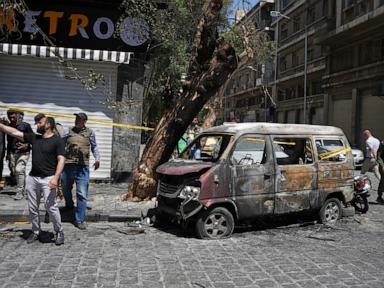
The sound of an explosion in a city that has known war for more than a decade does not just shake the windows. It rattles the teeth inside your skull. It alters the geometry of a afternoon. One moment, a street in the Sayeda Zeinab neighborhood of Damascus is a flurry of ordinary life—the scent of roasting coffee, the screech of cheap plastic chairs dragged across concrete, the low murmur of people buying vegetables. The next moment, the air itself turns into a fist.
When the dust settles, the silence is always the loudest part. Then comes the ringing in the ears. Then, the screaming.
Recently, the Syrian state television broadcasted images of men staring blankly into a camera lens. They were handcuffed, looking smaller than the terror they had reportedly unleashed. The official announcement was clipped, sterile, and standard for state media. It stated that security forces had arrested an Islamic State-linked cell responsible for the deadly bombings that had shattered the capital's fragile peace.
To the outside world, it was another fleeting headline from a distant, fractured place. A line of text scrolling across the bottom of an international news broadcast. But to understand what those arrests actually mean, you have to leave the press releases behind. You have to look at the glass on the sidewalk.
The Architecture of Fear
Imagine a young woman named Maya. She is a fictional composite, but her reality is shared by hundreds of thousands who walk these streets. Maya is twenty-four. She has never known an adulthood that did not involve checkpoints, shortages, and the sudden, violent evaporation of public spaces.
For Maya, a trip to the market is not a mundane chore. It is a calculation of risk.
When an explosive device detonates in a crowded district, the physical damage is contained to a specific radius. The psychological damage, however, expands indefinitely. The Islamic State, operating from the shadows of the vast Badia desert, understands this geometry perfectly. They no longer hold vast swaths of territory. They do not fly flags over government buildings. Instead, they weaponize randomness.
The recent arrests carried out by Syrian security apparatuses highlight a grim reality. The war is not over; it has merely changed form. The frontline is no longer a trench line visible from a drone camera. It is a crowded bus stop. It is a motorcycle parked casually near a shrine.
When the state security apparatus announced they had tracked down the cell behind the Damascus bombings, the state machinery presented it as a total victory. The state media showed confessions, a grim parade of men admitting to planting motorcycles rigged with explosives. They spoke of orders received from handlers hiding in the lawless pockets of the country. They spoke of money exchanged for blood.
But for the people living in the shadow of these events, the satisfaction of an arrest is always tangled with a deep, lingering dread.
The Logic of the Ghost Cell
How does a broken entity continue to strike the heart of a heavily fortified capital? The answer lies in the evolution of modern insurgency.
Think of the current iteration of ISIS not as an army, but as a virus. A virus does not need a massive headquarters to kill. It needs a host. It needs isolation. It needs the vast, unpoliced stretches of the Syrian desert where the central government's reach is thin and international coalition forces rarely tread. From these barren expanses, instructions travel along encrypted channels to sleeper cells embedded within urban populations.
The suspects paraded on television were not foreign fighters who crossed the border last week. They were locals. They were individuals who blended into the fabric of the city, breathing the same dust and buying the same bread as their victims.
This is what makes the threat so corrosive to a society trying to rebuild. It breaks the fundamental trust required for human community. When the person next to you on the minibus could be carrying the apparatus of your destruction in a faded backpack, the entire city becomes a hostile environment.
The official reports detail the seizure of weapons, explosive belts, and communication equipment. These are tangible artifacts of a conspiracy. Yet, the logic that drives these attacks remains untouched by handcuffs. The individuals arrested are replaceable parts in a machine designed to generate chaos. When one cell is dismantled, the handlers in the desert simply begin looking for the next disaffected, desperate, or radicalized soul willing to take their place.
The Weight of the Aftermath
There is an emptiness that follows these announcements. The state claims a triumph of intelligence, a proof of capability. The government reasserts its narrative of total control and stabilization. On paper, justice has been served. The perpetrators are behind bars, awaiting a fate that will undoubtedly be swift and merciless.
Yet, walk down the street where the bomb went off a few weeks ago. The storefronts have already been boarded up with cheap plywood or fitted with new, gleaming sheets of glass. The blood has been washed from the tarmac with buckets of soapy water. Life, out of sheer necessity, resumes its relentless pace. People must work. They must eat.
But watch the eyes of the people walking past.
Watch how they quicken their step when they pass a parked, unattended motorcycle. Watch how a mother pulls her child a little closer when a car backfires down the block. The physical shrapnel is cleared away, but the invisible shrapnel remains embedded in the collective psyche.
The arrest of a terrorist cell is a necessary act of state preservation. It is a tactical win. But it is also a reminder of how close the edge remains. It proves that the peace hanging over Damascus is not a solid foundation, but a thin sheet of ice over a dark and turbulent sea.
The suspects will go to prison or to the gallows. The press releases will archive themselves into the digital ether. And the people of the city will continue to walk their streets, looking at the ground, looking at each other, wondering if the quiet they feel today is real, or if it is just the silence that comes before the ringing in the ears begins again.