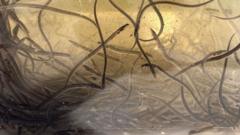
The feel-good narrative around the European eel (Anguilla anguilla) is a lie. You’ve seen the headlines: a sudden spike in glass eel recruitment, a handful of rivers seeing a "population boost," and the self-congratulatory pat on the back from conservation groups. It is scientific theater. We are watching a species slide into an evolutionary abyss, and our current "solutions" are actually accelerating the descent.
The "lazy consensus" is that if we stop overfishing and transport a few million tiny eels past hydro-electric dams, we can reverse decades of decline. It’s a comforting thought. It’s also fundamentally wrong. We are treating a systemic biological collapse like a simple plumbing problem.
The Recruitment Trap: Why Numbers Don’t Mean Recovery
Environmentalists love to cite recruitment numbers—the amount of young glass eels arriving on European shores—as a metric of success. This is a classic case of looking at the scoreboard while the stadium is on fire.
Recruitment is notoriously volatile. A single "good year" is often just a fluke of oceanic currents and North Atlantic Oscillation (NAO) shifts, not a sign of a rebounding population. When you look at the long-term data, we are still down roughly 90% to 95% from the levels seen in the 1970s.
By focusing on these minor upticks, we ignore the grim reality of the Escapement Goal. To save the species, we need adult silver eels to make it back to the Sargasso Sea to spawn. We aren't failing at the beginning of the cycle; we are failing at the end. We are obsessed with the "babies" because they are easy to count and make for great PR, while the actual breeding stock is being shredded by turbines or poisoned by PCBs in the silt.
The Great Relocation Myth
The industry standard for "saving" eels is trap-and-transport. We catch glass eels at the coast and truck them upstream to "safe" habitats. On paper, it looks brilliant. In practice, it’s ecological malpractice.
- The Orientation Crisis: Eels are migratory masterpieces. They rely on complex geomagnetic sensing and olfactory cues to find their way back to the Sargasso. When you toss them in a tank and drive them 200 miles inland, you are scrambling their internal GPS. There is zero definitive evidence that these relocated eels can successfully navigate back to the ocean a decade later. We might just be creating a generation of "lost" eels that will never reproduce.
- Parasitic Hitchhikers: By moving eels between river systems, we have effectively weaponized the nematode parasite Anguillicola crassus. This parasite infects the eel’s swim bladder, making it impossible for them to handle the pressure changes of deep-sea migration. We didn't just move the fish; we moved the plague.
- The Gender Imbalance: Eel sex is determined by density. In high-density areas, they tend to become males; in low-density areas, they become females. By artificially stocking certain rivers, we are manipulating the sex ratio of the entire species without understanding the long-term impact on the breeding pool.
The Hydro-Power Hypocrisy
We cannot have "green" energy and eels. It’s a binary choice that the industry refuses to admit.
Modern hydro-electric turbines are meat grinders. Even with "fish-friendly" bypasses, the mortality rate for migrating silver eels—which can be a meter long—is catastrophic. A 20% mortality rate at one dam sounds manageable until you realize an eel might have to pass through five or ten dams to reach the sea.
The math is simple and brutal. If an eel has an 80% chance of surviving a single dam, its chances of surviving five dams is $0.8^5$, or roughly 33%. By the tenth dam, its survival probability drops to about 10%. We aren't conserving a species; we are running a gauntlet where the house always wins.
Stop Planting Eels, Start Tearing Down Walls
If we actually wanted to save the eel, we would stop the expensive, performative art of glass eel relocation and focus on the only two things that matter: Habitat Continuity and Chemical Sovereignty.
Habitat Continuity isn't about fish ladders. It's about dam removal. If a waterway cannot support the natural, unassisted migration of a species, it is not a viable habitat. We spend millions on "mitigation" when we should be spending it on demolition. The industry hates this because it involves actual sacrifice, not just a line item in a CSR report.
Chemical Sovereignty refers to the eel's role as a lipid-heavy bottom feeder. They are essentially sponges for every toxin we dump into our soil. These toxins are stored in their fat. When the eel begins its 6,000 km swim to the Sargasso, it stops eating and starts burning that fat for fuel. The result? A concentrated dose of neurotoxins and endocrine disruptors is released directly into their developing eggs. We are producing "zombie" spawners—fish that might make it to the finish line but produce offspring that are DOA.
The Economic Reality of the Black Market
The "conservation" efforts are also being cannibalized by the sheer value of the commodity. Glass eels are the most trafficked wildlife item on the planet by value—surpassing rhino horn and ivory.
While we argue about river health, organized crime syndicates are shipping tons of glass eels to Asian fish farms. Every time we implement a "limited" legal catch for "research" or "restocking," we provide a legal veneer for the black market to operate. You cannot "manage" a fishery that is this lucrative and this broken.
Why the Current Model is Designed to Fail
The reason we stick to the current plan is that it’s profitable for the "Conservation Industrial Complex." It creates jobs for researchers, justifies budgets for government agencies, and allows power companies to claim they are environmentally conscious.
True conservation would require:
- A total, decade-long moratorium on ALL eel fishing—no "cultural" exceptions, no "glass eel" quotas for farms.
- Mandatory turbine shutdowns during peak migration windows (dark nights, high flow, autumn).
- The decommissioning of low-head dams that serve no modern power-generation purpose.
But we won't do that. It's easier to put some eels in a truck, take a photo, and tell the public the population is "showing signs of hope."
The Evolution of the Wrong Question
People ask: "How can we make hydro-power safer for eels?"
That is the wrong question.
The right question is: "Are we willing to accept higher energy costs and less 'renewable' base-load power to prevent the extinction of a 50-million-year-old lineage?"
People ask: "How many glass eels should we stock this year?"
The right question is: "Why are we pretending that a truck is a substitute for a functioning river?"
We are currently managing the decline, not the recovery. We have turned the European eel into a laboratory animal, a data point in a spreadsheet that helps bureaucrats sleep at night. If we continue on this path, the European eel will not go extinct because we didn't try to save it; it will go extinct because we were too cowardly to do what was actually required.
Stop looking at the recruitment spikes. Stop believing the press releases from the people who own the dams. The eel is screaming for us to get out of its way, but we are too busy building more "solutions" that kill them.
Move the dams, or admit you’ve already decided the eel isn't worth the price of the electricity. Anything else is just noise.
Pick a side. Eels or the grid. You can't have both.