The red light on the webcam blinks once, twice, and settles into a steady, unblinking stare.
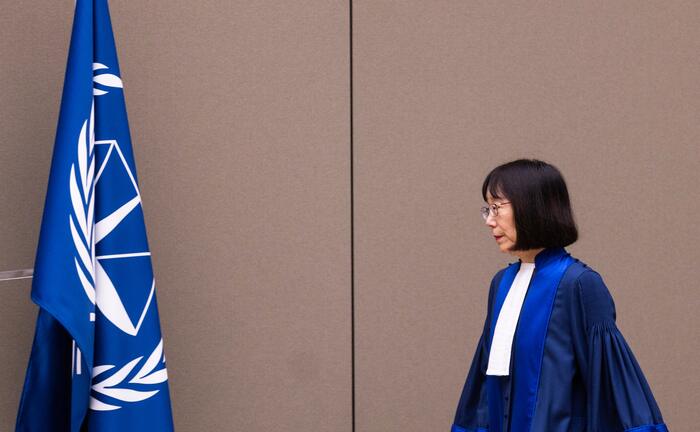
Four thousand miles away from the General Assembly hall in New York, inside a quiet, wood-paneled chamber in The Hague, Judge Tomoko Akane adjusts her glasses. There is no rustle of diplomatic robes behind her. There is no murmur of a crowded gallery, no quick, whispered consultations with aides in the corridors of Turtle Bay. Instead, there is only the sterile hum of a secure video feed and the vast, invisible gulf of an Atlantic Ocean that has suddenly grown much wider than water.
When the President of the International Criminal Court addressed the United Nations remotely, the medium was the message. She wasn't in the room because the room had become hostile territory.
Most people hear the phrase "international sanctions" and picture frozen offshore bank accounts belonging to warlords, arms dealers, or kleptocrats who siphon billions from failing states. You picture yachts seized in Mediterranean ports and luxury condos locked up in London. You do not picture a sixty-eight-year-old Japanese jurist who spent decades prosecuting mundane domestic crimes before rising to the bench of the world’s only permanent war crimes tribunal. Yet, when the Trump administration leveled sweeping penalties against the International Criminal Court—freezing assets, revoking visas, and threatening financial ruin for anyone who dares to assist its investigations—the machinery built to corner dictators was turned squarely on the judges.
It is a bizarre, disorienting inversion of reality. To understand why a remote video link from the Netherlands represents a seismic tremor in global justice, you have to look past the dry diplomatic cables and see what happens when the referee is tackled by the biggest player on the field.
The Architecture of a Broken Promise
Let us step back for a moment and consider a hypothetical scenario, one that plays out in smaller, quieter ways every day in the corridors of international law.
Meet Clara. Clara isn't a politician, and she isn't a soldier. She is a forensic accountant from Belgium, thirty-four years old, with a penchant for spreadsheets and a mortgage on a narrow brick house outside Brussels. For the past three years, Clara has worked as an external contractor for the ICC, tracing the labyrinthine shell companies used to fund militias in Central Africa and tracking the procurement of restricted weapons components in Eastern Europe. Her work is tedious, unglamorous, and entirely dependent on the global banking system.
One Tuesday morning, Clara tries to buy groceries. Her card is declined. By noon, she receives a polite, terrifying email from her bank explaining that her accounts have been placed under review due to potential exposure to United States secondary sanctions. Because her employer—the court—is under penalty, anyone providing "material support" to its operations risks being severed from the U.S. financial system. And in a world where the American dollar is the oxygen of global commerce, being cut off from U.S. banks is the financial equivalent of being exiled to a desert island.
Clara doesn't have an offshore fortune. She has a car payment and a toddler in daycare. Suddenly, the abstract geopolitical clash between Washington and The Hague isn't about treaties or sovereignty; it is about whether Clara can pay her electric bill.
This is the invisible choke chain of modern statecraft. You don't need to send tanks to The Hague to shut down a court. You just need to make it toxic for Microsoft to maintain its cloud servers, toxic for Visa to process its staff's paychecks, and toxic for local contractors to fix its plumbing. When Judge Akane spoke to the U.N. via video link, she wasn't merely protesting an insult to her dignity. She was sounding the alarm on a systematic attempt to starve an institution of the basic utilities of survival.
Why Washington Built the Walls
To be fair—and if we want to understand this without blinders, we must be brutally honest—the American hostility toward the ICC didn't materialize out of thin air. It is the culmination of a quarter-century of deep, bipartisan suspicion that hardened into outright aggression under the Trump administration.
Think of the International Criminal Court like a neighborhood watch agreement signed by 124 countries. Under the Rome Statute, the treaty that created the court in 1998, member states agreed to a simple, radical premise: if a country is unwilling or unable to prosecute genocide, war crimes, or crimes against humanity within its own borders, the court in The Hague steps in as a court of last resort.
The United States never signed up for this neighborhood watch. Neither did Israel, Russia, China, or India. From Washington’s perspective, the court’s claim to jurisdiction over citizens of non-member states—if those alleged crimes occur on the territory of a member state—is an intolerable violation of national sovereignty.
For years, that tension remained a cold war of words. Then the court opened investigations into alleged war crimes by U.S. personnel in Afghanistan, and later, issued arrest warrants for top Israeli leaders alongside Hamas commanders over the devastating conflict in Gaza. To the Trump administration, the line had been crossed. The court was no longer just an annoying international body; it was viewed as a rogue tribunal weaponizing the law against American allies and potentially American soldiers.
The response was swift and merciless. Executive orders were signed. Travel bans were slapped on court officials and their families. Financial penalties were weaponized to deter cooperation. The message from the White House was unambiguous: Touch us, or touch our friends, and we will dismantle your world.
The Speech Through the Glass
And so, we return to that glowing screen in the U.N. General Assembly.
I have watched dozens of diplomatic addresses over the years, and most of them are masterpieces of bureaucratic anesthesia. Speakers read carefully vetted platitudes in monotone voices while delegates scroll through their phones. Judge Akane’s remote address had none of that sleepy comfort. There was an unmistakable steeliness beneath her measured, judicial cadence.
She looked straight into the camera and called the penalties what they were: coercive measures designed to intimidate independent judges and undermine the rule of law. She didn't plead. She didn't ask for special favors. Instead, she held up a mirror to the 193 member states sitting in that hall—many of whom had ratified the Rome Statute with grand speeches about "never again"—and asked a silent, devastating question: Are you going to let one nation bully the world's conscience into silence?
Wait. Think about the sheer absurdity of the moment.
The United Nations was born from the ashes of World War II, built on the agonizing realization that unchecked power leads inevitably to mass graves. The ICC is the direct descendant of the Nuremberg trials, where American prosecutors—men like Robert Jackson—argued passionately that the law must apply equally to the victors and the vanquished, to the powerful and the weak. Jackson famously warned that if we pass a poisoned chalice to others, we must be prepared to put it to our own lips.
Watching the ICC president forced to beam into the U.N. remotely because of penalties imposed by the very nation that once championed Nuremberg felt like watching history fold in on itself. It was a stark admission that the post-war consensus isn't just fraying; it is being actively torn apart by its chief architect.
The Domino Effect of Impunity
It is tempting to look at this standoff as an elite squabble between lawyers in tailored suits and politicians in Washington. After all, what does a sanction on a judge in the Netherlands have to do with you, sitting at your kitchen table, worrying about inflation, healthcare, or the daily grind?
Everything. Because the erosion of rules at the top never stays at the top.
Imagine a small town where the wealthiest family decides they no longer recognize the local sheriff. They don't shoot him; they simply buy the bank that holds his mortgage, pressure the grocery store not to sell him food, and threaten to sue anyone who testifies in his courtroom. What happens to the rest of the town? The local bullies realize the sheriff is powerless. Contracts stop meaning anything. The strong take what they want, and the weak learn to keep their heads down.
That is the exact dynamic playing out on the global stage right now. When a superpower uses financial warfare to cripple an international court, dictators and warlords everywhere take notes.
If the ICC can be paralyzed because its warrants inconvenience Washington, what stops Moscow from ignoring warrants over the abduction of Ukrainian children? What stops military juntas in Myanmar or generals in Sudan from laughing off the threat of future prosecution? They see that international justice isn't a blindfolded goddess holding balanced scales; it is a fragile construct that bends the moment it collides with raw geopolitical muscle.
The invisible casualties of these penalties aren't the judges in The Hague. They are the survivors sitting in refugee camps in Chad, the mothers searching for mass graves in Ukraine, and the villagers in Gaza and Israel whose lives have been shattered by endless cycles of violence. For decades, investigators have told these victims: Give us your testimony. Show us the scars. Trust the process. One day, there will be a reckoning.
Now, those same investigators have to look victims in the eye while worrying whether their own laptops will be remotely wiped by a tech vendor complying with U.S. sanctions. That is a betrayal that no diplomatic communiqué can smooth over.
The Fractured Future of Global Justice
Where does this leave us? Honestly, it leaves us in uncharted, deeply unsettling territory. Anyone who tells you they know how this ends is selling you a comfortable lie.
The ICC is currently caught in an existential bind. If it backs down, drops politically sensitive investigations, and quietly shelves warrants that anger Washington, it survives financially—but it dies morally. It becomes a "white man's court" or a "weak man's court," a tribunal that only ever prosecutes defeated African warlords while giving a permanent free pass to nuclear powers and their allies.
On the other hand, if Judge Akane and her colleagues hold the line, the court faces a slow, agonizing strangulation. European allies—including the Netherlands, France, and Germany—have voiced strong verbal support for the court's independence. They have invoked "blocking statutes" meant to shield European companies from complying with extraterritorial U.S. sanctions. Yet, as history has repeatedly shown, when a European bank has to choose between honoring a Brussels directive and keeping its access to Wall Street, Wall Street wins every single time.
Judge Akane knows this. You could hear the weight of that reality in her voice during her remote U.N. address. She wasn't naive about the storm battering her institution. She knew that speeches don't unblock bank accounts, and applause in New York doesn't restore revoked visas.
Yet, she spoke anyway. She insisted that the court would continue its work without fear or favor, guided solely by the evidence and the law.
There is a strange, quiet heroism in that stubbornness. In an era dominated by loud, transactional politics—where loyalty is bought, threats are tweeted, and every principle has a price tag—a soft-spoken judge refusing to flinch in front of a webcam carries a weight that outlasts the news cycle.
The broadcast eventually ended. In New York, the delegates moved on to the next item on the agenda, shuffling papers and checking their watches. In The Hague, the red light on the webcam blinked off, plunging the chamber back into silence. The sanctions remained in place. The bank accounts stayed frozen. The invisible wall between the court and the world's most powerful nation stood just as high as it had an hour before.
Outside the court's gleaming glass facade, the autumn wind swept off the North Sea, rattling the flags of the 124 member nations—a neat row of bright colors flapping fiercely against a gray, indifferent sky, waiting to see who would blink first.