The Ghost in the Pipe
There is a smell every old mechanic knows by heart. It is sharp, chemical, and stubborn—the scent of hot vinyl burning against a manifold where it had no business being. For decades, polyvinyl chloride has been the ghost in the machine of modern manufacturing. We wrapped our houses in it, built our water mains out of it, and squeezed it into millions of consumer goods. And then, when its useful life ended, we threw it away. Or tried to.
Plastic does not simply vanish because a bin is labeled recycling. It lingers. It fights. It degrades into microscopic ghosts that drift through oceans and settle deep into the soil. For a more detailed analysis into this area, we recommend: this related article.
Thirty years ago, standing in a dim salvage yard with grease dried into the cracks of my knuckles, I watched a crew toss a pile of shattered grey PVC piping into a landfill trench. The foreman spat on the ground and shook his head.
"You can burn it, but you'll choke the town," he muttered, wiping soot from his brow. "You can melt it, but it ruins the batch. It's useless." To get more background on this development, detailed analysis can also be found at Mashable.
That word has always haunted us. Useless. We built an entire civilization on synthetic polymers, yet we never quite figured out what to do with the stubbornest of them all. Chlorine atoms locked tightly into a carbon backbone make PVC fiercely durable, resistant to fire, water, and time. Those exact traits, the ones that made it an industrial miracle, also made it an ecological nightmare. It was a material designed to outlive the people who made it, sitting in massive heaps while chemists threw their hands up in despair.
Until now.
The Chemistry of Redemption
Consider what happens when a material is pushed past its breaking point. For years, scientists viewed PVC as a chemical dead end. Add plasticizers, mold it, extrude it, throw it away. The chlorine trapped inside acted like a locked door, keeping standard recycling processes at bay. Heat it too much, and toxic gases vent into the air. Melt it down with other plastics, and the whole mixture fouls the machinery.
Recently, a team of researchers looked at that locked door and realized they did not need a key. They needed a crowbar made of molecular engineering.
(Note: This breakthrough relies on catalytic degradation, a method where chemical catalysts break heavy polymer chains down into smaller, highly controlled hydrocarbon fragments.)
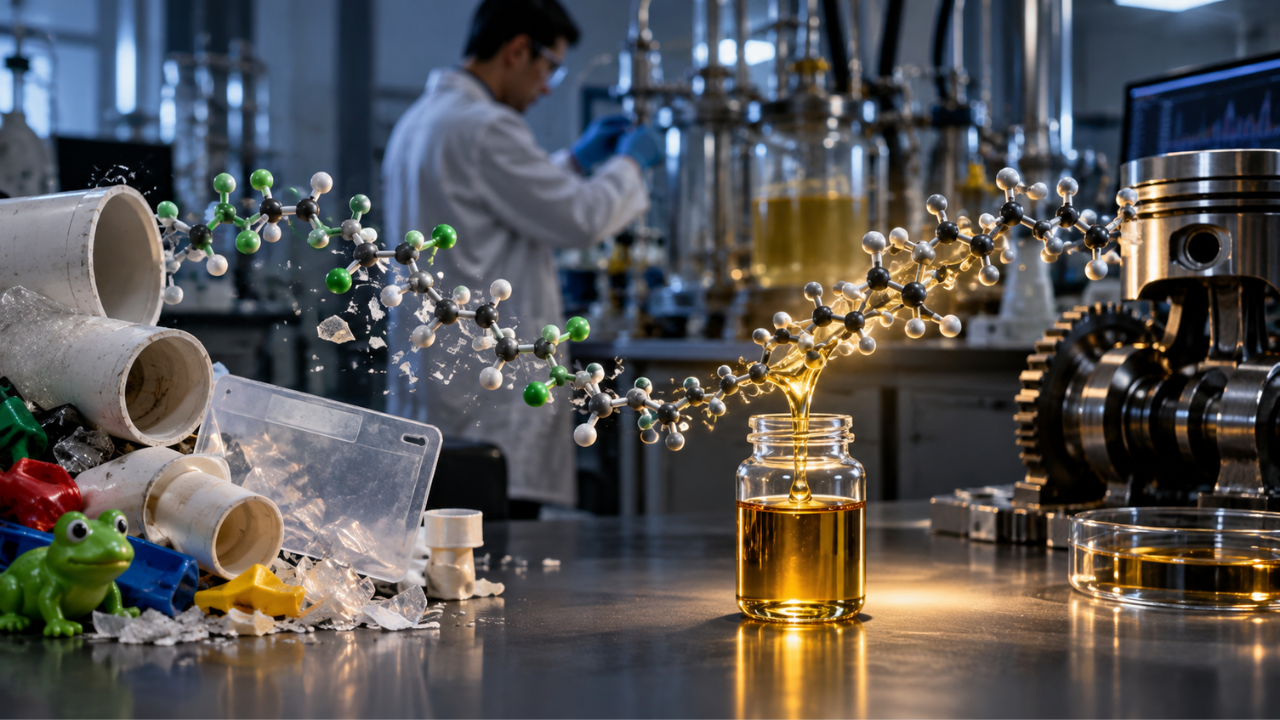
Imagine taking rigid, brittle window frames, worn-out credit cards, and discarded medical tubing, throwing them into a reactor, and watching them transform. Not into cheap plastic pellets that snap under pressure, but into something smooth, amber, and impossibly slick.
High-performance engine lubricant.
It sounds like alchemy. It reads like a fairy tale cooked up by a desperate marketing department. Yet, the physics check out. The chlorine that once made PVC a villain is stripped away through precise chemical wizardry, leaving behind pure, orderly hydrocarbon chains. These chains are then rebuilt into base oils designed to withstand the brutal friction of a modern combustion engine or an industrial gearbox.
Think about that for a moment. The very pipe that once carried city sewage or sheltered electrical wires could soon be circulating through the crankcase of a high-performance engine, taking the brunt of thousands of RPMs, keeping metal from grinding against metal under extreme heat.
The Weight of the Crankcase
I remember my first old truck. It was a rusted-out Ford that drank oil the way a marathon runner drinks water. Every Saturday morning meant sliding a flattened cardboard box beneath the oil pan, unscrewing the plug, and letting the dark, exhausted fluid drain out into an old pan.
That oil had a job to do. It lived in a violent world of reciprocating pistons, searing temperatures, and crushing pressures. It had to coat surfaces measured in microns, holding its ground when everything else wanted to tear itself apart. We mined crude oil from deep within the earth, hauled it across oceans, and refined it through energy-intensive towers just to keep those pistons moving.
We never stopped to think about where the waste was coming from, or where it was going.
When you trace the lifecycle of a gallon of motor oil, you see a straight line from extraction to combustion. When you trace the lifecycle of a piece of PVC, you see a straight line from factory floor to a landfill hole. For generations, these two lines ran parallel, never touching, each representing a separate crisis of human consumption.
The new chemical pathway connects those two lines into a loop.
When chemists convert rigid waste polymers into synthetic lubricants, they are performing a quiet magic trick on our global supply chain. They are taking a liability—something municipalities pay millions of dollars to bury or incinerate—and turning it into an asset of extreme precision.
The Turning Point
We are standing at a strange threshold in human history. For a long time, progress meant invention. We invented stronger plastics, faster engines, more efficient fuels. But invention without consequence management is just borrowing against the future.
The real genius of this discovery is not just that it makes a good lubricant out of garbage. It is that it forces us to rethink what garbage actually is.
(Note: The following breakdown illustrates the structural shift from linear disposal to cyclical transformation.)
- The Old Way: Extract crude oil, refine lubricants, burn through them, discard plastic waste into landfills where it remains chemically unchanged for centuries.
- The New Way: Capture hard-to-recycle chlorine-containing polymers, break their chemical bonds safely, and restructure them into high-grade synthetic oils that reduce the demand for virgin crude.
The machinery of the future will not be fueled by virgin extraction. It will run on the ghost of our past mistakes, refined and purified into something better than what we started with.
When you drive down the highway tomorrow, listening to the quiet hum of an engine under the hood, remember the pipeline beneath the asphalt. Remember the old salvage yards, the stubborn smell of burning vinyl, and the quiet labs where researchers finally figured out how to turn our refuse into gold. The world is heavy, and the problems we have built for ourselves are vast. But every now and then, chemistry offers us a way to clean up our own mess while keeping the wheels turning.
The pipe is gone. The oil is flowing. And the cycle, for the very first time, is closed.