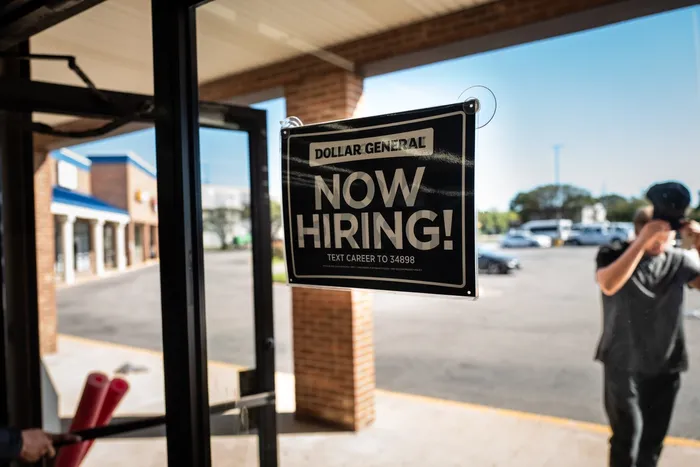
The coffee shop at the corner of 4th and Main isn’t a place where people usually talk about macroeconomics. They talk about the humidity, the local high school football scores, or why the price of a blueberry muffin just jumped fifty cents. But every Thursday morning, a quiet tension ripples through the air as the clock strikes 8:30. In the offices upstairs and the breakrooms in the back, people check their phones. They are looking for a number. It isn’t a lottery result or a sports score. It is the tally of how many people across the country just lost their livelihood.
Lately, that number has been whisper-quiet.
Historically low jobless claims have become the background noise of the American economy, a steady hum of stability that we have almost learned to ignore. But stability is never a given. It is a hard-won peace. When we read that initial unemployment filings have dipped to levels not seen since the 1960s, we aren’t just looking at a spreadsheet. We are looking at a million Sunday nights where the dread of the Monday morning alarm didn't include the fear of a locked door or a deactivated badge.
The Anatomy of a Second Chance
Consider a hypothetical worker named Sarah. Sarah spent fifteen years at a manufacturing plant that finally succumbed to the slow rot of obsolescence. Five years ago, a layoff would have been a death sentence for her zip code. She would have stood in a line that snaked around a gray brick building, waiting to file paperwork that felt more like an admission of failure than a safety net.
Today, Sarah’s story is different. The data shows us that when people like Sarah lose a job in this market, they aren't staying on the sidelines. They are being snapped up by the hunger of a thousand different industries. The "stable labor market" isn't a static thing. It is a churning, high-velocity machine where the time spent between "I’m let go" and "I’m hired" has shrunk to a blink.
This is the hidden soul of the data. When jobless claims remain low, it means the leverage has shifted. It means the person behind the counter or the developer at the desk knows they have a value that exceeds the line on their paycheck. Employers are no longer looking for reasons to trim the fat; they are hoarding talent like it’s a precious metal. They are terrified of the vacancy.
The Invisible Shield
To understand why 210,000 or 200,000 claims a week is a miracle, you have to look at what usually breaks the system. Normally, interest rate hikes act like a cold wind, freezing the blood of the economy. When the Federal Reserve raises the cost of borrowing, the conventional wisdom says that companies should start cutting. They should stop building. They should start firing.
Yet, here we are.
The wind is howling, but the house isn't shaking. This resilience is a mystery to some, but a lifeline to most. We are seeing a structural shift in how we value work. During the Great Recession, the labor market was a puddle—shallow and easily evaporated. Today, it is an ocean. Even as certain sectors like big tech or commercial real estate see localized storms, the sheer depth of the service, healthcare, and construction industries provides a buoyancy that defies the old rules of gravity.
Metaphorically, the American worker has traded a flimsy umbrella for a reinforced bunker. The "claims" we track are the cracks in that bunker. When they stay low, it signifies that the foundation is holding. It tells us that despite the headlines about inflation and the cost of eggs, the fundamental engine of the household—the paycheck—is still firing on all cylinders.
The Psychology of the Empty Queue
There is a specific kind of silence that exists in a Department of Labor office when the claims are low. It’s a silence that carries a heavy weight of relief. If you walk into one of those offices today, you won’t see the desperate crowds of 2008 or the frantic confusion of 2020. You see a system that is, for the moment, breathing easy.
But numbers are cold. They don't capture the anxiety of the "almost." For every person who doesn't file a claim, there is someone who worried they might have to. The stability we see in the reports is the cumulative result of millions of individual decisions. A manager decides to cut the travel budget instead of the junior analyst. A restaurant owner decides to work the extra shift themselves rather than let go of their lead cook.
These are the invisible stakes. Every week that jobless claims remain at historic lows is a week where the social fabric remains unfrayed. Unemployment is more than an economic indicator; it is a leading indicator of heartbreak. It tracks the moments when a parent has to explain why there are no birthday presents, or why the family is moving to a smaller apartment. When the numbers stay low, those conversations don't happen.
The Friction of Success
It is a mistake to think that low jobless claims mean everything is perfect. In fact, this level of stability creates its own kind of heat. It creates "labor tightness," a phrase that sounds clinical but feels like a headache for a small business owner.
Imagine a local bakery. The owner, Marcus, hasn't seen a jobless claim from his staff in three years. That sounds like a victory. But it also means that when his head baker moves away, there is no one standing in line to take the job. He has to compete with the Amazon warehouse down the road, the hospital system in the city, and the remote tech firms offering California wages to people living in Ohio.
The low claims are a double-edged sword. They represent security for the worker and a frantic, unending search for the employer. This is the "friction" of a healthy economy. We are trading the tragedy of mass unemployment for the frustration of help-wanted signs that stay up for months. It is a trade most of us would make in a heartbeat, but it is a pressure point nonetheless.
The Ghost in the Machine
We must admit that this stability feels fragile. We have been conditioned by history to wait for the other shoe to drop. We look at the low numbers and ask, "When does the cycle turn?"
The truth is, the cycle always turns. But the current data suggests that the "natural rate" of unemployment—the baseline of how many people are moving between jobs at any given time—has fundamentally shifted. We are becoming more efficient at matching people with work. The digital age has turned the job hunt from a local trek into a global search.
When we talk about "historically low" claims, we are acknowledging that the old benchmarks might be dead. We are in uncharted waters where the American worker has more staying power than the models predicted. We are seeing a defiance of the traditional boom-and-bust narrative.
The Sunday Night Test
The real measure of the US labor market isn't found in a Bureau of Labor Statistics PDF. It is found in the quiet moments of a Sunday evening, just as the sun is dipping below the horizon and the reality of the coming week begins to set in.
For the vast majority of people in the country right now, that moment is characterized by a sense of "keep on keeping on." There is no shadow of the pink slip looming over the dinner table. There is no frantic scrolling through job boards out of pure survival instinct.
The low jobless claims are the statistical representation of that peace of mind. They are the proof that the heart of the economy—the ability for a person to trade their time and talent for a dignified life—is beating with a steady, rhythmic pulse.
We watch the numbers not because we love the math, but because we know what happens when they spike. We remember the ghosts of 1929, 1982, and 2008. We know that behind every digit is a person like Sarah, hoping that the world still has a place for her skills.
For now, the door is open. The lights are on. The Monday morning alarm is just an alarm, not a warning bell. And in a world that often feels like it is spinning out of control, that steady, boring, low-claim number is the most beautiful thing on the page.