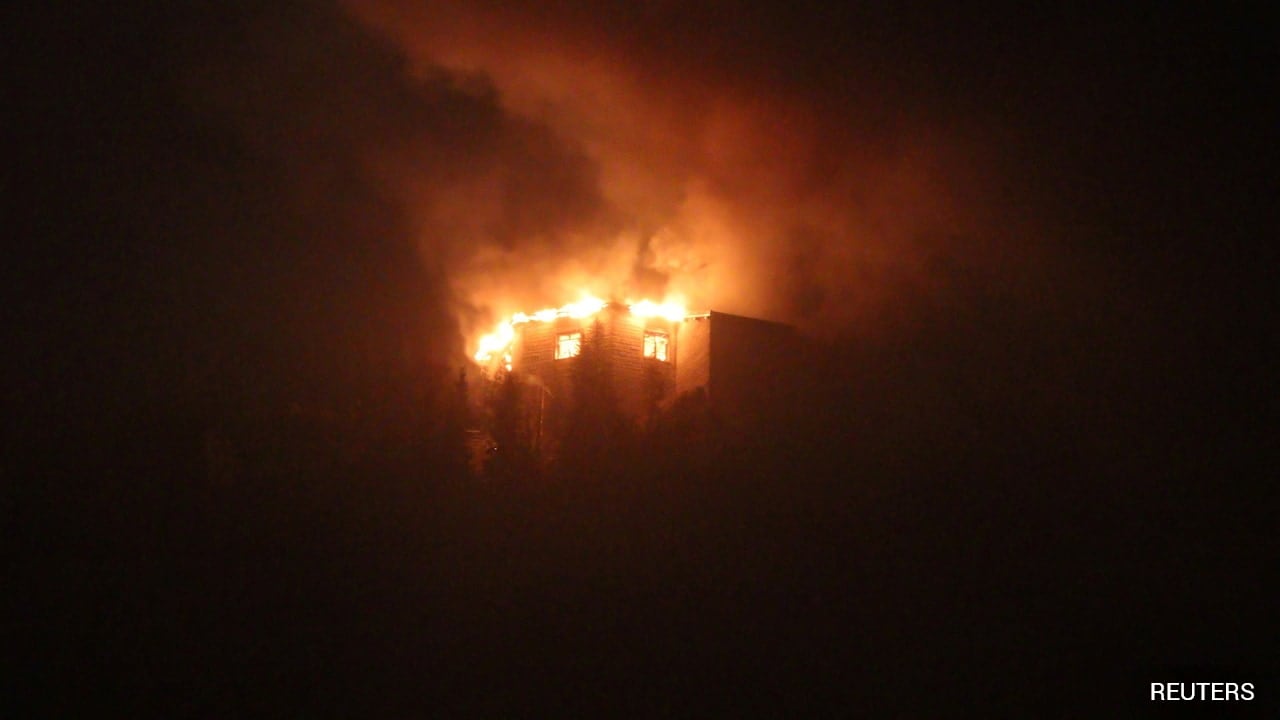
Smoke.
It is the oldest signal in human history, a gray plume rising against a blue sky that tells anyone watching from the valley below that something has changed, something is being destroyed, or someone is trying to send a message. When thick, dark smoke began curling out of the windows of the Kehlsteinhaus—better known to millions of tourists and history buffs as the Eagle’s Nest—high atop the Kehlstein peak in the Bavarian Alps, the first reaction from the people watching in Berchtesgaden was not panic. It was a strange, heavy confusion.
A suspect was quickly detained. Arson was suspected. On paper, it reads like a routine police blotter item from a quiet German mountain town: a historic building, an intentional fire, a swift arrest.
Yet anyone who has ever stood on that wind-scoured granite ridge at 6,017 feet knows that nothing about this mountain is routine. To understand why a flickering match inside a stone teahouse triggers such a visceral reaction across Europe, you have to understand what that building actually is, what it isn't, and why the ghosts of the twentieth century refuse to let us simply walk away from the view.
The Architecture of a Lie
Consider what happens next when a traveler takes the brass-lined elevator up through the heart of the mountain.
I have made that ascent myself, packed shoulder-to-shoulder with retired schoolteachers from Ohio, backpackers from Seoul, and quiet German teenagers on mandatory school trips. You walk down a damp, 400-foot tunnel blasted straight through solid Alpine rock—a tunnel so cold it smells like wet iron and deep winter even in the middle of July. The heavy bronze doors slide shut. Forty-one seconds later, you step out into a bright, wood-paneled octagonal room with panoramic windows framing one of the most breathtaking vistas on earth.
The beauty is the trap.
When Martin Bormann commissioned the Kehlsteinhaus as a fiftieth-birthday gift for Adolf Hitler in 1938, the engineering was meant to be an explicit statement of supreme power. Thirteen months of relentless labor, dozens of workers killed in accidents on the sheer cliff faces, and millions of Reichsmarks poured into a single road and a single granite lodge. The message was unmistakable: the regime could conquer even the jagged peaks of the Alps.
Here is the historical irony that most visitors only discover once they are already sipping a Bavarian beer on the terrace. Hitler hated the place. He was terrified of heights, prone to claustrophobia in the elevator, and paranoid about the thin mountain air and the risk of lightning strikes. By most verified historical accounts, he visited the Eagle’s Nest fewer than fourteen times, rarely staying for more than an hour or two. His actual residence, the Berghof, sat much lower down the mountain on the Obersalzberg—a sprawling complex that Allied bombers reduced to rubble in April 1945, and which Bavarian authorities later blew up entirely in 1952 to keep it from becoming a neo-Nazi shrine.
The Eagle’s Nest survived only because Allied commanders realized it was largely a logistical white elephant, too high and isolated to serve as a meaningful rally point, and too valuable as a strategic lookout post. Today, it operates as a restaurant, with proceeds going to charitable causes, while the Documentation Obersalzberg museum further down the slope does the heavy lifting of historical education.
Still, when fire breaks out inside those thick granite walls, the distinction between a tourist restaurant and a fascist monument vanishes instantly.
Two Perspectives on a Burning Room
To grasp the invisible stakes of an arson attempt on the Kehlstein, picture two hypothetical people standing on opposite sides of the police tape as firefighters haul hoses up the steep, single-lane mountain road.
First, imagine Lukas, a twenty-eight-year-old volunteer firefighter from Berchtesgaden. For Lukas, this peak is not a symbol of global evil; it is his backyard. His grandfather worked the salt mines beneath the valley. Lukas has spent his whole life watching buses wind up the switchbacks, bringing the tourist revenue that keeps local bakeries, guesthouses, and mechanics afloat. When the dispatch radio crackles with news of a structure fire at the Kehlsteinhaus, Lukas doesn't think about 1939. He thinks about dry timber beams, forty-mile-per-hour ridge winds that can turn a spark into an inferno in ninety seconds, and the sheer logistical nightmare of pumping water up a vertical cliff face. To Lukas, arson isn't a political statement. It is a reckless, selfish act that puts his neighbors' lives at risk on a treacherous mountain road.
Now, picture Elena, a historian from Munich who has spent fifteen years studying how post-war democracies handle toxic heritage. When Elena hears that someone deliberately set a fire inside Hitler’s mountain retreat, her stomach drops for an entirely different reason.
In the world of extremist symbolism, fire is never neutral. If the suspect turns out to be a far-right agitator, a fire at the Eagle's Nest becomes a twisted piece of theater—an attempt to reclaim a site through spectacle, or a warning shot aimed at the democratic institutions that currently manage it. Conversely, if the suspect is a vigilante trying to burn away a stain on German soil, the act is equally dangerous. Destroying a physical artifact doesn't erase the ideology that built it; it merely turns a cold, demystified stone building into a martyr's myth.
We want history to be tidy. We want to believe that if we simply turn a dictator’s teahouse into a place where tourists eat apple strudel and take selfies, the poison has been neutralized. An arsonist strikes at that fragile illusion.
The Burden of Dark Heritage
Preserving the physical remnants of atrocities is like keeping a vial of a deadly virus locked inside a glass laboratory. You don't keep it because you admire it. You keep it so you never forget what it looks like under a microscope, and so no one can claim it never existed.
Across Europe, communities live every day with this uncomfortable tension. In Nuremberg, city planners have spent decades agonizing over whether to let the massive concrete ruins of the Nazi party rally grounds crumble naturally or spend millions of euros stabilizing them so future generations can stand in the space and understand the sheer scale of totalitarian propaganda. In Austria, the government finally seized Hitler’s birthplace in Braunau am Inn after years of legal battles, deciding to convert it into a police station—a deliberate, mundane function designed to strip the house of any dark mystique.
The Kehlsteinhaus walks an even narrower tightrope. Unlike the Documentation Center down the mountain, which confronts visitors with photographs of concentration camps, invasion maps, and the brutal machinery of the Third Reich, the Eagle’s Nest sits in the clouds, bathed in sunlight and Alpine romance.
I remember standing near the red marble fireplace inside the main hall—a gift from Benito Mussolini—watching a young couple pose for a photo, smiling broadly as if they were at a ski resort in Aspen. I felt a sudden wave of unease, a quiet confusion about whether I was witnessing a triumph over history or a slow, creeping amnesia. When you turn a site of tyranny into a scenic overlook, you invite the public to consume the view without tasting the ash beneath their boots.
And yet, what is the alternative? If Bavaria had dynamited the Eagle's Nest in 1952 alongside the Berghof, what would we have gained? A blank ridge. An empty space where conspiracy theories and nostalgic fantasies could grow unchecked, unburdened by the cold, sterile reality of a room that actually feels surprisingly small, drafty, and sterile once you step inside it.
Why the Past Still Sparks
The authorities in Bavaria have remained tight-lipped about the exact motives of the detained suspect, following standard legal protocols while investigators sift through charred floorboards, security footage, and forensic residue. In the immediate aftermath of a crime like this, the public always craves a simple label: political extremist, disturbed individual, thrill-seeker, vandal.
Labels give us comfort because they wall off the threat. They let us tell ourselves that the person who struck the match is an aberration, completely disconnected from the rest of us.
Look closer at the broader pattern across the continent, however, and that comfort dissolves. Incidents involving historic sites, memorials, and contested monuments have ticked steadily upward over the past decade. Sometimes it is spray paint on a synagogue wall in Berlin; sometimes it is a vandalized plaque at a former labor camp; sometimes it is a suspicious fire in a place whose name still carries an electric, forbidden charge.
These acts are rarely just about brick and mortar. They are symptoms of a deeper restlessness—a growing friction between a generation that feels suffocated by the weight of historical guilt and a world where the living witnesses of that era are nearly gone. When the last survivors pass away, the physical places become the only witnesses left. That makes them targets.
The Stone Remains
By the time the fire crews finished dousing the hot spots on the Kehlstein, the mountain wind had already swept the smoke away toward the Austrian border. The granite walls, nearly three feet thick in places, held firm. They were built to withstand Alpine blizzards and time itself, and a localized fire inside the structure was never going to bring the building down.
When the ridge eventually reopens to visitors, the buses will climb the hairpin turns again. The brass elevator will hum smoothly through the cold rock. Tourists will step out onto the terrace, blink against the bright mountain glare, and raise their cameras toward the jagged peaks of the Watzmann across the valley.
If you look closely at the stone, though, you begin to see the truth that neither a dictator’s ego nor an arsonist’s match can alter. The mountain does not care who built the walls, and it does not care who tried to burn them. High above the treeline, where the air turns thin and the clouds scrape against the rock, the stone simply waits—cold, silent, and indifferent—forcing every person who steps off that elevator to decide for themselves what they are actually looking at.