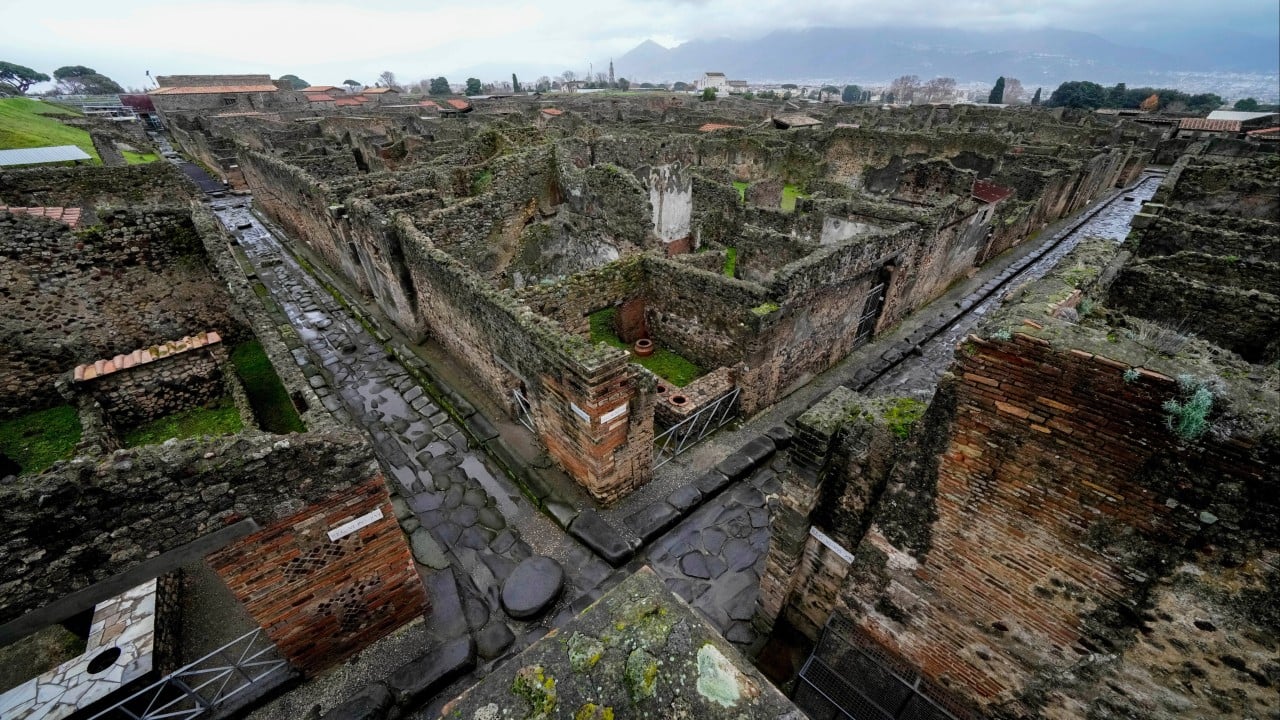
The dust of seventy-nine years after the birth of Christ does not taste like modern dirt. It is acrid. It is heavy with the memory of a mountain that decided to liquidize itself. For centuries, when we looked at the victims of Pompeii, we weren't looking at people. We were looking at plaster. We were looking at the negative space where a human being used to be—a hollow shell created by pouring cement into the cavities left by decayed flesh.
We called them "casts." We treated them like statues. We forgot that they had dental appointments, or the Roman equivalent of them. We forgot they had unrequited loves, favorite sandals, and a specific way their eyes crinkled when they laughed at a bad joke in the forum.
Then came the math.
The Digital Resurrection
Deep in a laboratory, far from the sun-drenched ruins of the Decumanus Maximus, a computer screen flickers with a cloud of points. This is not a photo. It is a topographic map of a tragedy. Using a combination of CT scans and neural networks, archaeologists are no longer guessing what lay beneath the ash. They are reconstructing it.
Consider the man found near the House of the Menander. For nearly two millennia, he was just a slumped figure, a geometric shape of agony frozen in a final, futile crouch. To a tourist, he is a curiosity. To the AI, he is a data set of bone density, cranial structure, and soft-tissue depth markers.
The process is surgical without the scalpel. The AI analyzes the skull structure—the width of the zygomatic arches, the protrusion of the jaw, the depth of the eye sockets. It compares these measurements against thousands of biological markers. It doesn't just "draw" a face. It grows one. It calculates how the skin would have draped over those specific cheekbones. It estimates the muscle mass of a man who spent his days walking the steep, paved streets of a port city.
Suddenly, the plaster cast isn't a statue anymore. It is a person.
The Man in the Machine
Let’s call him Marcus.
Marcus was roughly thirty-five. He had a slight asymmetry to his nose, perhaps from a childhood fall or a tavern brawl that he’d long since stopped bragging about. Thanks to the high-resolution rendering of the AI, we can see the wear on his teeth—the signature of a Mediterranean diet heavy on stone-ground bread that acted like sandpaper on enamel.
When the reconstruction is complete, the screen doesn't show a generic Roman. It shows someone you might pass on a subway in Rome today. He has a weary kind of handsomeness. He looks like he was worried about his taxes.
This is where the technology shifts from a tool of science to a tool of empathy. When we see the "before"—the grey, featureless plaster—we feel a distant, intellectual pity. When we see the "after"—the warm skin tones, the stubble of a man who hadn't shaved in two days because the world was ending, the moisture in the tear ducts—the pity turns into a physical ache.
The stakes of archaeology have changed. We are no longer just digging up pots and coins; we are reclaiming identities from the void. The AI acts as a bridge across a two-thousand-year-old chasm. It takes the "standard" archaeological find and injects it with a soul.
Why the Data Matters More Than the Art
There is a temptation to view this as a high-tech parlor trick. It isn't. The AI used by the Pompeii teams is grounded in forensic accuracy that would hold up in a modern court of law. By utilizing deep learning algorithms trained on diverse human craniofacial data, the researchers can strip away the distortions caused by the weight of the volcanic debris.
Think of it as a reverse-aging process. The pressure of the pyroclastic flow often crushed bone or warped the soft tissue as it carbonized. Human artists, no matter how skilled, bring their own biases to a reconstruction. They want to make the victim look heroic or saintly. The machine has no such ego. It only cares about the probability of a curve. It looks at the attachment points of the masseter muscle and concludes, with cold, hard logic: This man had a heavy jaw.
This precision allows us to solve mysteries that have sat cold for centuries. Was this victim a local or a migrant? The facial structure, combined with isotopic analysis of the teeth, tells a story of movement. We are finding that Pompeii was far more diverse than the history books suggested. We see the faces of North Africa, the Levant, and Northern Europe all huddled together in the same rooms, seeking shelter from a sky that had turned into a furnace.
The Ethics of the Unburied
There is a discomfort that comes with this level of clarity. When you look into the eyes of a reconstructed victim, you are trespassing on their final moment. There is a silent weight to it. We are "un-dying" them without their permission.
But the alternative is worse. To leave them as featureless lumps of plaster is to allow the volcano to win. It is to accept the erasure of their humanity. By using AI to pull these faces out of the ash, we are performing a digital act of restoration. We are saying that their lives mattered enough to be remembered, not as statistics, but as individuals.
The technology is moving fast. We are already seeing the integration of DNA phenotyping—where a single fragment of bone can tell the AI the color of the victim's hair, the shade of their eyes, and even their predisposition to certain skin conditions. We aren't just seeing a face; we are seeing a biological biography.
The Last Glance
Imagine Marcus again.
He is standing in a courtyard. The air is vibrating. The ground isn't just shaking; it is humming with a frequency that feels like it’s trying to shake his teeth loose. He looks toward the mountain. He isn't a historical figure in that moment. He is a man who is terrified.
He turns his head. That specific movement—the way his neck muscles tauten, the way his brow furrows—is what the AI captured. It captured the geometry of his fear.
When the rendering is finished and the historians stand back from the monitors, the room goes quiet. No one talks about "data points" or "neural pathways" anymore. They talk about the man. They notice the way his lip curls slightly on the left side. They notice the deep lines around his eyes, the "crow's feet" of someone who spent a lot of time squinting into the Italian sun.
We used to think of Pompeii as a city of the dead. It was a necropolis, a museum of the macabre. But the more faces we pull from the silence, the more it feels like a city that is simply waiting.
The ash gave them a shape, but the algorithms gave them back their names. Not the names written on birth scrolls, perhaps, but the names we give to people we recognize. The neighbor. The baker. The tired father. The frightened boy.
As the sun sets over the modern ruins, the screens in the lab stay lit. Another face is forming. Another ghost is being pulled back from the edge of the dark. We are realizing, bit by bit, that the past isn't a different world. It’s just this one, covered in a very thick layer of dust, waiting for someone to look closely enough to see the person underneath.
Marcus stares out from the 8K resolution monitor, his gaze fixed on a point somewhere behind the shoulder of the technician. He looks like he has something to say. And for the first time in two thousand years, we are finally in a position to listen.