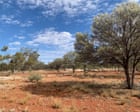
Red dust tastes like iron and old bones when the wind picks up west of the Darling River.
You can feel it grit between your teeth before you even step out of the LandCruiser. Out here, in the vast, sun-bleached expanse of New South Wales and western Queensland, the horizon does not curve; it flattens into an endless copper plate under a sky too big for human scale. Nothing grows fast in the arid Australian outback. Everything here survives by hoarding moisture, curling its leaves against the glare, and waiting years between rains.
Yet, according to the ledger books of corporate Sydney and Melbourne, this parched country is booming with lush, miraculous new woodland.
Billions of dollars have flowed into a government-backed carbon market built on a simple, seductive promise. A polluting company—an airline, a coal miner, a gas giant—pays for credits generated by regrowing native trees on degraded farmland. The trees suck carbon dioxide out of the atmosphere. The company’s emissions are neutralized. The planet breathes easier.
Except when researchers, satellite analysts, and whistleblowers actually looked at the dirt where these trees were supposed to be thriving, they found something else entirely.
Nothing.
Or rather, they found the exact same scraggly mulga scrub and red dirt that had been there twenty years ago.
The Architecture of an Invisible Forest
To understand how an entire country ended up buying and selling trees that do not exist, you have to meet someone like Arthur. Arthur is a hypothetical composite of the dozens of western grazier families who have watched this gold rush sweep across their fence lines over the past decade, though his dilemma is painfully real.
Picture Arthur sitting at his laminate kitchen table in Bourke, staring at a glossy contract left behind by a carbon developer from the city. Wool prices are volatile. Drought is always one failed wet season away. The developer offers Arthur a lifeline: steady, guaranteed income for twenty-five years. All Arthur has to do is reduce his sheep stocking rates slightly or stop clearing scrub he had no intention of clearing anyway, and let the native forest regenerate.
"You get paid to leave the country alone," the pitch goes.
Who wouldn't sign that? I spent years reporting on land management and environmental markets across rural Australia, and I have sat at those exact kitchen tables. You can smell the diesel from the generator outside and feel the heavy silence of a town praying for rain. When someone offers a struggling pastoralist drought-proof cash without forcing them to sell the family property, skepticism feels like a luxury nobody can afford.
The trouble is not Arthur. The trouble is the math used to turn Arthur’s paddock into a climate solution.
Under Australia’s Human-Induced Regeneration (HIR) scheme—the crown jewel of the nation's carbon credit system—projects are awarded Australian Carbon Credit Units, or ACCUs, for allowing native forests to grow back after land-clearing pressures are removed. One credit equals one metric ton of carbon dioxide supposedly pulled from the sky and locked into wood and roots.
Think of a carbon credit like a bank note backed by gold in a vault. For the currency to mean anything, the gold actually has to be sitting behind the steel door. If you print banknotes against an empty room, you haven't created wealth; you have just engineered inflation.
In the outback, the vault was supposed to be verified by satellite imagery and modeling. Instead, researchers led by Andrew Macintosh, a former head of the government’s own Emissions Reduction Assurance Committee, began cross-referencing the carbon credit claims against decades of high-resolution satellite data.
What they uncovered shook the foundations of global climate finance.
Watching Paint Dry on a Desert Wall
In nearly eighty percent of the Human-Induced Regeneration projects analyzed across the outback, forest cover had barely changed at all. In many cases, tree cover had actually declined over the life of the project, shriveled by the same brutal droughts that have governed the interior for millennia.
Wait. Read that again.
Millions of carbon credits—worth hundreds of millions of dollars—were issued for forests that were either stagnant, shrinking, or already mature before the contracts were even signed.
How does a system miss an entire missing forest?
The answer lies in a bureaucratic sleight of hand that confuses modeling with reality. Rather than sending boots onto the red dirt to measure actual tree trunks with tape measures every year, the system relied heavily on predictive computer models. Those models assumed that if a landowner promised to change how they managed livestock or feral goats, a vibrant forest would naturally spring forth.
Anyone who has ever tried to grow a tomato plant in Bourke knows nature does not obey a spreadsheet.
In the semi-arid rangelands, rainfall is episodic, violent, and rare. Seeds can lie dormant in the baked clay for fifteen years waiting for a flood that turns the channel country green for six weeks before the sun burns it back to brown. Furthermore, much of the land enrolled in these schemes had never been cleared in the first place. You cannot regenerate a forest that was never cut down.
Yet the credits kept minting.
Consider what happens next when a fake credit enters the bloodstream of the economy. An energy company burns real coal, pumping real, heat-trapping carbon dioxide into the atmosphere—gas that will linger above our heads for centuries, warming the oceans and fueling megafires. To balance the ledger, the company buys a bundle of outback carbon credits. On paper, the net emissions drop to zero. The company puts a green leaf on its annual report, advertises "carbon-neutral" flights or fuel, and keeps drilling.
In the atmosphere, however, no trade occurred. The coal smoke went up. No tree grew to pull it back down. The net result isn't zero; it is worse than doing nothing at all, because the illusion of progress delays the hard, expensive work of actually cutting fossil fuels.
The Confessions Inside the Machine
I remember the first time I tried to read a full carbon methodology determination from the Clean Energy Regulator. Forty pages into the dense legalese of "stratification," "carbon estimation areas," and "baseline trajectories," my eyes glazed over. The sheer complexity of the jargon acts like a fortress wall. It intimidates the public into assuming that smart people in suits have the science locked down tight.
That complexity is the exact camouflage that allows a broken market to survive.
When Professor Macintosh and his colleagues at the Australian National University first blew the whistle, calling the scheme a "rort" and accusing it of manufacturing "phantom credits," the backlash from the industry was swift and ferocious. Carbon brokers, major pastoral companies, and government officials insisted the science was sound, that critics didn't understand the nuances of rangeland ecology, and that questioning the credits would chill vital private investment in conservation.
They had a point about one thing: the money was real, and some of it was doing genuine good. Some graziers did use carbon revenue to eradicate feral goats, fence off fragile waterholes, and give overgrazed land a desperately needed rest. Nobody wants to see rural communities stripped of funding that helps them steward fragile ecosystems.
But good intentions do not absorb carbon dioxide.
Eventually, the pressure forced an independent review led by former Chief Scientist Ian Chubb. While the review stopped short of scrapping the entire system—concluding the architecture was fundamentally sound—it quietly conceded the core critique. It recommended freezing new Human-Induced Regeneration projects under the old rules and demanding stricter, real-world verification of tree growth.
The rules were quietly retired. The loophole was patched.
Yet tens of millions of those legacy credits remain in circulation, sitting in corporate portfolios and government contracts like unexploded ordnance, still eligible to offset real industrial pollution for years to come.
The Heavy Cost of Cheap Promises
Why does a dispute over scraggly trees in remote Australia matter to someone sitting in an apartment in London, Toronto, or Sydney?
Because Australia was supposed to be the gold standard.
Unlike shaky, unregulated offset schemes in countries with weak governance, the Australian Carbon Credit Unit was backed by a wealthy, stable democracy with strict laws and world-class scientists. If a government-verified carbon market in Australia could produce millions of phantom forests, what does that say about the voluntary carbon markets exploding across the rest of the globe?
We are living through an era addicted to painless solutions. We want to keep flying, keep driving, keep consuming, and pay a few extra dollars at checkout to make the guilt evaporate. Carbon offsets feed that hunger. They promise that we can solve an existential physical crisis through clever accounting.
Out in the western plains of New South Wales, the mulga trees do not care about corporate sustainability targets or quarterly earnings calls. They grow at the speed of dust and rare thunderclouds—a millimeter at a time, stubborn and slow.
If you stand under one at noon, the shade is thin, broken into sharp fragments of light and shadow. You can look straight through the sparse canopy to the blinding blue sky above. It is honest country. It refuses to pretend to be a rainforest just because someone in a boardroom needs it to be.
Until our climate accounting becomes just as honest as the desert, we will keep trading in shadows while the heat rises.


