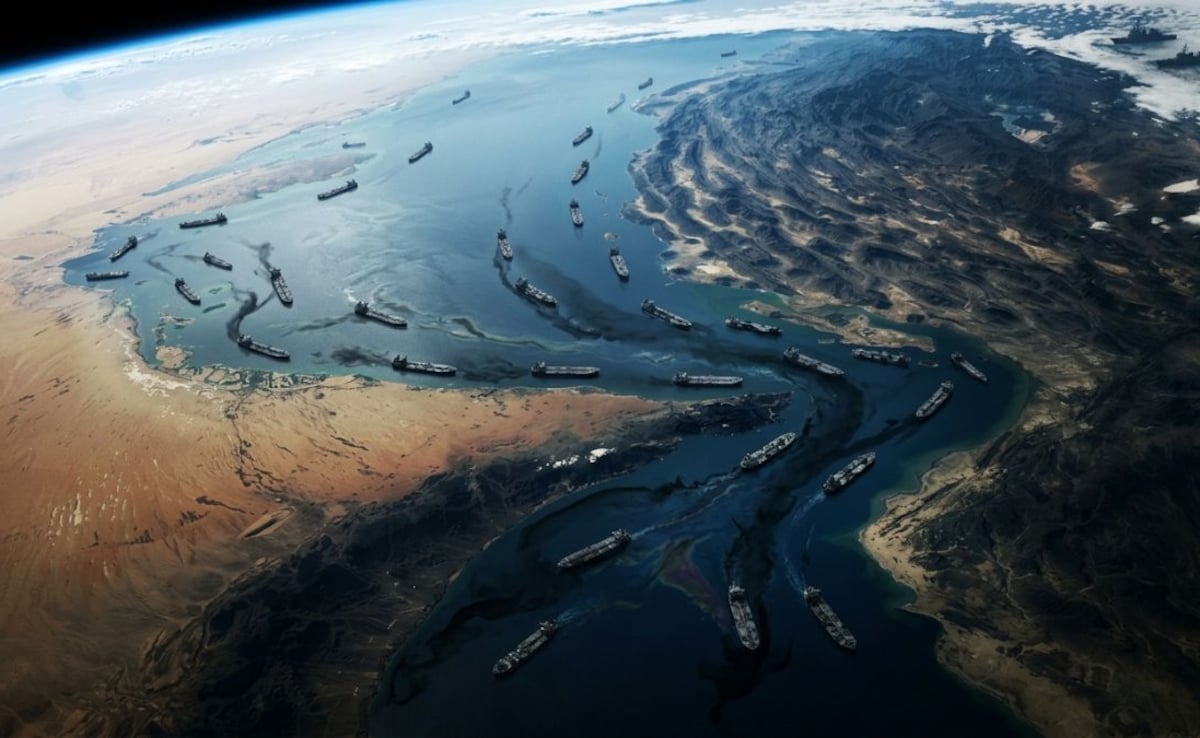
The sun hadn’t yet broken over the jagged cliffs of the Musandam Peninsula when the first signal died. On the digital charts of global maritime tracking systems, a massive crude oil tanker simply ceased to exist. One moment, it was a pulsing green icon plodding through the Strait of Hormuz; the next, it was a hole in the data.
This wasn't a mechanical failure. It was a choice.
Down in the engine rooms and cramped bridges of these vessels, men are playing a high-stakes game of hide-and-seek with the world’s most powerful superpowers. They call it the "Ghost Fleet." These are the aging, rust-streaked giants carrying the lifeblood of the global economy through the narrowest of needles. Recent reports indicate that 34 Iranian tankers have successfully slipped past the U.S. blockade in the Strait of Hormuz, carrying over $900 million worth of oil.
To the bureaucrats in Washington or the oil traders in London, these are just numbers on a spreadsheet. But out on the water, it is a visceral, oily reality.
The Art of Disappearing
Imagine you are a captain on one of these vessels. You are sitting on two million barrels of "black gold." You know that every satellite, every drone, and every naval patrol is looking for your specific electronic signature. Your survival depends on your ability to become a phantom.
The primary tool of this deception is the AIS—the Automatic Identification System. It is the lighthouse of the digital age, a transponder that broadcasts a ship’s position, speed, and identity to ensure ships don't collide in the night. To slip through a blockade, you have to kill the light.
"Going dark" is a terrifying gamble. When you turn off your AIS in the most crowded shipping lane on the planet, you are flying blind in a room full of moving furniture. You are a 300,000-ton behemoth hoping that the other behemoths can see you on their radar, even if the computers say you aren't there.
But the deception goes deeper than a simple flick of a switch. These ships practice "spoofing," sending out false coordinates that place them hundreds of miles away from their actual location. They change their names with a bucket of paint and a new registration under a "flag of convenience." A ship that was the Blue Marigold yesterday might be the Desert Rose today, flying the flag of a landlocked nation that has never seen an ocean.
The Invisible Economy of the Strait
The Strait of Hormuz is a choke point only 21 miles wide at its narrowest. Through this gap flows roughly one-fifth of the world’s total oil consumption. When the U.S. imposes a blockade or sanctions, they aren't just trying to stop a boat; they are trying to suffocate a nation's ability to trade.
The $900 million in oil that recently slipped through represents more than just a breach of policy. It is the sound of a pressure valve hissing. For Iran, this money is the difference between a collapsing currency and a functioning state. It pays for bread, for medicine, and for the very military apparatus that keeps the Strait tense.
Consider a hypothetical shopkeeper in Tehran named Hassan. He doesn't know the name of the tankers. He doesn't understand the intricacies of maritime law or the technical specs of a VLCC (Very Large Crude Carrier). But he understands that when the "Ghost Fleet" successfully reaches its destination—often refineries in China or hidden hubs in Southeast Asia—the price of the cooking oil on his shelf might stabilize for another month.
The stakes aren't abstract. They are caloric.
The High Price of Secrecy
The world pays for this shadow trade in ways that aren't immediately obvious. Because these ships operate outside the law, they often bypass standard safety inspections. They are the "clunkers" of the sea—vessels that should have been sold for scrap years ago but are kept afloat because they are expendable.
If one of these aging tankers, sailing dark and without insurance, were to collide or run aground, the environmental catastrophe would be unparalleled. There would be no company to sue, no insurance policy to trigger the cleanup. The oil would simply wash onto the shores of the Gulf, destroying desalination plants and fishing grounds.
We are essentially watching a fleet of unexploded bombs drift through the world’s most important gas station.
The U.S. Navy and its allies maintain a massive presence in the region, utilizing the most sophisticated surveillance technology ever devised. They see the wakes. They hear the screws of the engines through underwater sonar. Yet, the 34 tankers got through.
How?
The answer lies in the sheer volume of global trade. Trying to find a single rogue tanker in the Strait of Hormuz is like trying to find a specific grain of sand in a hurricane. There are thousands of vessels moving through these waters. The sheer noise of global commerce provides the perfect static for a ghost to hide in.
The Geopolitical Shell Game
The movement of this oil is a masterclass in obfuscation. Often, the oil isn't delivered directly to a port. Instead, it happens via Ship-to-Ship (STS) transfers. Two tankers meet in the middle of the ocean, often at night, and tether themselves together. Hoses thick as tree trunks are connected, and the "tainted" oil is pumped into a "clean" ship.
By the time that oil reaches a refinery, it has been mixed, rebranded, and sold through a dozen shell companies. It is no longer "Iranian oil." It is a "Middle Eastern Blend" or a "Malaysian Product." The paper trail is a labyrinth designed to exhaust even the most dedicated investigator.
This $900 million isn't a fluke; it's a feature of a world that still runs on carbon. As long as there is a buyer willing to look the other way for a discount, there will be a captain willing to turn off his lights and sail into the dark.
The Human Shadow
Behind the headlines of "blockades" and "sanctions" are the sailors. These aren't political masterminds; they are often men from developing nations who take these jobs because the pay is higher for "high-risk" routes. They live in a state of constant anxiety, knowing that at any moment, they could be boarded by commandos or involved in a collision that no one will come to rescue them from.
They live in the silence of the switched-off transponder. They eat, sleep, and smoke on top of a million barrels of contraband, watching the horizon for the gray hull of a destroyer.
The success of these 34 tankers tells us that the world is far less controlled than we like to believe. We think of our era as one of total surveillance, where every square inch of the planet is accounted for by a lens in the sky. But the Ghost Fleet proves that there are still shadows.
There is a profound irony in the fact that the most advanced economy in history can be bypassed by a forty-year-old ship and a man with his hand on a power switch. It reminds us that power is not just about who has the biggest fleet, but who has the most to lose.
As the sun sets over the Strait, another tanker is likely slowing its engine. A hand reaches for the AIS toggle. The screen goes blank. The ship is still there, pushing through the salt and the heat, a billion-dollar ghost carrying the weight of a nation through the black water.
You can’t stop what you refuse to see.