Paper remembers what people try to forget.
If you hold a book long enough, especially one bound in cardboard and stamped with a royal title, you can feel the slight buckle in the spine where a hand once rested. You can sense the nervous hesitation of the pen tip hitting the first page. It is a peculiar kind of intimacy, buying someone else’s discarded memorabilia on the internet. You are purchasing a proxy for proximity. You are paying for a stranger’s fleeting moment of grace.
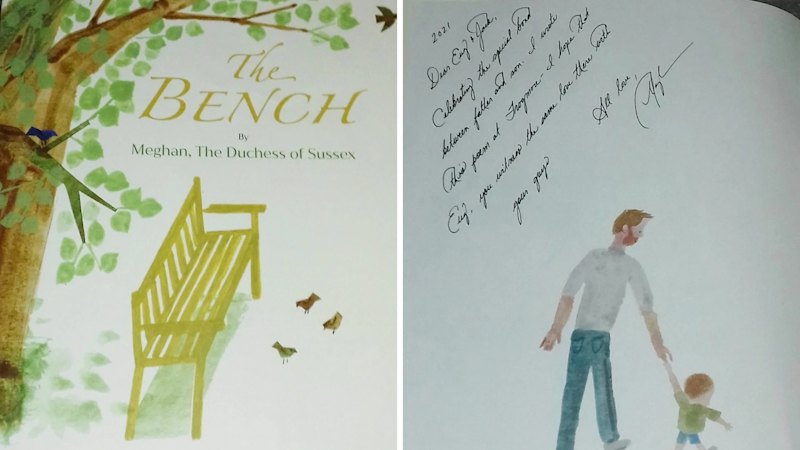
The listing appeared quietly on eBay, flickering across computer screens like a digital ghost. A copy of Meghan Markle’s children’s book, The Bench, offered for sale with a bold claim: signed by Princess Eugenie. The price tag attached to the volume transformed it from a piece of nursery literature into a cultural artifact, a tangible cross-section of royal alliances, family fractures, and the relentless machinery of modern celebrity capitalism.
To understand why a signed children's book commands attention on a digital auction block, you have to look past the ink. You have to look at the architecture of modern attention.
Long before the book reached an online marketplace, it existed as a gesture. When Meghan Markle published The Bench in June 2021, it arrived wrapped in the warm vocabulary of family life. Inspired by a poem written for Prince Harry on Father’s Day, the book aimed to capture the quiet, often overlooked bond between fathers and sons, viewed through the lens of Prince Harry and Archie. It was soft. It was domestic. It was intensely personal, released precisely at a moment when the authors' lives were anything but domestic or quiet.
Enter the cousin. Princess Eugenie has occupied a unique, precarious bridge across the chasm of Windsor family dynamics. While other senior royals maintained a glacial distance following the Sussexes' departure to California, Eugenie visited. She walked with Harry. She laughed under the California sun. When she inscribed a copy of The Bench, whether as a gift to an acquaintance, a charity contributor, or a staff member, it was interpreted by the public as an olive branch written in ballpoint.
Ink is binding. Or so we like to think.
When that same book drifted away from its original recipient and surfaced on eBay, it triggered a strange cognitive dissonance. How does a symbol of quiet family solidarity end up sitting next to used electronics and vintage t-shirts in a digital warehouse?
The answer lies in the unforgiving economics of modern proximity. We live in an era where interpersonal relationships are constantly commodified. Every autograph is a currency. Every gift, once detached from its original context, becomes a speculative asset. When an ordinary person lists a royal book online, they are participating in a very modern ritual: monetizing a brush with history. They are extracting economic value from emotional residue.
Consider the journey of that book. Someone received it. Perhaps they valued it. Perhaps, over time, the weight of keeping a piece of polarizing royal drama on a bookshelf became too heavy, or the temptation of an eBay payout became too bright. The digital listing transformed a private gesture into a public transaction. Bids trickled in. Watchers clicked the little heart icon, tracking its fate from the safety of their phones.
This is how modern myths are traded. Not in grand castles or wood-paneled auction houses like Sotheby's, but in the glowing, frictionless bazaar of the internet, where a royal signature is worth whatever a stranger is willing to charge for rent that month.
The irony is sharp. The Bench is a book about sitting still, about observing the small, unchanging moments of life—a father holding a child, a garden growing, the sun hitting a wooden seat. Yet the book itself has been dragged into the hurricane of relentless movement that defines the lives of its creators. It cannot stay still. It must travel, circulate, be bought, sold, analyzed, and stripped for parts in the cultural conversation.
We project so much onto these fragments. We look at a signature scrawled on a flyleaf and try to read tea leaves in the loops of the letters. Does the slant of the 'E' indicate affection? Does the absence of a personalized inscription mean the book was meant to be passed along all along? We are desperate for decoded messages because the actual human beings behind the headlines remain stubbornly out of reach.
When the auction closes and the package ships, wrapped in bubble wrap and cardboard, the buyer will unwrap it in a quiet room somewhere. They will flip open the cover. They will trace the ink with a fingertip, searching for the pulse of a world they only know through screens.
And for a brief second, holding the pages, they might almost forget that behind every royal keepsake, behind every viral listing and digital bidding war, there is just paper, ink, and the quiet, ordinary human desire to hold onto something that cannot slip away.