The air inside the Sukhoi manufacturing plant in Komsomolsk-on-Amur does not smell like the future. It smells of industrial grease, ozone, and the distinct, sharp tang of cold metal. For decades, this facility in Russia’s Far East has been the crucible where Soviet and Russian aviation pride took physical form. But pride is a difficult thing to rivet together when the supply chains are bleeding.
Somewhere on the floor, a technician—let's call him Mikhail—stares at a titanium bulkhead. Mikhail represents a generation of aerospace engineers caught between a grand geopolitical vision and the stubborn reality of a missing microchip. He knows the blueprints by heart. He knows what the aircraft is supposed to be.
But what an aircraft is on paper rarely survives the friction of reality.
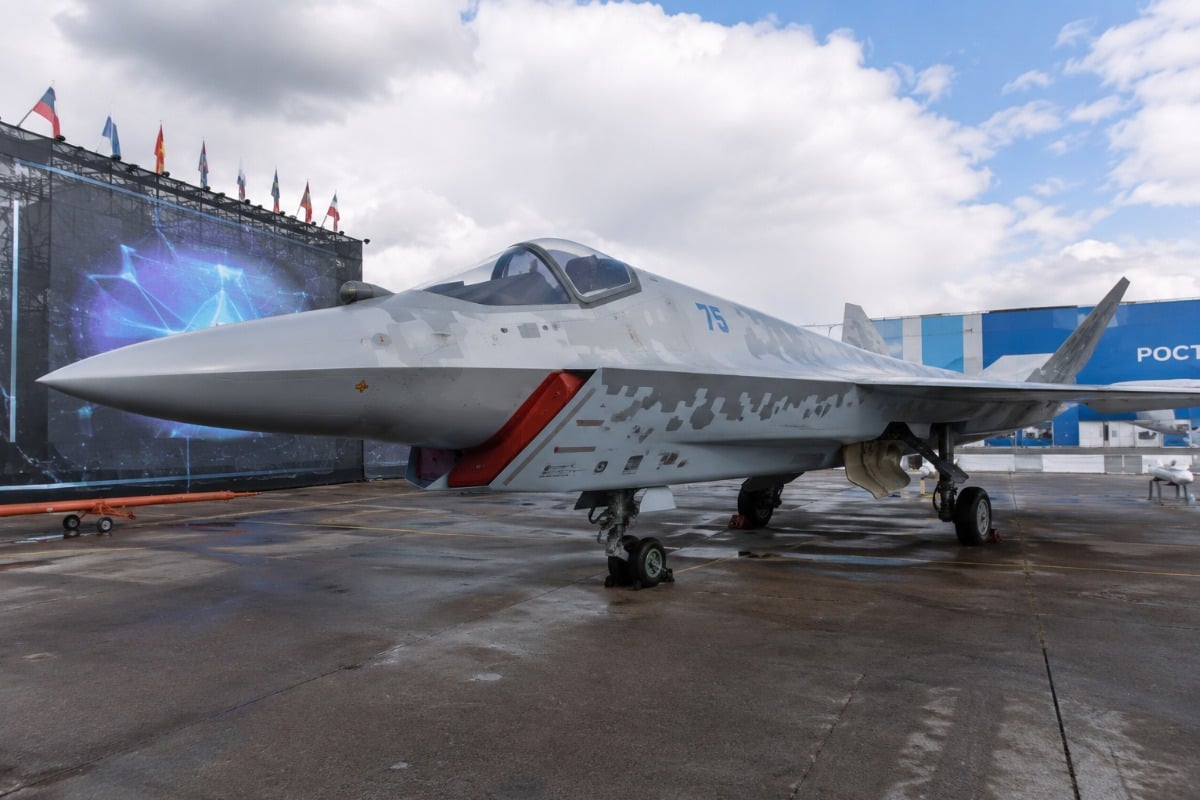
The Kremlin wants the world to believe that a new phantom is about to haunt the skies. They call it the Su-75 "Checkmate." It is marketed as a budget-friendly, single-engine stealth fighter designed to disrupt the global arms market. Moscow claims construction on the first prototypes has finally begun.
The announcement was delivered with the usual flourish of state-backed confidence. Yet, beneath the press releases lies a deeper, more human story of desperate engineering, economic isolation, and the impossible physics of building a modern war machine while cut off from the rest of the world.
The Shadow of the Su-57
To understand why the Checkmate matters, you have to look at its older, heavier sibling.
Russia’s journey into the fifth generation of fighter jets was supposed to be defined by the Su-57 Felon. It was designed to match the American F-22 Raptor and F-35 Lightning II. It was supposed to be the apex predator of the skies.
It wasn't.
Production slowed to a crawl. Engine development lagged for a decade. When the aircraft finally flew in operational environments, it did so in tiny numbers, carefully kept away from airspace where it might actually be shot down. The world watched a superpower struggle to mass-produce a single advanced airframe.
Then came the sanctions.
When global trade avenues snapped shut, the aviation sector felt the tremor instantly. A modern stealth jet is not just made of Russian aluminum and titanium. It relies on a delicate, highly complex nervous system of advanced semiconductors, thermal imaging sensors, and composite matrix materials. Many of these components historically flowed from Western European and Asian markets.
When those taps turned off, engineers like Mikhail were left holding blueprints for machines they could no longer build.
The Su-75 Checkmate was conceived as an escape hatch from this strategic corner. Unveiled at the MAKS airshow, it was a marketing department’s dream. It looked exotic, boasted a chin-mounted intake reminiscent of experimental American designs, and carried a price tag that seemed laughably low—somewhere around $30 million per unit. For context, an American F-35 costs closer to $80 million.
The pitch was simple: stealth capabilities for countries that couldn't afford Western hardware or weren't allowed to buy it.
The Physics of a Budget Ghost
How do you build a stealth aircraft on a budget when your economy is under siege?
You compromise.
Stealth is not a coating you paint onto a fuselage. It is a grueling, unforgiving discipline of geometry and material science. Every seam, every bolt, and every curve must be designed to scatter radar waves away from the emitting source. If a single panel misaligns by a millimeter, the aircraft lights up on an enemy radar screen like a flare in a dark room.
Consider the engine. The Checkmate is designed as a single-engine fighter. This reduces weight, lowers fuel consumption, and cuts manufacturing costs in half compared to twin-engine heavy fighters. Russia has a legendary history of building rugged, powerful jet engines. The Saturn AL-41F1 is a beast of a powerplant, capable of incredible thrust.
But a stealth engine requires more than brute force.
It requires specialized nozzles to mask the searing heat of the exhaust from infrared sensors. It requires internal radar-blockers inside the air intake to hide the spinning compressor blades, which reflect radar waves like a disco ball. Designing these components requires advanced computational fluid dynamics and access to precision manufacturing tools that Russia is currently struggling to import.
The blueprint demands perfection. The factory floor offers improvisation.
This tension is where the human drama unfolds. Engineers are forced to substitute military-grade Western components with domestic alternatives or components smuggled through third-party nations via grey-market networks. When a specific machine tool from Germany or Japan breaks down, it cannot easily be replaced. The technicians must fix it themselves, fabricating parts on the fly, or watch the assembly line grind to a halt.
The Empty Order Book
An aircraft cannot survive on domestic ambition alone. Aerospace projects are black holes for capital; they require immense upfront investment that can only be recouped through economies of scale. You build hundreds of jets so that the cost of developing them gets distributed evenly.
The Checkmate was explicitly designed for export. Moscow looked at the global map and saw opportunities in the Middle East, Asia, and Latin America. They courted India. They eyed the United Arab Emirates. They wanted a partner with deep pockets to fund the transition from a wooden mockup to a flying prototype.
The buyers looked, whispered, and walked away.
India, having already burned billions on a joint fifth-generation fighter program with Russia before pulling the plug due to delays and technological disagreements, showed little appetite for another venture. The UAE pivoted toward other procurement strategies. Potential buyers realized that buying a Russian fighter jet in the current geopolitical climate means inheriting a logistical nightmare.
If you buy a fleet of Checkmates, you are tying your national security to a supply chain that is currently being suffocated. If a radar module fails three years from now, will Moscow be able to ship a replacement, or will that component be diverted to sustain Russia's own front-line losses?
Without an anchor customer to inject billions into the program, the financial burden falls entirely back on the Russian state budget. It is a budget already strained by prolonged conflict, shifting priorities, and the systemic drag of economic isolation.
Yet, the state claims production has begun.
The Mirage of Progress
In the world of state-run military industries, "production" is a slippery word.
It can mean that the automated assembly lines are humming, turning out a fuselage every week. Or it can mean that a small team of workers in a quiet hangar is painstakingly hand-crafting a single shell made of aluminum and fiberglass, destined to be rolled out at the next domestic trade show to prove that the project is not dead.
The current timeline suggests a first flight within the next few years, followed by serial production toward the end of the decade. To anyone who has monitored aerospace development cycles, these numbers feel like fiction. The United States, with an unconstrained budget and a massive industrial base, took over a decade to bring the F-35 from its first prototype flight to true combat readiness.
The idea that Russia can develop, test, and mass-produce an entirely new stealth platform in a fraction of that time, while under the most severe sanctions regime in modern history, defies engineering logic.
But the project serves a purpose that has nothing to do with aerodynamics.
It is a narrative. It is a message directed inward to the Russian public and outward to global adversaries: We are still a superpower. We can still innovate. We are not broken.
The Reality on the Tarmac
Step away from the political rhetoric and return to the hangar floor.
Mikhail works beneath the fluorescent lights. He knows the difference between propaganda and metallurgy. He understands that a jet fighter is a collection of a million individual choices, each one requiring precision, time, and resources.
He can see the gaps where the advanced avionics are supposed to go. He can feel the weight of the delays. He knows that even if this specific airframe takes to the sky, it will be a solitary ghost—a technological achievement, perhaps, but not an operational fleet capable of shifting the balance of power.
The Checkmate is an apt name, though perhaps not for the reason its creators intended. In chess, checkmate is the end of the line. It is the moment where every move you make is dictated by an opponent's pressure, where your options narrow until there is nowhere left to run.
The jet on the floor is a monument to that pressure. It is a beautiful, lethal design trapped in a historical moment that lacks the industrial oxygen to let it breathe. As the technicians tighten the bolts on the prototype, they are not just building a fighter jet. They are trying to manufacture an illusion of normalcy in a world that has fundamentally changed.
The metal is cold. The hangar is quiet. The ghost remains on the ground.