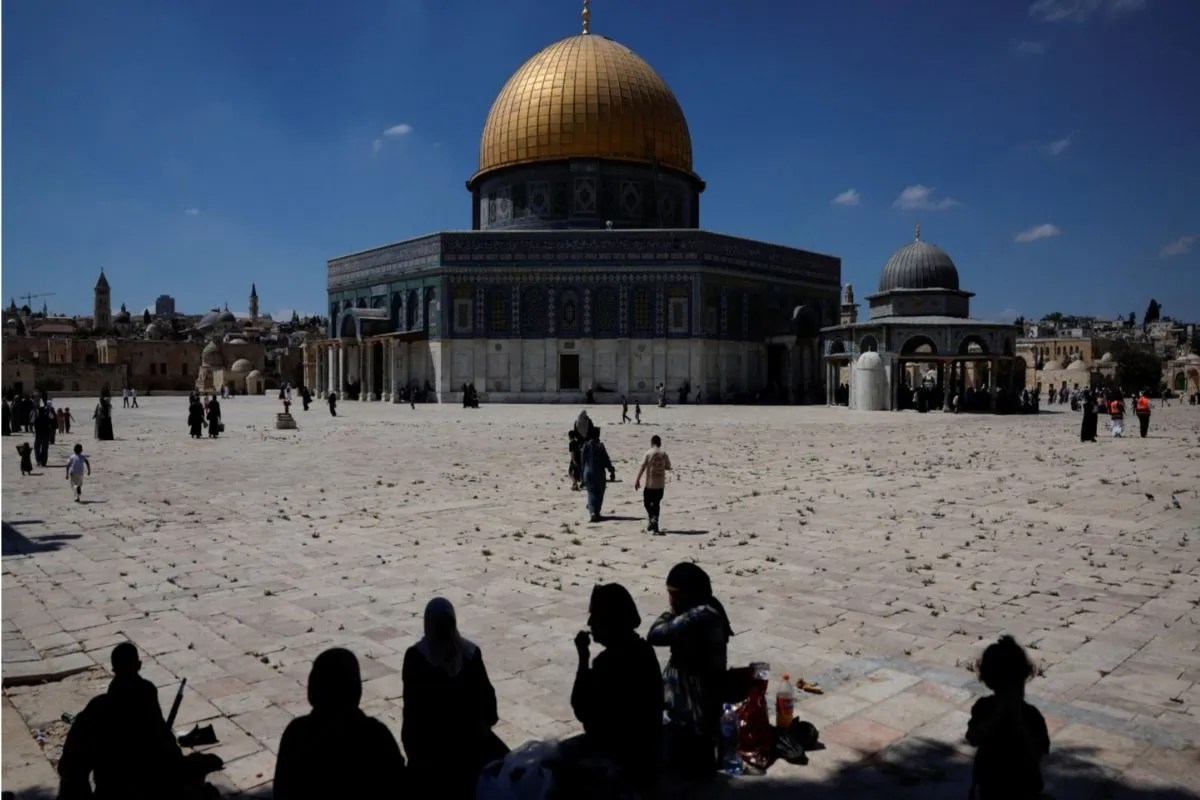
Geopolitical stability within the Old City of Jerusalem is governed by a precarious administrative equilibrium known as the Status Quo. When state-backed actors or religious nationalists alter access protocols at the Al-Aqsa Mosque complex—historically administered by the Jerusalem Islamic Waqf under Jordanian custodianship—the resulting friction creates immediate systemic repercussions across regional diplomatic networks. Analyzing these flashpoints requires moving past superficial event reporting to examine the structural mechanics of sovereignty, legal frameworks, and escalation dynamics.
The Institutional Architecture of the Status Quo
The governance framework regulating the 35-acre compound, designated as Al-Haram al-Sharif by Muslims and the Temple Mount by Jews, rests on an operational separation of administrative authority and security control. Established following the 1967 Arab-Israeli War, the arrangement designates the Jordanian Waqf as the sole authority for managing religious affairs within the site. Non-Muslim visitors are permitted access during designated hours under specific bureaucratic pathways, while formal religious worship remains legally restricted exclusively to Muslims. Meanwhile, you can find other stories here: What Really Happened When Imran Khan's Sisters Were Detained Before the Islamabad March.
This baseline is subjected to continuous pressure by shifting political incentives inside Israeli domestic governance. Right-wing factions frequently utilize site access as a mechanism for signaling ideological commitment to their base, gradually eroding the enforcement of non-worship protocols. When security forces facilitate entries that include restricted ritual behaviors, the operational reality diverges from the formal legal agreement, triggering immediate friction with regional stakeholders, notably Jordan and the Palestinian Authority.
The Escalation Mechanics and Regional Spillover
Every alteration in access volume or protocol at the compound triggers a multi-tiered reaction function across the Middle East. The sequence of institutional response follows a predictable vector: To explore the full picture, check out the recent report by NPR.
- Local Friction and Documentation: Waqf officials and local monitors log infractions, such as unauthorized prayers or ritual movements, documenting shifts in enforcement tolerance by accompanying police units.
- Diplomatic Condemnation: Regional governments, particularly Jordan—whose Hashemite monarchy derives constitutional legitimacy in part from its historic custodianship—issue formal diplomatic protests.
- International Multilateralization: Incidents are routinely elevated to international bodies, including emergency sessions or briefings within the United Nations Security Council, where member states utilize the platform to contest the legal status of East Jerusalem.
- Security Posture Realignment: Militant factions and political entities leverage visual documentation of access breaches to mobilize broader protests or escalate tactical postures along adjacent fronts, transforming a localized administrative violation into a generalized security crisis.
This transmission mechanism proves that physical actions within a confined urban footprint possess immediate macroeconomic and geopolitical contagion effects.
The Cost Function of Jurisdictional Ambiguity
The fundamental vulnerability of the Jerusalem holy sites lies in the absence of a mutually agreed-upon final-status resolution. Legal interpretations of sovereignty remain irreconcilable. Israeli legislative frameworks treat the entirety of Jerusalem as its unified capital under domestic law, while international law and bilateral agreements define East Jerusalem as occupied territory, subject to the Fourth Geneva Convention.
This legal bifurcation creates a permanent incentive structure for unilateral actions. Proponents of gradual sovereignty expansion calculate that incremental, repeated breaches of the Status Quo normalize changes over time, effectively establishing facts on the ground that outpace diplomatic pushback. Conversely, defending entities view every operational shift as an existential threat to the demographic and religious identity of the city, necessitating aggressive political and diplomatic countermeasures to prevent a permanent baseline reset.
Strategic Forecast and Systemic Vulnerability
The recurrence of high-visibility incursions and subsequent diplomatic crises highlights the fragility of current security arrangements. Without a binding, enforceable enforcement mechanism independent of domestic Israeli political cycles or regional patronage networks, the compound remains a high-frequency volatility engine. Future stability depends entirely on whether administrative authorities can restore strict adherence to the historical Status Quo or if incremental erosion continues to widen the delta between legal frameworks and operational reality on the ground.