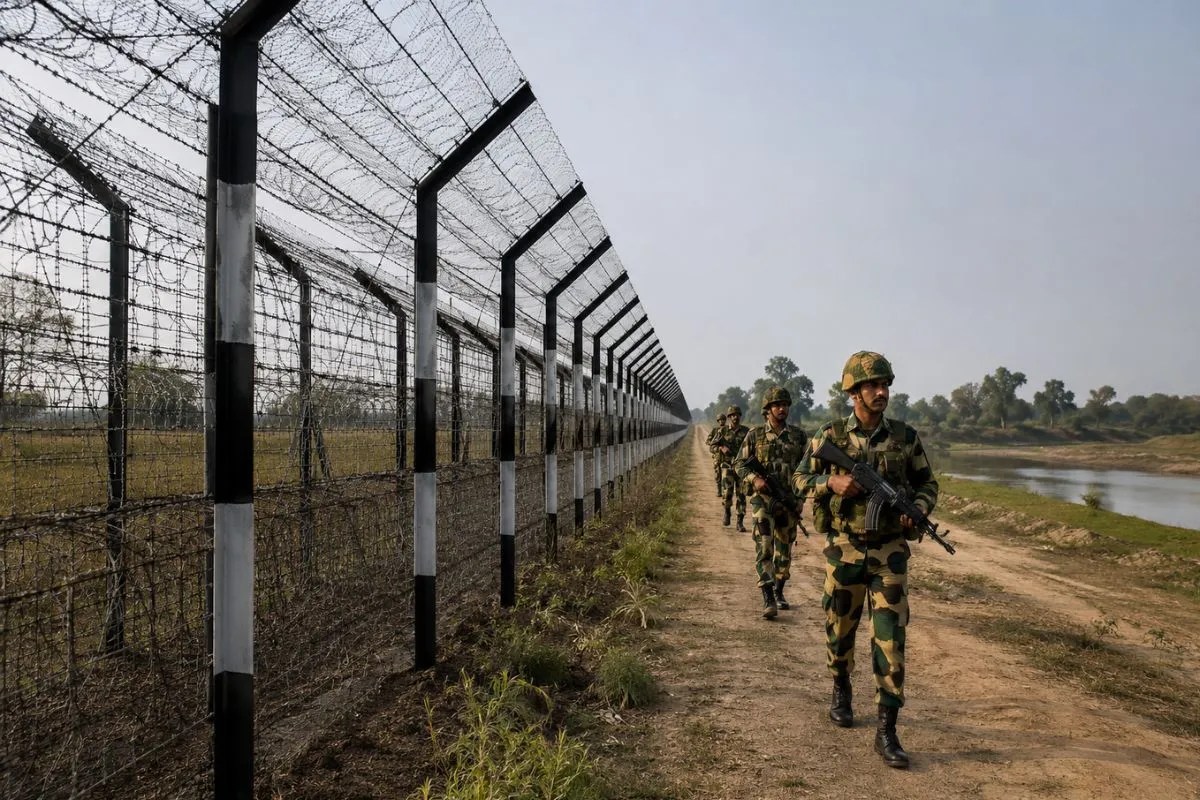
The completion of the Indo-Bangladesh border fence represents a shift from a porous, socio-economic boundary to a hard-state security barrier. While political rhetoric often frames this through the lens of national pride or fear, the actual efficacy of the project rests on a triad of structural variables: physical permeability, surveillance-to-response latency, and the bilateral economic incentives for illegal transit. The decision by West Bengal’s administrative leadership to facilitate land acquisition for the remaining stretches of the fence—specifically within the North 24 Parganas and Malda sectors—fundamentally alters the strategic calculus for the Tarique Rahman-led administration in Dhaka. This is not merely a "wall" but an integrated system designed to disrupt the informal trade networks and population movements that have defined the region for half a century.
The Logic of Physical Denial Systems
Border fencing operates on the principle of "delay and detect." No fence is impenetrable; its primary function is to increase the "time-to-breach" beyond the "time-to-respond" of border patrols. In the context of the 4,096-kilometer border, of which approximately 3,145 kilometers are already fenced, the final gaps represent the most difficult terrain—riverine stretches, marshes, and densely populated villages where the international boundary bisects houses.
The strategic significance of the latest land clearances lies in closing the "sieve effect." When 90% of a border is fenced, the remaining 10% does not just carry 10% of the traffic; it becomes a high-pressure funnel for all illegal movement. By closing these specific gaps, the Indian Border Security Force (BSF) transitions from a wide-area patrol model to a point-defense model.
The Technological Stack of Modern Fencing
A modern border barrier is a multi-layered sensor array. The "Smart Fence" technology being deployed consists of:
- Thermal Imaging and IR Arrays: These provide visibility in the Brahmaputra mists and nighttime conditions where human eyesight fails.
- Seismic Sensors: These detect underground vibrations, effectively neutralizing the threat of tunneling in the soft alluvial soil of the Bengal Delta.
- Fiber Optic Interception: Sensors attached to the fence itself detect the specific vibration of a wire cutter or a scaling ladder, triggering localized alarms.
This technological integration reduces the reliance on "boots on the ground" per kilometer. However, the system faces a hard limit in the riverine "Char" areas. In these zones, the fence is replaced by a "Brave-Line" of laser sensors and water-borne patrols. The Dhaka administration’s public indifference to these developments ignores the operational reality: a fenced border drastically increases the cost of illegal migration and cattle smuggling, which currently serves as a shadow economy for many Bangladeshi border districts.
The Economic Disruption of Shadow Markets
The rhetoric from the Tarique Rahman government suggesting they are "not afraid" of the fence overlooks the micro-economic impact on the Bangladeshi side. The informal trade across the border, estimated by various think tanks to be worth billions of dollars annually, relies on low-friction crossings.
The Cost Function of Smuggling
The introduction of a hard fence changes the profit-and-loss statement for smuggling syndicates.
- Risk Premium: As the probability of detection increases, the "fee" charged by traffickers rises.
- Logistics Latency: Smugglers must spend more time scouting for gaps or bribing low-level officials, reducing the volume of goods (primarily cattle and narcotics) that can be moved per unit of time.
- Capital Expenditure: Overcoming a smart fence requires sophisticated equipment, shifting the activity from local opportunistic individuals to organized criminal enterprises with higher overheads.
This economic pressure creates a feedback loop. When the cost of illegal transit exceeds the price differential of the goods being smuggled, the trade collapses. For a government in Dhaka dealing with precarious foreign exchange reserves and inflation, the sudden cessation of this shadow trade can lead to localized economic shocks in border provinces.
Diplomatic Friction and the Sovereignty Paradox
The Indo-Bangladesh border is governed by the 1974 Land Boundary Agreement (LBA) and the 1975 Border Management Guidelines. These guidelines stipulate that no permanent structures can be built within 150 yards of the Zero Line. This buffer zone has historically been a source of tension.
The shift in the West Bengal government’s stance to allow fencing right up to the 150-yard limit—or in some cases, negotiating with Dhaka for "zero-line fencing"—removes a major diplomatic shield that Bangladesh has used to stall construction. The "sovereignty paradox" here is that while Dhaka claims the fence is an insult to bilateral relations, the lack of a defined, secure border often leads to more lethal encounters between the BSF and Bangladeshi nationals, which causes greater diplomatic damage.
Strategic Response Latency
The Tarique Rahman administration's dismissal of the fence’s impact is likely a domestic political necessity. Acknowledging the effectiveness of the fence would be an admission of a loss of leverage. From a strategic perspective, Bangladesh's options are limited:
- Passive Resistance: Continuing to delay land acquisition through local protests or bureaucratic hurdles.
- Economic Diversification: Formalizing trade to offset the loss of the shadow economy.
- Security Tit-for-Tat: Increasing their own border guard (BGB) presence, which strains an already tight military budget.
The Geopolitical Realignment
The acceleration of the fence under the current political climate suggests a hardening of India’s "neighborhood first" policy into a "security first" policy. The movement of people across this border is no longer viewed merely as a demographic issue but as a potential vector for security threats.
The completion of this project will likely result in the following outcomes:
- Data-Driven Enforcement: The BSF will move toward a "virtual command center" model, where data from drones and fence sensors are synthesized via AI to predict breach attempts before they occur.
- Shift in Migration Patterns: Hardening the land border will likely push illegal movement toward the maritime boundary in the Bay of Bengal, which is significantly harder to monitor but much more dangerous for the migrants.
- Bilateral Recalibration: Dhaka will eventually be forced to negotiate more robust formal trade agreements as the informal "safety valve" of the porous border is welded shut.
The strategic recommendation for regional stakeholders is to treat the fence as a fait accompli. The technical and political momentum behind the project has reached a point of no return. For the Bangladeshi government, the optimal play is not to dismiss the barrier, but to aggressively formalize border haats (markets) and legal transit points to capture the economic activity that is currently being forced out of the shadows. Failure to adapt to the new "hard border" reality will result in economic stagnation in border districts and an increase in high-risk, high-lethality border incidents. The fence is not just a wire structure; it is a permanent redefinition of the Indo-Pacific’s most complex land boundary.
The final phase of this securitization involves the deployment of the Comprehensive Integrated Border Management System (CIBMS). This system integrates human resources, technical platforms, and structural barriers into a single operational loop. When the North 24 Parganas gaps are closed, the BSF achieves a continuous "operational picture" for the first time in the history of the 1971 partition. This ends the era of the "negotiated border" and begins the era of the "monitored border." Any strategy from Dhaka that does not account for this total visibility is grounded in an obsolete geopolitical framework. Movements must now be planned through legal channels, or they will be neutralized by a system that prioritizes signal detection over political sentiment.