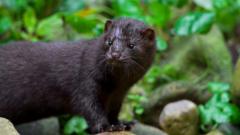
The recent announcement that American mink numbers in Kent are to be slashed by 90% is a masterclass in ecological theater. It sounds decisive. It sounds bureaucratic. It makes for a fantastic headline that reassures the public that local biodiversity is being fiercely protected.
It is also an expensive exercise in futility.
For decades, conservation groups and local authorities have treated invasive species management like a numbers game. They look at a map, count a population, declare an arbitrary reduction target, and deploy the traps. But anyone who has spent years managing river catchments or studying population dynamics knows that biology does not bow to political targets. Targeting a 90% reduction in a highly adaptive, hyper-fecund predator without a permanent, regional eradication strategy is a recurring expenditure disguised as a solution.
We are about to spend an immense amount of capital to temporarily clear out a biological vacuum, only to watch nature fill it right back up.
The Rebound Effect: How Population Dynamics Outsmart Traps
The lazy consensus in wildlife management is linear: if you remove nine out of ten mink, you have solved 90% of the problem. This logic completely ignores the foundational mechanics of density-dependent fecundity.
When a habitat is saturated with American mink, competition for territory and food resources is fierce. Juvenile mortality is high. Litters are constrained by the available caloric intake of the adult female. When you aggressively cull 90% of that population, you do not break the species; you optimize the environment for the remaining 10%.
- Resource Abundance: The surviving mink suddenly inherit an oasis of unchecked food sources (water voles, ground-nesting birds, and fish).
- Surge in Litter Sizes: Starvation pressures vanish. Average litter sizes, which typically hover around four to six kits, can spike dramatically when females are hyper-nourished.
- Sinking Mortality Rates: Juvenile survival rates skyrocket because the territorial infighting that keeps populations stable is eliminated.
By clearing out Kent’s waterways without a simultaneous, bulletproof barrier across neighboring counties, you are essentially creating a low-density luxury resort for the surrounding mink population.
The Myth of the Localized Border
Mink do not read county maps. Kent is not an island.
The idea that you can manage a highly mobile riparian mammal within strict administrative borders is a flawed premise that I have seen fail in environmental initiatives across Europe. American mink are phenomenal dispersers. Sub-adult males routinely travel up to 30 to 50 kilometers along river networks to establish new territories.
If Kent reduces its population by 90% while East Sussex, Surrey, and London maintain baseline populations, a biological vacuum is created. The laws of ecology dictate that moving water, abundant prey, and empty territory will pull individuals from high-density peripheral zones straight into the newly cleared streams of Kent.
Within two breeding seasons, the numbers reset. The public money spent on trapping networks, tracking hardware, and coordinator salaries evaporates, leaving nothing behind but a spreadsheet showing temporary compliance with an arbitrary metric.
Dismantling the Top Water Vole Preservation Questions
Can we save the water vole through targeted mink culling?
Not using the current framework. Protecting vulnerable native species like the water vole (Arvicola amphibius) requires total, permanent absence of mink, not a reduced presence. A single remaining pregnant female mink can decimate a localized water vole colony in a matter of weeks. If your strategy leaves 10% of the predator population active, you have not saved the voles; you have just delayed their localized extinction.
Why not scale up trapping indefinitely?
Because infinite trapping requires infinite capital, and conservation budgets are notoriously fragile. Relying on an endless cycle of trapping without a definitive end-state creates a permanent financial drain. The moment funding is redirected or a policy shift occurs, the entire defensive line collapses and the mink reclaim the territory instantly.
What Actually Works: The Uncomfortable Alternative
If we are serious about biodiversity in Kent, we have to abandon the comfort of partial cull targets. The only metric that matters in invasive predator management is zero.
Achieving actual eradication requires a brutal, uncompromising operational shift that most local authorities lack the stomach or the funding to execute.
Macro-Regional Coexistence or Total Eradication: We either fund a massive, multi-county, simultaneous eradication effort that seals off the entire South East peninsula, or we accept that the mink is now a permanent component of our novel ecosystem.
Structural Habitat Resilience: Instead of obsessing over mink body counts, investment should shift toward rendering the landscape hostile to them while favoring native species. This means massive investments in complex wetland topographies, deep reed beds, and underwater refuges where water voles can evade detection.
Genetic Biocontrol: We need to look toward the horizon of conservation technology. Gene-drive technology and synthetic biology offer options to introduce sterile traits into wild populations, suppressing numbers permanently without laying a single trap.
The current strategy in Kent is a comforting lie. It satisfies the need to "do something" while ensuring that the exact same press release will have to be written again in five years. Stop counting the mink you kill, and start looking at the systemic flaws that ensure they keep coming back.