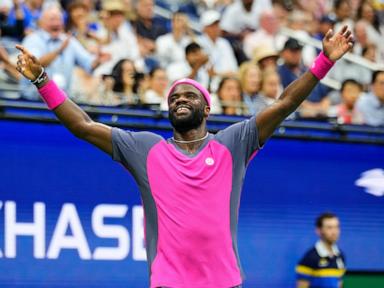
Frances Tiafoe is channeling his own tournament prize money, endorsement capital, and personal time into funding and mentoring junior tennis players while still actively competing at the top of the ATP Tour. Unlike retired legends who launch foundations after cashing out their career earnings, Tiafoe is underwriting travel stipends, coaching access, and equipment through his Frances Tiafoe Fund right in the middle of his competitive prime. He is doing this because the financial architecture of junior tennis systematically prices out working-class athletes before they ever reach a professional qualifying draw.
Most sports philanthropy happens in the rearview mirror. Athletes wait until their bodies give out, their endorsement deals dry up, and their tax accountants suggest a charitable vehicle to offset decades of accumulated wealth. Tiafoe rejected that timeline. Having grown up sleeping on a spare massage table at the Junior Tennis Champions Center in College Park, Maryland, where his immigrant father worked as the head of maintenance, Tiafoe understands that talent is evenly distributed across zip codes while opportunity is strictly gated by net worth. You might also find this connected story useful: Why Major League Baseball Is Cruising Straight Toward a 2027 Lockout.
The Brutal Math of Junior Tennis
To understand why an active top-tier pro feels compelled to subsidize teenagers, you have to look at the balance sheet of modern junior development. Tennis is not a public-school sport where a pair of sneakers and a municipal gym can carry a prodigy to a college scholarship. It is a privatized, year-round arms race.
A competitive junior player in the United States faces staggering baseline expenses long before earning a single dollar on the ITF or Challenger circuits. Private coaching, court time, stringing, physical therapy, and tournament entry fees easily clear five figures annually. Then comes the real killer. Travel. As reported in latest coverage by Sky Sports, the results are significant.
To earn the ranking points necessary to enter Grand Slam junior events or attract collegiate recruiters, a fourteen-year-old has to fly across the country—and eventually across oceans—accompanied by a parent or a paid traveling coach. Flights, hotels, and rental cars push the annual cost of developing a single elite junior player well past $50,000 to $100,000 a year. For a family earning the median American household income, those numbers are not merely daunting. They are mathematically impossible.
National governing bodies like the USTA do offer grants and training centers, yet institutional money rarely moves fast enough or covers enough of the hidden friction costs to keep a cash-strapped family afloat. When a promising kid from an under-resourced neighborhood hits a growth spurt and suddenly needs four new racquets, custom orthotics, and a last-minute plane ticket to an ITF Grade 1 event in South America, institutional bureaucracy stalls. Tiafoe’s approach bypasses the red tape.
The Structural Gamble of Mid-Career Philanthropy
Running a philanthropic initiative while grinding through an eleven-month ATP calendar carries real professional risk. Tennis is uniquely unforgiving. Unlike team sport athletes on guaranteed multi-year contracts, a tennis player is an independent contractor whose income evaporates the moment an ankle twists or a forehand loses its timing. Every dollar Tiafoe directs toward junior development—and every afternoon he spends at clinics instead of inside a hyperbaric chamber—is a direct reallocation of resources away from his own Grand Slam ambitions.
Critics inside the sport occasionally whisper that active players should maintain monastic focus until age thirty-five. They argue that the margins between world number fifteen and world number five are razor-thin, decided by a handful of points in third-set tiebreaks, and that off-court obligations dilute competitive ruthlessness.
That argument misunderstands how psychological fuel works for athletes who grew up without a safety net. For Tiafoe, the court is not an isolated vacuum. His identity as a player is inextricably tied to the community that kept him in the game when his family could barely afford restringing fees. Watching a kid from Prince George's County step onto a pristine hard court with proper gear does not drain Tiafoe's focus. It validates why he endures the brutal travel schedule in the first place.
How the Funding Model Actually Works
In 2023, Tiafoe formally launched the Frances Tiafoe Fund in partnership with the USTA Foundation, the philanthropic arm of the United States Tennis Association. Structuring the fund inside an existing 501(c)(3) infrastructure was a shrewd operational move.
Many athlete-led charities fail within five years because the founder underestimates administrative overhead. Hiring executive directors, managing compliance, vetting grant applicants, and auditing expenses can eat up forty cents of every donated dollar if an athlete builds an organization from scratch. By plugging directly into the USTA Foundation’s National Junior Tennis and Learning (NJTL) network, Tiafoe ensured that his capital hits the ground immediately across more than 250 community chapters nationwide.
The money targets three specific choke points in the pipeline:
- Direct Player Grants: Covering tournament travel, coaching fees, and equipment costs for high-potential juniors who lack family wealth.
- Community Chapter Infrastructure: Funding court resurfacing, lighting, and free after-school programming in underserved urban and rural districts.
- Exposure and Access: Bringing junior players inside the ropes at major ATP events, demystifying the professional tour so it stops feeling like an exclusive country club.
The Myth of the Meritocracy in Racket Sports
Tennis loves to market itself as the ultimate individual meritocracy. There are no coaches calling plays from the sidelines, no teammates to bail you out, and no referees making subjective calls on balls and strikes in the era of electronic line calling. You win or you lose entirely on your own racquet.
That narrative falls apart the second you step outside the stadium gates. Before two players ever walk onto a court for a first-round match, one of them may have had a full-time nutritionist, a biomechanical analyst, and three European clay-court training blocks, while the other practiced on cracked asphalt with dead balls and drove twelve hours overnight in a minivan to save on airfare. The scoreboard measures the match, not the unequal starting lines.
Consider a hypothetical example to see how this plays out in real time. Imagine two sixteen-year-old players with identical serve speeds, identical footwork, and identical competitive drive. Player A comes from an upper-middle-class suburb; Player B comes from an inner-city public program. Both reach the quarterfinals of a national junior championship. Player A loses, flies home, debriefs with a private mental skills coach, and enters three more international tournaments that month to sharpen their game. Player B also loses, but because the travel budget is exhausted, Player B sits out the next eight weeks of competition. By autumn, Player A has climbed fifty spots in the junior rankings and secured blue-chip sponsorship offers, while Player B has fallen off the radar entirely.
Tiafoe lived on the wrong side of that divide. He survived it only because coaches at the Junior Tennis Champions Center recognized his raw athleticism early and absorbed costs his family could not pay. His current mission is to institutionalize that rescue mechanism so that survival does not depend on pure luck or the generosity of a single local club director.
Beyond Checks The Power of Social Capital
Money solves logistical problems, yet social capital is often the harder currency to acquire in elite tennis. The upper echelons of the sport operate like a closed guild. Agents, tournament directors, apparel executives, and academy founders all know one another, and they naturally steer wildcard invitations and sponsorship contracts toward familiar names.
When Tiafoe shows up to hit with junior players, invites them into his player box during major tournaments, or puts his personal brand behind their development, he is transferring his own hard-won credibility onto them. A tournament director who might ignore an email from an unknown municipal coach will immediately pick up the phone when Frances Tiafoe’s team vouches for a young