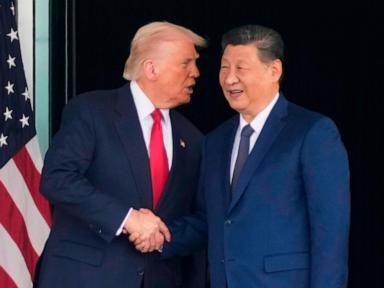
The superficial calm currently settling over trade relations between Washington and Beijing is not a resolution. It is a tactical pause. While headlines suggest a dialing down of the long-standing trade war following the latest summit between Donald Trump and Xi Jinping, the structural rot beneath the surface remains untouched. Investors cheering for a reprieve are misreading the room. The reality is that both superpowers have simply realized they cannot afford a total collapse right now, but the fundamental collision over technological supremacy and industrial dominance is accelerating.
To understand why this "thaw" is likely a mirage, one must look past the immediate talk of soybean purchases and tariff delays. The core of the dispute has shifted from simple trade deficits to a zero-sum struggle for the future of the global economy. This is no longer just about steel or aluminum. It is about who owns the intellectual property of the next century.
The High Cost of the Silicon Ceiling
Washington has moved its primary focus from general tariffs to a targeted strangulation of China’s high-tech aspirations. This "silicon ceiling" is designed to prevent Beijing from achieving self-sufficiency in semiconductors, artificial intelligence, and quantum computing. While the summit produced handshakes, it did not produce a roadmap for lifting the export controls that are currently crippling Chinese firms like Huawei and SMIC.
China views these restrictions not as trade policy, but as an act of containment. They are right to see it that way. The U.S. government has effectively weaponized the global supply chain, betting that China’s domestic industry cannot innovate fast enough to replace Western equipment.
For the American side, the risk is a forced decoupling that hurts Silicon Valley’s bottom line. For the Chinese side, the risk is a permanent secondary status in the digital world. Neither side can back down because the stakes are existential. When two powers view their survival through the lens of the other's stagnation, a dinner meeting in a neutral city changes very little about the underlying trajectory.
The Subsidies Trap
Beijing’s state-led economic model remains the ultimate sticking point that no amount of diplomatic "toning down" can fix. The U.S. demands an end to massive state subsidies for Chinese industries, arguing that they create an uneven playing field. However, asking the Communist Party to abandon these subsidies is like asking it to abandon its grip on power. These financial lifelines are the very tools the Party uses to maintain social stability and ensure national champions dominate global markets.
Consider the electric vehicle market. Through a decade of heavy state intervention and subsidies, China has secured a dominant position in the battery supply chain.
[Image of the electric vehicle battery supply chain]
Washington now faces a dilemma. If it allows these cheap, subsidized goods into the American market, it risks the total destruction of its own domestic manufacturing base. If it blocks them, it raises costs for consumers and slows down the transition to green energy. The summit offered no solution to this paradox. Instead, it merely kicked the can down the road, leaving businesses to operate in a perpetual state of uncertainty.
The Weaponization of Finance and Data
We are entering an era where data is treated with the same level of security as nuclear secrets. The trade war has evolved into a data war. The U.S. is increasingly skeptical of any Chinese-owned platform that handles American user information, while China is tightening its "Great Firewall" and data sovereignty laws to ensure that no domestic information can be used by foreign intelligence.
This creates a massive barrier for any multinational corporation trying to operate in both jurisdictions. You cannot have a globalized internet and a fractured data regime. Companies are now being forced to build "in-country" stacks—separate teams, separate servers, and separate products for the U.S. and China. This redundancy is expensive. It kills the efficiency that once drove the global economy. It is a tax on innovation that no one is talking about.
The Ghost of the 2024 Election
Politics, more than economics, is the primary driver of this volatility. Donald Trump’s rhetoric on the campaign trail has consistently focused on a "10 percent universal baseline tariff" and even higher levies on Chinese goods. This creates a strange dynamic where the current administration's attempts at stabilization are viewed by Beijing as temporary and unreliable.
Xi Jinping, meanwhile, is dealing with a domestic economy that is sputtering. The property market is in a tailspin, and youth unemployment remains a sensitive issue. He needs the trade war to cool off to give the Chinese economy room to breathe, but he cannot afford to look weak in front of his internal rivals.
This leads to a "Performative Diplomacy" cycle. Both leaders meet to show their respective audiences that they are in control and avoiding a shooting war. But once the cameras are gone, the bureaucratic machines in Washington and Beijing continue to grind out new sanctions, new investment bans, and new export restrictions.
A Supply Chain Built on Sand
Businesses that moved their manufacturing out of China to places like Vietnam or Mexico are finding that the "de-risking" strategy is more complicated than it looks. Many of the components used in those Vietnamese or Mexican factories still come from China. The world is addicted to Chinese manufacturing efficiency, and breaking that addiction is proving to be a decades-long project rather than a few years of policy shifts.
The summit did nothing to address the logistical reality that the global supply chain is still deeply intertwined. By pretending the trade war is "dialed down," leaders are encouraging a false sense of security. Smart money is still diversifying. The "China Plus One" strategy isn't a trend; it is a survival requirement for any company with a global footprint.
The Silent Escalation in the South China Sea
Trade does not happen in a vacuum. The military tension in the South China Sea and around Taiwan acts as a constant, underlying pressure on every trade negotiation. If a maritime incident occurs, all the progress made on soybean quotas or intellectual property protections will vanish in an afternoon.
The U.S. continues to increase its military presence in the Indo-Pacific, while China expands its naval capabilities at a record pace. This arms race is the real "lurking challenge" that the polite language of a summit communique tries to hide. You cannot have a stable trade relationship with a country you are actively preparing to fight.
The Currency Question
A looming factor that rarely makes the H1 headlines is the role of the dollar. China has been steadily reducing its holdings of U.S. Treasuries, reaching levels not seen in over a decade. Beijing is terrified of the "Russia treatment"—having its foreign reserves frozen by Washington.
The push for "de-dollarization" is a direct response to the trade war. If China can move more of its trade into the yuan or other currencies, it reduces the leverage the U.S. holds over its economy. This is a long-term threat to American financial hegemony, and it is a direct consequence of using the global financial system as a weapon of trade policy.
The Myth of the Level Playing Field
We must stop pretending that a "level playing field" is even possible between two such fundamentally different systems. The U.S. is a market-driven democracy with a focus on quarterly earnings and shareholder value. China is a state-capitalist autocracy with a focus on five-year plans and national rejuvenation.
These two systems were able to coexist when China was the "world's factory" making toys and textiles. Now that China is a "world leader" making fighter jets and supercomputers, the friction is inevitable. The trade war isn't a misunderstanding that can be cleared up over a summit dinner. It is a fundamental conflict between two civilizations that have different ideas about how the world should be run.
The summit provided the optics of stability, which is what the markets wanted to see. But optics are not policy. Behind the smiles, the walls are still going up. The export bans are still in place. The tariffs are still being collected. And the rhetoric on both sides is still hardening.
Stop looking for the end of the trade war and start preparing for the reality of a bifurcated world. The pause we are seeing now is the eye of the storm, not the end of it. Diversify your supply chains, secure your data, and stop betting on a return to the status quo. The old world of frictionless global trade is dead, and no amount of high-level summits is going to bring it back.