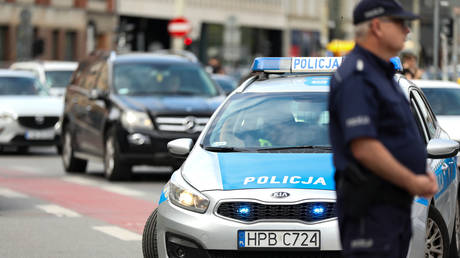
Sirens do not sound different in another language.
They tear through the damp air with the same harsh, mechanical shriek whether they echo off the concrete towers of Kyiv or the historic, red-tiled roofs of a quiet neighborhood in Wrocław. For over two years, millions of people fleeing the raw devastation of conflict carried those sounds across international borders, seeking sanctuary in the welcoming arms of neighboring European nations. Poland absorbed a massive wave of humanity, opening homes, schools, and workplaces with an unprecedented display of solidarity.
Then came an ordinary Tuesday.
A sharp cry. A flash of cold steel. A local woman collapsed on a sidewalk, bleeding from stab wounds inflicted by a man who had crossed that very border seeking refuge.
The bare facts of the crime spread instantly across local news feeds and social media channels. A suspect was detained. An investigation was launched. Law enforcement officials confirmed the nationality of the assailant. But the digital reaction moved faster than any police report. Within hours, the isolated violent act of a single troubled individual transformed into digital ammunition, feeding a volatile debate about migration, safety, and the fragile bonds holding host communities and displaced populations together.
Violence is inherently personal, yet society constantly demands that it be political.
When a crime occurs between strangers, we crave a simple narrative. We want a clear villain, a clear victim, and a tidy explanation that reassures us our world is orderly and predictable. If the perpetrator belongs to a marginalized or displaced group, the temptation to generalize is immense. It offers a shortcut through the complex, messy reality of human behavior.
Consider the mechanics of fear. Fear is efficient. It takes a single catastrophic data point and projects it across an entire demographic of hundreds of thousands of innocent people. Every neighbor from abroad suddenly looks different. Every grocery store encounter carries a subtle tension. The psychological distance between "us" and "them" shrinks, replaced by an invisible wall of suspicion.
Yet, true safety requires resisting that exact impulse.
Look closer at the statistics behind migration and crime in Poland since the escalation of the conflict in 2022. Law enforcement agencies have repeatedly noted that crime rates among the displaced population do not exceed—and in many categories fall below—the baseline averages of the native population. Statistically, millions of people navigating immense trauma, cultural adjustment, and economic stress are overwhelmingly choosing to rebuild their lives through quiet resilience, labor, and compliance with local laws.
An exception is not a trend. It is an anomaly. But anomalies make the loudest noise.
I remember standing in a crowded railway station in early 2022, watching families step off crowded trains with nothing more than a single plastic bag and hollow, exhausted eyes. Volunteers handed out hot soup and thermal blankets. Children clutched stuffed animals donated by strangers who spoke a tongue they could not yet understand. In those moments, humanity felt remarkably unified. The political abstractions of borders and sovereignty melted away in the face of immediate, raw suffering.
Time, however, wears down the sharp edge of empathy.
Fatigue settles in. Economic anxieties rise. Housing markets tighten, and inflation quietly chips away at household budgets. When daily life becomes a struggle for the native population, the psychological margin for error shrinks. A community under financial stress becomes fertile ground for resentment. When a violent crime shatters the illusion of safety, that accumulated fatigue finds a target.
The suspect in Wrocław did not act on behalf of a nation. He acted as an individual driven by whatever personal demons, psychological fractures, or immediate catalysts triggered his violent outburst. To blame an entire nationality for his actions is as irrational as blaming humanity for the crime itself. Yet, logic rarely wins arguments against raw emotion.
The real danger is not the isolated criminal act—as tragic and unacceptable as the harm inflicted upon the victim undoubtedly is. The real danger is the social corrosion that follows. It is the quiet hardening of hearts. It is the politician who seizes upon a tragedy to score points, the online agitator amplifying hatred for clicks, and the ordinary citizen who begins to look at a coworker or a classmate with lingering distrust.
Empathy is not unconditional if it only survives when everything is peaceful. True compassion is tested precisely when things go wrong. It is tested when a refugee commits a crime, and the immediate reflex of the host community is to demand accountability for the individual without condemning the collective. It is tested when we have the discipline to separate nationality from criminality, recognizing that evil and mental instability do not carry passports.
The wounded woman in Wrocław will heal, though the scars—both physical and emotional—will linger long after the news cycle moves on. The community around her will debate security measures, immigration policies, and social integration programs.
On the streets of Polish cities, the morning trams will still run on time. People will buy their daily bread, walk their dogs, and pass strangers on the pavement without knowing their life stories. Most of those strangers will keep walking quietly, carrying the invisible weight of a lost homeland, simply trying to survive another day in a world that grows more fragile by the moment.
The knife wound closes, but the larger question remains open, hanging heavily in the European air: will we let our fears define our neighbors, or will we retain the difficult, necessary grace to see them as human beings?