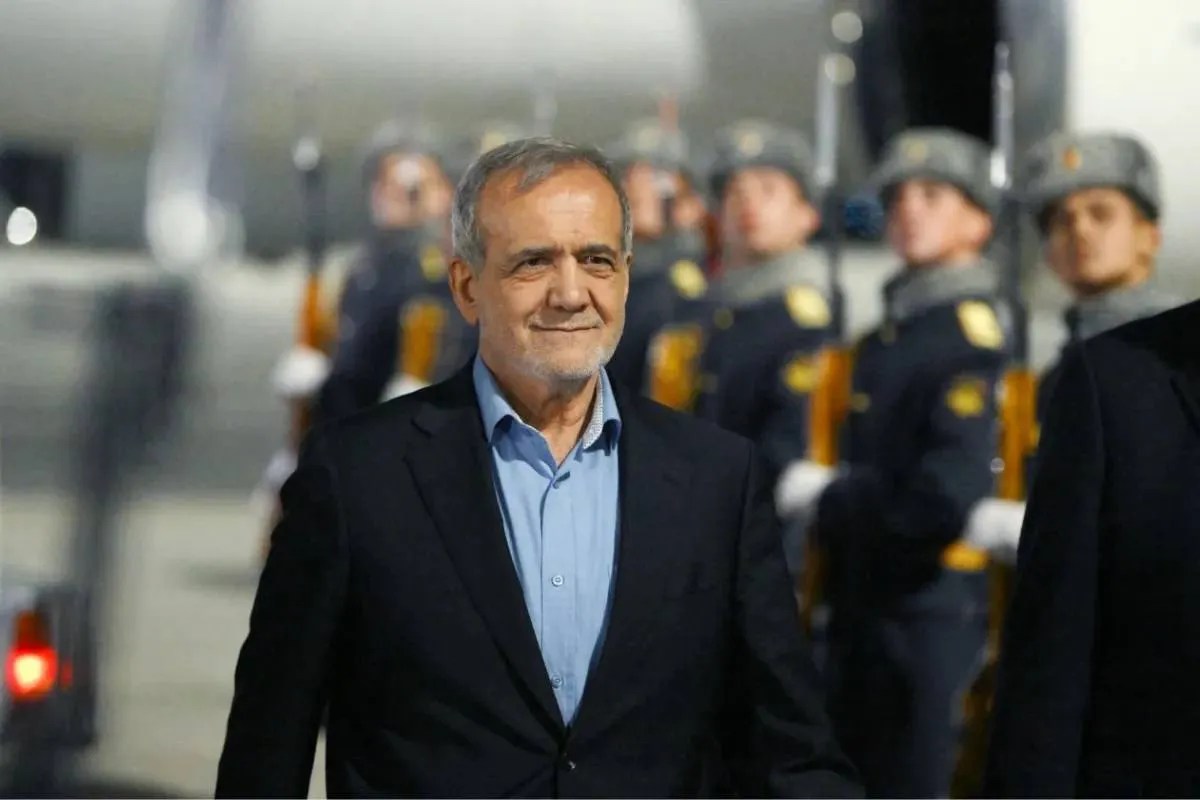
The foreign policy of Iranian President Masoud Pezeshkian operates under a severe structural constraint: any diplomatic overture directed toward western powers, specifically the United States, triggers an immediate and proportional domestic backlash that threatens the stability of his administration. This internal friction is not merely political disagreement. It is a systemic feature of the Iranian power structure. The baseline assumption that a sovereign executive can independently negotiate international treaties fails to account for the dual-vortex nature of Iran's governance, where the elected presidency is perpetually subordinated to the unelected clerical and military apparatus. When Pezeshkian signals a willingness to engage in dialogue with Washington to alleviate economic sanctions, he inadvertently activates an ideological immune response from hardline factions, the Islamic Revolutionary Guard Corps (IRGC), and conservative media elements.
Understanding this dynamic requires breaking down the Iranian state into its functional power centers and analyzing the strategic cost function that Pezeshkian must navigate. The primary objective of the current administration is economic stabilization, which is mathematically impossible without the removal of secondary sanctions targeting petroleum exports and banking access. However, the domestic currency required to purchase the political capital for such negotiations is finite and rapidly depleting. Read more on a similar issue: this related article.
The Dual Hierarchy Architecture
To analyze the pushback against Pezeshkian, one must first map the structural asymmetry of the Iranian constitution. The system splits authority into two distinct tracks: the republican track and the theocratic track.
                  [Supreme Leader]
                 /                \
        [Theocratic Track]     [Republican Track]
               |                       |
        [IRGC / Clerical]         [President]
               |                       |
     (Ideological Hegemony)    (Economic Management)
The presidential office occupies the republican track, tasked with day-to-day governance, budgetary allocation, and public service delivery. The presidency bears the brunt of public discontent regarding inflation, currency devaluation, and unemployment. Conversely, the theocratic track—headed by the Supreme Leader and operationalized by the IRGC and the Guardian Council—retains absolute veto power over macro-strategic decisions, national security, and foreign alignment. Additional analysis by The New York Times highlights similar perspectives on this issue.
This architecture creates a permanent misalignment of incentives. The president requires pragmatic, sanctions-relief mechanisms to fulfill domestic economic mandates. The theocratic track, however, derives its institutional legitimacy from a posture of perpetual resistance against western hegemony. Consequently, any rhetorical deviation by Pezeshkian toward conciliation is viewed by hardliners not as diplomacy, but as an existential threat to the ideological foundation of the state.
The Three Pillars of Hardline Counter-Mobilization
The domestic opposition to Pezeshkian’s diplomatic trial balloons follows a predictable, highly coordinated mobilization framework. This counter-strategy deploys three specific vectors to neutralize executive initiatives.
Ideological Purism as a Political Vetogate
Hardline factions utilize state-aligned media and Friday prayer networks to frame diplomatic overtures as a betrayal of the revolutionary ethos. By positioning the United States as an inherently bad-faith actor based on historical precedents—most notably the unilateral American withdrawal from the Joint Comprehensive Plan of Action (JCPOA)—the opposition establishes a logical trap: negotiation equals guaranteed strategic loss. This framing effectively raises the political cost of engagement for Pezeshkian, forcing him to spend valuable capital defending his loyalty to the revolution rather than advancing policy.
The Security Apparatus Economic Monopoly
The IRGC is not merely a military force; it is a massive economic conglomerate with deep financial interests in the continuation of a resistance economy. Sanctions create black markets, smuggling routes, and front companies—environments where the security apparatus possesses a distinct competitive advantage. By dismantling sanctions through conventional diplomacy, a normalized economy would reintroduce standard international banking compliance (such as FATF regulations). This transparency would directly threaten the off-book financial networks that fund the security elite. Therefore, the domestic pushback is driven by a rational actor model maximizing institutional wealth and power under the guise of national security.
Legislative Attrition
The Iranian parliament (Majles), currently dominated by conservative and ultra-conservative coalitions, serves as a formal institutional barrier. The legislative body possesses the power to summon ministers, reject cabinet appointments, and pass binding legislation that restricts the executive’s negotiating mandate—similar to the 2020 law that forced the acceleration of uranium enrichment. Pezeshkian faces a constant threat of legislative paralysis if his foreign policy rhetoric shifts too far from the approved doctrine of the supreme leadership.
The Cost Function of Sanctions Relief
Pezeshkian’s strategic calculus can be modeled as an optimization problem where he attempts to maximize economic yield while minimizing domestic political risk. The core dilemma rests on the reality that the mechanisms required to achieve the former exponentially increase the latter.
To secure substantial sanctions relief, the administration must offer verifiable concessions on two frontlines: the nuclear enrichment trajectory and regional proxy alignment. Each concession carries an escalating domestic cost:
- Nuclear Deceleration: Reductions in the stock of highly enriched uranium (60% purity) are viewed by the military establishment as stripping Iran of its primary strategic leverage. Hardliners argue that dismantling this leverage without upfront, irreversible western guarantees is systemic malpractice.
- Regional Detachment: The network of non-state actors across the Levant and the Arabian Peninsula forms Iran’s forward defense doctrine. Any diplomatic signaling that implies a reduction in logistical or financial support for these entities in exchange for economic normalization faces an absolute veto from the IRGC Quds Force.
Because Pezeshkian cannot realistically offer these concessions without triggering a domestic constitutional crisis, his diplomatic strategy is constrained to rhetorical positioning and incremental, back-channel de-escalation rather than a grand bargain.
Structural Bottlenecks in the Negotiation Apparatus
The friction surrounding the presidency is amplified by a critical operational flaw: the lack of a unified negotiating mandate. In western models, the executive branch speaks for the state in foreign affairs. In the Iranian model, the president speaks only for the civil administration.
This creates an acute credibility problem on the international stage. Foreign interlocutors are aware that commitments made by the Iranian foreign ministry can be instantly invalidated by a decree from the Supreme Leader or a provocative military kinetic action by the IRGC in the Persian Gulf. This structural bottleneck ensures that even when Pezeshkian attempts to project a moderate, engagement-ready stance, the external world price-adjusts his rhetoric based on the visible domestic opposition he faces at home. The resulting gridlock confirms the hardliners' thesis that diplomacy yields no tangible results, completing a self-fulfilling feedback loop.
Strategic Forecast and Executive Trajectory
Pezeshkian will not achieve a structural breakthrough with Washington. The domestic cost function is too high, and the structural vetogates are too well-entrenched. Instead, the administration will likely shift toward an alternative operational equilibrium.
The executive will pivot toward a "Look to the East" optimization strategy, attempting to secure marginal economic viability through non-western frameworks such as the Shanghai Cooperation Organisation (SCO) and expanded bilateral oil sales to China via dark fleet logistics. This approach allows the presidency to address basic economic survival metrics while avoiding the domestic political landmines associated with direct American engagement.
Diplomatic rhetoric regarding the West will be downgraded from "negotiation" to "tension management." The administration will focus entirely on preventing a kinetic escalation while accepting that comprehensive sanctions relief is structurally unattainable under the current domestic distribution of power. Pezeshkian's presidency will consequently evolve into a management exercise in economic containment, defined by constant concessions to internal hardline factions to preserve baseline administrative functionality.


