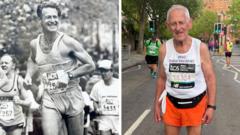
The asphalt of the Mall doesn't feel like a finish line anymore. It feels like a debt. For forty-five years, that stretch of road between Greenwich and Buckingham Palace has been the singular axis upon which my year rotated. When you do something forty-five times—when you run 1,179 miles of competitive London road—you stop being a participant. You become part of the city’s geological record. Your footprints are pressed into the tarmac deeper than the paint of the starting lines.
But the body has a way of speaking when the mind refuses to listen. It starts as a whisper in the meniscus. Then it becomes a shout in the lower vertebrae. Eventually, it is a roar that drowns out the cheers of the crowds at Cutty Sark.
There is a specific kind of madness required to stand at a starting line in 1981, when the London Marathon was a fledgling experiment, and decide that you will never miss a single one. It wasn't about the medal then. It was about the rhythm. In the early eighties, we ran in heavy cotton and shoes that felt like cardboard compared to the carbon-plated propulsion systems of today. We didn't have GPS watches to tell us our heart rates were skyrocketing; we just felt our chests tightening and pushed through because that was the currency of the era.
Forty-five years is a lifetime. In that span, I have watched the skyline of London transform from a post-war silhouette into a forest of glass and steel. I have run through the reigns of monarchs and the terms of countless prime ministers. I have run through personal grief, professional triumphs, and the slow, inevitable erosion of my own pace.
Consider the math of a long-term obsession. If you run twenty-six miles once, you are a marathoner. If you do it every year for nearly half a century, you are a curator of your own decline. Every year, the clock tells a slightly more honest story. The sub-three-hour bursts of my thirties faded into the steady four-hour grinds of my fifties. Then came the six-hour battles of my seventies, where the goal shifted from "beating the person in front" to "finishing before the street sweepers reclaim the road."
The decision to stop isn't a surrender. It’s a negotiation.
The transition from athlete to spectator is often framed as a tragedy, but there is a hidden dignity in knowing exactly when the tank is empty. I remember the 2024 race vividly. The rain was a cold, insistent needle against the skin. My knees weren't just aching; they were failing. Every stride felt like a mechanical error. I looked at the younger runners—the charity walkers in giant rhino suits, the elite athletes who move like liquid, the first-timers trembling with adrenaline—and I realized I was no longer chasing them. I was chasing a ghost of who I used to be.
We live in a culture that fetishizes "never giving up." We are told to grind until the gears seize. But there is an art to the exit. To walk away while you can still walk at all is a victory that the record books don't track.
Metaphorically, every person has their own London Marathon. It might be a career you’ve held for decades, a house you’ve lived in since the kids were small, or a version of yourself you’ve spent years perfecting. We hold onto these things because the repetition provides a sense of safety. As long as I am "The Man Who Runs London," I know who I am. The moment I stop, I am just a man. That identity crisis is far more terrifying than a hamstring tear.
But the silence that follows the decision is surprisingly sweet.
When I told my family I was hanging up the laces, the air in the room changed. There was a collective exhale. For years, my Christmases were defined by training blocks. My springs were defined by tapering and carbohydrate loading. My life was structured around a Sunday in April. Now, for the first time in nearly five decades, April belongs to me again. It doesn't belong to the pavement.
Health isn't just the absence of injury; it is the presence of wisdom. Pushing a seventy-eight-year-old frame through twenty-six miles of concrete is a feat of will, but at a certain point, it becomes a feat of vanity. The cartilage doesn't grow back. The heart, while strong, deserves a pace that allows it to actually see the city it's moving through.
I think about the 1981 race often. There were only 6,255 finishers then. We were pioneers in short shorts. Now, there are over 50,000 people flooding the streets. The event has become a behemoth, a televised spectacle of human endurance and costume-shop absurdity. I am proud to have been a stitch in that tapestry, but a stitch is allowed to fray.
There is a specific spot on the course, just around mile twenty-three, where the shadows of the Blackfriars underpass provide a momentary chill. For forty-five years, that was my "dark night of the soul." It was the place where I questioned why I was doing this. It was the place where the pain peaked. Next year, when the elite wave goes off and the masses follow, I won't be in that shadow.
I will be at home. I will have a cup of tea. I will watch the television and see the sweaty, exhausted, beautiful faces of people discovering the pain for the first time. I will feel a phantom ache in my calves, a muscle memory that may never truly dissipate.
Stopping is the hardest endurance test of all. It requires you to look at a streak—a perfect, decades-long record—and be the one to break it. It requires the courage to be finite.
The medals are in a box now. They aren't trophies of speed anymore; they are a timeline of a life. Each one represents a year of survival. But the forty-sixth year doesn't need a medal. It needs a rest.
I used to think that the finish line was the point of the race. I was wrong. The point was the 1,179 miles of preparation, the cold Tuesday mornings in February when the sun wasn't up, and the quiet realization that I don't have to prove anything to the road anymore. The road knows me. We are old friends. And friends know when it’s time to say goodnight.
I am looking at my running shoes by the door. They are caked with the dust of a thousand Sundays. I’m not throwing them away. But I’m not putting them on tomorrow, either.
The city will keep running. The clock will keep ticking. The Mall will fill with the roar of a hundred thousand lungs. And in the quiet of my own garden, for the first time in forty-five years, I will finally be still.