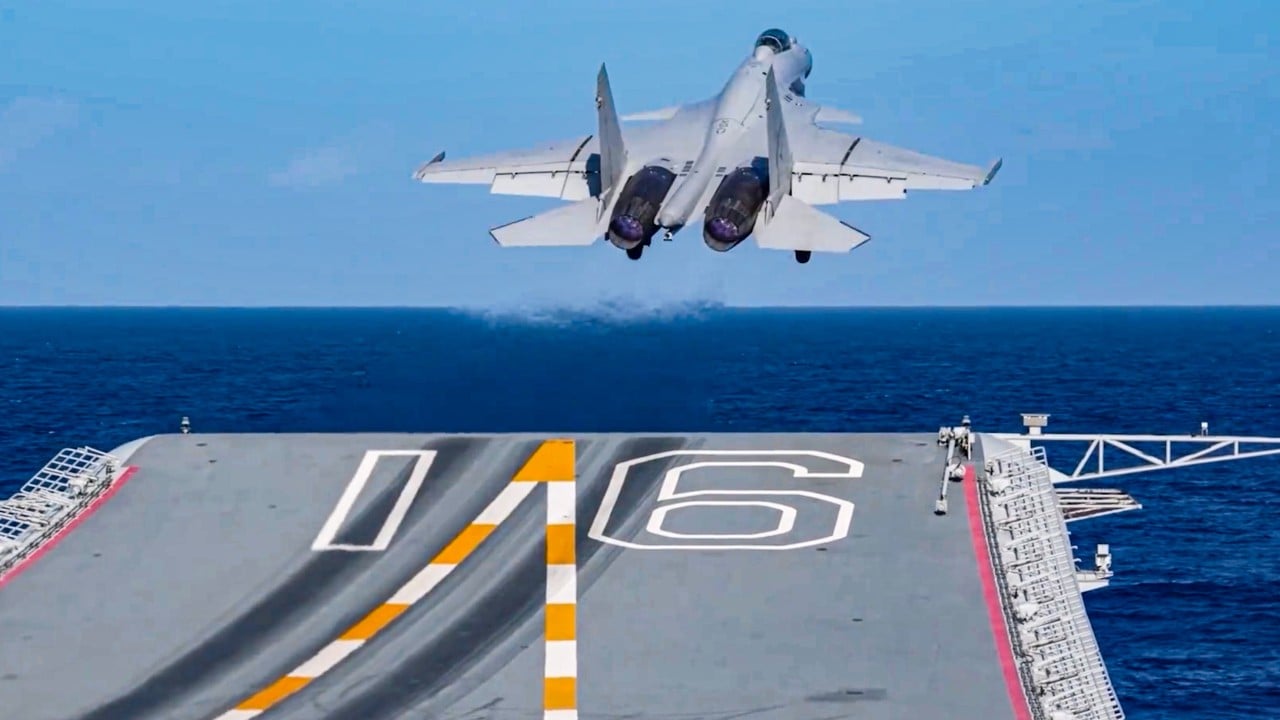
The operational utility of an aircraft carrier is not determined by the displacement of its hull, but by the performance envelope and deployment flexibility of its organic air wing. The recent validation by the People’s Liberation Army Navy (PLAN) that its next-generation carrier-based combat aircraft—specifically the J-35 stealth fighter and the J-15T heavy strike fighter—can operate interchangeably across both legacy Short Take-Off Barrier Arrested Recovery (STOBAR) and modern Catapult Assisted Take-Off Barrier Arrested Recovery (CATOBAR) hulls alters the strategic equilibrium in the Western Pacific. By engineering a single, cross-compatible aviation suite, Beijing has mitigated a structural vulnerability that historically fractured its naval architecture into isolated tactical echelons.
Understanding the mechanics of this transformation requires moving past vague notions of "integrated combat capabilities" and analyzing the specific engineering and logistical levers at play.
The Cross-Deck Compatibility Matrix
Historically, the PLAN’s carrier fleet was bifurcated by launch mechanics. The Liaoning (Type 001) and Shandong (Type 002) utilize a mechanical ski-jump ramp, relying entirely on an aircraft's thrust-to-weight ratio for launch. The Fujian (Type 003) utilizes an Electromagnetic Aircraft Launch System (EMALS).
Prior to the deployment of the J-15T and J-35, a carrier air wing optimized for one system could not seamlessly transition to the other. The introduction of unified air frames introduces three core operational efficiencies.
       [ J-35 Stealth / J-15T Heavy Multirole ]
                      │
       ┌──────────────┴──────────────┐
       ▼                             ▼
[ STOBAR Hulls ]              [ CATOBAR Hulls ]
(Type 001 / 002)               (Type 003 / Type 004)
 Launch: Ski-Jump              Launch: EMALS Catapult
 Recovery: Arresting Wire       Recovery: Arresting Wire
1. Structural Load Standardization
Catapult-launched aircraft require reinforced forward landing gear assemblies and tow-bar attachments to withstand the instantaneous longitudinal force of an EMALS stroke. Conversely, ski-jump aircraft prioritize minimal forward deadweight to maximize rotation at the lip of the ramp. The J-15T and J-35 reconcile these divergent engineering requirements by utilizing adaptive nose-gear shock absorbers and high-tensile alloy frames that are lightweight enough for ski-jump rotation yet structurally sound enough for catapult stroke loads.
2. Launch Weight and Payload Optimization
The primary limitation of STOBAR operations is the maximum take-off weight (MTOW) penalty. On the Liaoning and Shandong, heavy fighters like the base J-15 must sacrifice fuel volume or ordnance mass to achieve safe lift-off speeds.
The J-35 mitigates this through a dual-engine configuration featuring a high thrust-to-weight ratio combined with a lower empty weight compared to the legacy J-15. When operating from STOBAR ramps, the J-35 retains a viable combat radius and internal weapons load. When operating from the Fujian’s EMALS, it can utilize its maximum external hardpoint capacity.
3. Depot-Level Logistical Simplification
Maintaining distinct aircraft variants for different hulls creates parallel supply chains, separate pilot training pipelines, and fragmented maintenance facilities. Universal compatibility compresses these requirements. The same parts inventory, field-level testing equipment, and technician skill sets apply whether an air wing is deployed to the ski-jump Shandong or the catapult-equipped Fujian.
The Strategic Cost Function of Fleet Interoperability
To quantify why this cross-deck capability matters, one must examine the operational availability and tactical flexibility of the PLAN fleet during a prolonged regional contingency. In naval warfare, a non-interchangeable air wing acts as a rigid constraint on force projection.
The mathematical utility of a carrier fleet can be expressed through a simplified availability and sortie-generation function:
$$U = \sum_{i=1}^{n} (A_i \times S_i \times C_i)$$
Where:
- $A_i$ represents the operational availability of carrier hull $i$.
- $S_i$ represents the baseline sortie generation rate of that hull's launch mechanism.
- $C_i$ represents the compatibility coefficient of the available aircraft fleet relative to that hull (where $0$ is incompatible and $1$ is fully interchangeable).
When $C_i$ is a variable tied to specific hulls, the sinking or disabling of a single carrier strands its unique aircraft component ashore, rendering those airframes useless for the remaining hulls. By establishing $C_i = 1$ across the entire fleet, the PLAN transforms its carrier aviation assets into a fluid pool.
If the Fujian must return to port for battle damage repair or routine maintenance, its high-end J-35 and J-15T squadrons can immediately redeploy to the Shandong or Liaoning. This prevents the systemic operational overstretch that occurs when specialized units are locked into single-point-of-failure hardware.
Combat Architecture of the Layered Air Wing
The integration of the J-35 and J-15T across all hulls allows the PLAN to field a standardized, multi-tiered combat architecture regardless of which carrier is on station. This operational mix complicates allied defensive planning by eliminating predictable capabilities based on hull identification.
- Low-Observable Penetration Echelon (J-35): Operating as the forward sensory and strike node, the J-35 uses its fifth-generation stealth characteristics to penetrate contested airspace, map enemy air defense networks, and provide mid-course guidance updates to stand-off weapons.
- Heavy Multirole Firepower Echelon (J-15T): Freed from the structural limits of older variants, the J-15T serves as the primary ordnance truck. Carrying heavy anti-ship cruise missiles (ASCMs) and land-attack munitions, these platforms exploit the gaps created by the stealth echelon.
- Electromagnetic Suppression Escort (J-15D): Operating in tandem with both platforms, the twin-seat electronic warfare variant provides localized escort jamming and cyber-electromagnetic attacks to degrade allied radar and communication nodes.
The structural commonality between the J-15T and the J-15D means that even the legacy STOBAR carriers can now field an advanced electronic attack capability that was previously restricted by launch weight constraints.
Systemic Limitations and Operational Bottlenecks
While cross-compatibility optimizes air wing distribution, it does not entirely erase the hardware disparities inherent to the carrier hulls themselves. Strategic assessments must account for two persistent bottlenecks that universal aircraft cannot resolve.
The first limitation is the persistent sortie-generation deficit of STOBAR hulls. Even with highly optimized aircraft like the J-35, the physical process of positioning, aligning, and launching an aircraft via a mechanical ramp is inherently slower than using multiple, parallel EMALS tracks. The Fujian can cycle aircraft at a rate significantly higher than the Shandong, meaning that while a J-35 can land on a legacy carrier, that carrier cannot match the volume of fire delivered by a CATOBAR platform.
The second limitation is the airborne early warning (AEW) gap. The KJ-600, China’s equivalent to the U.S. Navy’s E-2D Advanced Hawkeye, requires a catapult launch to achieve operational velocity with its heavy radar payload. It cannot safely operate from the ski-jump ramps of the Liaoning or Shandong.
As a result, while the older carriers gain advanced stealth and strike fighters, they remain dependent on land-based radar aircraft or less capable rotary-wing AEW platforms for over-the-horizon targeting. This limits the independent power projection capability of STOBAR strike groups when operating outside the umbrella of land-based PLA Air Force assets.
The Tactical Play
The integration of J-35 and J-15T fighters across all three Chinese aircraft carriers marks a transition from experimental naval aviation to an interchangeable fleet model. Western naval commanders can no longer treat the Liaoning and Shandong as secondary training platforms or lower-tier threats. Every PLAN carrier strike group entering the Philippine Sea or Indian Ocean must now be assumed to possess low-observable penetration and heavy, catapult-optimized anti-ship capabilities.
To counter this distributed threat, allied operational planning must pivot away from targeting specific "high-value" hulls like the Fujian as a means to neutralize fifth-generation maritime threats. Defense resources should instead focus on disrupting the shared logistical links, data networks, and standardized maintenance pipelines that enable this cross-deck flexibility. If the universal supply chain supporting the unified air wing can be severed via kinetic or cyber interdiction, the interchangeability of the aircraft becomes a moot point.