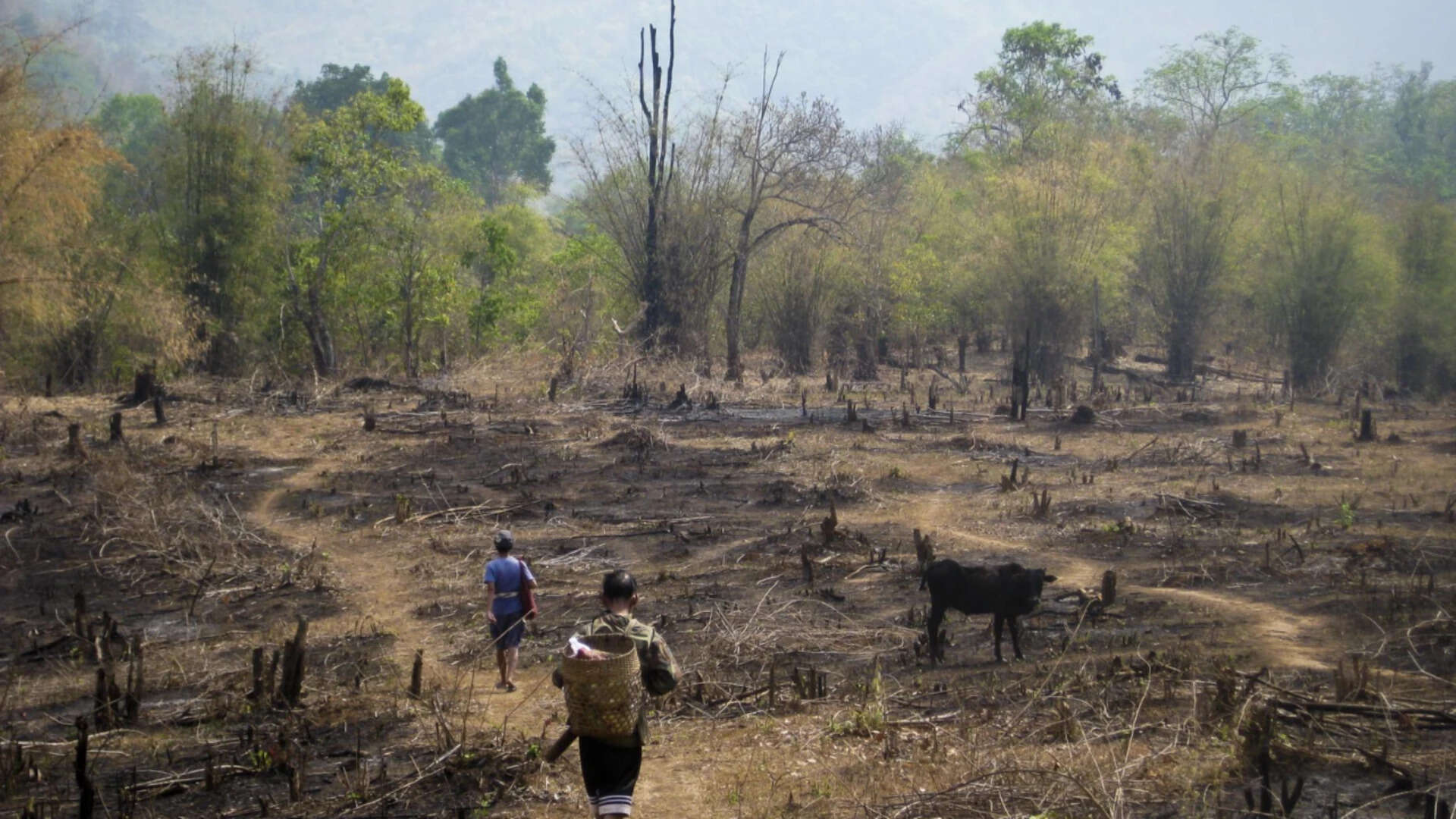
The smoke always arrives before the dawn. It hangs heavy, tasting of charcoal and damp earth, a ghost that clings to your lungs. For decades, the global narrative has been simple, brutal, and widely accepted: slash-and-burn farming is the arsonist of the rainforest, a reckless, primitive itch that must be scratched out of existence if we are to save the planet.
We painted the smallholder farmer as the villain. We looked at the charred patches of Amazonian or Congolese forest and saw greed. We saw ignorance. We saw the end of the world.
But standing on the edge of a cleared plot in the humid heat, the truth feels less like a crime scene and more like a misunderstanding.
Consider Mateo. He is not a corporate executive looking to squeeze every cent out of a timber lease. He is a father. His family has worked this specific patch of soil for three generations. When he takes a machete to the undergrowth, he isn't dreaming of global deforestation; he is thinking about the nutritional deficit in his youngest daughter’s diet. He is trying to coax beans and manioc from soil that, in the tropics, is often as thin and fragile as parchment.
For years, researchers told us Mateo was destroying the lungs of the earth. The logic seemed ironclad: trees capture carbon; fire releases it. If the trees go, the climate suffers. Case closed.
Yet, science—the patient, observant, often humble kind of science—has recently started to suggest that we were looking at the wrong calendar. We were obsessed with the fire, but we ignored the cycle.
A new wave of research is challenging the assumption that small-scale rotational agriculture is the primary driver of permanent forest loss. In many regions, the data indicates something far more nuanced. When farmers like Mateo clear a patch, they aren't necessarily converting it into permanent, industrial-scale pasture or soy monocultures. They are engaging in a cyclical rhythm of clearing, planting, and—critically—abandoning.
They let the forest return.
This isn't a permanent scar. It is a rotation. By leaving a plot fallow, the jungle reclaims it. The secondary forest that grows back in these abandoned patches is, in many ways, an efficiency expert. It drinks carbon dioxide with a frantic, youthful hunger, sequestering carbon far more rapidly than the old, stagnant growth that preceded it.
When we conflate the desperate, managed clearing of a family farm with the massive, mechanized bulldozing of global agribusiness, we aren't just being imprecise. We are being dangerous. We are effectively criminalizing a survival strategy that has existed for centuries, while letting the true drivers of industrial-scale deforestation—driven by global commodity demand—slip quietly into the shadows.
It is a strange irony. We tell the people who live most closely with the forest that their way of life is the enemy, all while the supermarkets in the North continue to demand the cheap beef and soy that fuels the real, permanent destruction.
Walking through these fields, you realize the forest is not a static museum piece. It is a living, breathing entity that responds to human touch. In some instances, human intervention actually promotes biodiversity. The mosaic of different forest ages—from newly cleared patches to thick, maturing secondary growth—creates an edge effect. More edges mean more niches. More niches mean more life.
This isn't to say that all burning is benign. We know the risks. We know the atmospheric cost. But there is a massive difference between a surgical, controlled fire used to nourish soil and the wildfires sparked by illegal land grabbing and industrial encroachment.
The tragedy is that our policies have been built on a foundation of "if," not "why." If there is smoke, there is destruction. But why are they burning? If we don't understand the motivation, we will never understand the solution.
When you sit with someone like Mateo, the silence is often more informative than the talk. He points to a patch of ground that looks like a tangled mess of weeds to the untrained eye. To him, it is a pharmacy. It is a grocery store. It is a classroom. He knows exactly when the rains will come by the way the ants move. He knows that if he clears the land at the wrong time, the soil will wash away into the river before the first sprout even dares to show its head.
He is not a master of destruction. He is a partner in a precarious, high-stakes balance.
We have spent decades trying to dictate the terms of this relationship from a distance. We use satellite imagery to count the fires, but we lack the resolution to see the intention. We see a heat signature and we demand a ban. We see a loss of canopy and we scream for intervention.
But what happens when the policies we write to "save" the rainforest actually push the people who protect it into deeper poverty? When they can no longer farm in the way their ancestors taught them, they don't simply stop eating. They move deeper into the forest. They hunt more. They clear different, perhaps more fragile, areas to survive. The policy meant to protect the forest becomes the catalyst for its fragmentation.
This isn't a call for chaos. It is a call for humility.
We need to stop viewing the forest as something that must be locked behind glass. We need to start looking at it as a landscape that has been shaped by human presence for thousands of years. We must distinguish between the fire that feeds a family and the fire that clears a thousand acres for a tax write-off.
The solution is not to ban the fire. It is to support the cycle.
If we want to save the lungs of the earth, we need to stop holding our own breath long enough to listen to the people who are actually standing in the smoke. We need to invest in the indigenous knowledge that understands soil health, and we need to confront the industrial supply chains that are the real arsonists in this drama.
The fire is still burning. But it is not a monolithic disaster. It is a story of survival, of human ingenuity, and of a fragile, broken connection that we are only just beginning to map.
Across the valley, the wind shifts. The scent of ozone and wet wood sharpens. Somewhere, a tree is falling, and in the space where it stood, a tiny, defiant green shoot is already reaching for the sun.
The forest doesn't need our permission to recover. It just needs us to stop burning the wrong things.