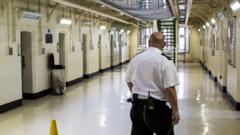
The heavy steel door does not click shut; it groans. For anyone who has stood inside the echoing corridors of a maximum-security intake wing, that sound is a physical weight. It vibrates through the floorboards and settles directly behind the ribs.
Imagine walking down that corridor on a Tuesday evening. Dozens of men, their worldly possessions stuffed into clear plastic bags, wait in rows of plastic chairs under buzzing fluorescent strips that hum at an irritating, high-pitched frequency. They are waiting for a bed that essentially no longer exists.
Across England and Wales, the margin between order and administrative chaos has shrunk to a statistical razor's edge. At multiple points during the recent capacity crisis, the entire male prison estate—housing tens of thousands of individuals across historic Victoriana brick complexes and modern privatized monoliths—hovered dangerously close to total saturation, with fewer than eighteen hundred spaces left.
Numbers on a spreadsheet look sterile. They suggest a neat row of empty cells ready to receive occupants like books slotted onto library shelves. But the reality of a system operating at ninety-nine percent capacity is vastly different. It is a game of human musical chairs played with high stakes, where the music never stops, and every single chair is already occupied by two people.
Consider what happens next in an overcrowded facility. When a court passes a custodial sentence, the system cannot simply put up a "fully booked" sign like a roadside motel. Magistrates are forced to weigh public safety against structural impossibility. Judges delay sentencing hearings, not out of leniency, but because sending one more man through the gates means shuffling another into an already doubled-up cell designed for a single occupant decades ago.
The architecture of British confinement tells a story of relentless pressure. Many facilities were built in the nineteenth century, intended to separate men in silent reflection. Today, those same stone walls contain bunk beds wedged into spaces so tight that inmates take turns standing just to let their cellmate climb down. More than seventy percent of prisons in England and Wales are officially classified as overcrowded.
Let us look closer at the human element of this bottleneck. When populations surge past safe thresholds, the invisible scaffolding holding the institution together begins to buckle. Rehabilitation programs vanish first. Education classes are canceled because prison officers are redeployed simply to maintain basic unlock routines. Mentorship, substance abuse support, and psychological counseling are traded away for crowd control.
A prison that cannot breathe becomes a pressure cooker. Tempers fray in the stagnant air of overcrowded wings where men spend upwards of twenty-two hours a day locked behind iron bars. Violence climbs. Self-harm statistics tick upward with the thermometer. The staff, outnumbered and chronically stretched thin, walk the landings with a quiet exhaustion that comes from knowing they are attempting to bail out an ocean liner with a teaspoon.
The crisis is not merely a legal or political abstraction. It is a slow-moving structural failure that ripples outward into local communities. When sentences are truncated through emergency early release schemes to clear a few hundred precious beds, local probation services scramble to manage an influx of men thrust back onto the streets without adequate housing or support structures. The revolving door spins faster.
We are left staring at a system caught between two impossible truths. Society demands accountability, protection, and justice from its courts, yet refuses to invest in the physical infrastructure required to sustain those ideals without human warehousing.
The last available bed is filled. The door swings shut with a heavy, final thud. And the corridor waits for the next arrival.