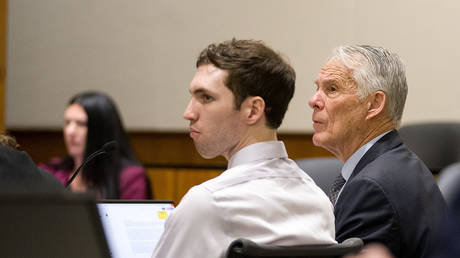
Every legal pundit in the country is currently hyperventilating over the exact same predictable talking point. The defense attorneys representing the suspect accused of murdering Charlie Kirk have filed motions arguing their client is ineligible for the death penalty. The mainstream media treats this as a profound constitutional wrestling match, a delicate balancing act of Eighth Amendment jurisprudence and statutory nuance.
They are missing the entire game.
The lazy consensus says this motion is about saving a life. It is not. It is a calculated distraction designed to anchor public outrage to a predictable procedural fight while the real institutional mechanics quietly shift in the background. If you think this defense strategy is about moral objection or statutory technicalities, you are falling for the oldest magic trick in the criminal justice handbook.
Let us look at the actual architecture of high-profile capital litigation. I have watched defense teams deploy this exact playbook in politically charged murder trials for decades. They do not file these motions expecting a sudden, enlightened awakening from a judge who wants to abolish capital punishment on a whim. They file them to exhaust the prosecution, lock the state into specific evidentiary burdens early, and completely hijack the cultural narrative before a single juror is seated.
The Flawed Premise Of The Eighth Amendment Debate
The mainstream coverage frames this around standard proportionality reviews. Does the punishment fit the crime? Is the defendant intellectually disabled, mentally ill, or young enough to trigger statutory exemptions?
Stop asking those questions. They are designed to trap you in a moral loop that benefits the defense.
The real question is how capital eligibility motions alter the timeline of state resources. When a defense team forces a protracted pretrial evidentiary hearing on death penalty eligibility, they drain the district attorney's operational bandwidth. Capital cases require exhaustive mitigation investigations. By litigating eligibility aggressively at month three, the defense is quietly weaponizing the clock. They are forcing the state to prove aggravating factors long before the physical evidence is fully tested in court.
Consider the standard statutory framework for capital murder. Prosecutors must prove specific aggravating circumstances beyond a reasonable doubt. By attacking those aggravators preemptively, the defense is not trying to take lethal injection off the table. They are running a reconnaissance mission to force the state to show its entire evidentiary hand under oath years before trial.
The Real Danger Of Taking Execution Off The Table
There is a strange paradox here that nobody in the mainstream legal press has the stomach to print. Pushing to remove the death penalty can actually backfire on a defendant in a high-visibility ideological murder.
Remove the ultimate penalty, and what happens to the psychological profile of the jury pool?
When the death penalty is on the table, voir dire is an agonizing, multi-week slog precisely because courts must weed out jurors who are categorically opposed to capital punishment, as well as those who are too eager to pull the trigger. It forces a tedious moderation of the room. Take the death penalty away, cap the maximum sentence at life without parole, and you streamline the jury selection process. You create a streamlined glide path for a swift conviction.
I have seen prosecutors quietly breathe a sigh of relief when certain procedural hurdles take capital punishment off the table. Why? Because a life sentence trial moves faster, carries lower appellate scrutiny on obscure constitutional technicalities, and often makes it easier to secure a conviction without the suffocating burden of proving premeditated statutory aggravators to a unanimous, death-qualified jury.
The defense thinks they are playing four-dimensional chess by filing these motions. Sometimes, they are walking straight into a conviction machine that no longer has to trip over its own shoelaces to satisfy the Supreme Court's stringent Eighth Amendment standards for state-sanctioned execution.
The Media Manipulation Playbook
Look at how the headlines are framed. They center the suspect's eligibility, shifting the psychological focus away from the victim, the details of the assassination, and the broader societal shockwaves of the crime.
This is narrative laundering.
Every hour spent debating whether a specific psychological evaluation or statutory loophole shields the accused from the death penalty is an hour not spent dissecting how the suspect acquired the weapon, who financed the logistics, or what radicalized networks enabled the act. The defense wins the moment the public starts viewing the defendant through the clinical, sterile lens of procedural eligibility rather than raw culpability.
Legal realism requires us to strip away the courtroom theater. Capital punishment in America is broken, bloated, and largely symbolic. Less than one percent of convicted murderers are ever executed. Prosecutors know this. Defense attorneys know this. The entire dance over eligibility is often a performative ritual designed to burnish appellate records for the next twenty years while everyone in the courtroom collects a paycheck.
Unconventional Reality Check
If you want to understand how this case actually concludes, stop reading briefs on statutory mitigation. Look at the plea bargain infrastructure.
High-profile murder trials involving politically polarizing figures almost never end in a dramatic jury verdict where the death penalty is handed down. The system is too fragile, the appeals are too expensive, and the political fallout of a botched execution or a hung jury is too toxic for any local government to stomach.
The death penalty motion is the opening salvo in a long, grinding negotiation toward a permanent, anonymous eternity behind maximum-security glass, far away from cameras, microphones, and public martyrdom.
The defense isn't saving a life today. They are managing a brand. And the public is buying the ticket without realizing the house always wins the spread.