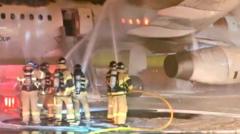
The footage is haunting. A Frontier Airlines jet taxiing toward a gate, a sudden flash of movement, and a human life extinguished in a vacuum of jet intake. The internet reacts on cue. Panic. Outrage. Demands for "better safety protocols."
Stop.
If you are watching these videos and feeling a sense of creeping dread about your next flight, you aren't just being sensitive. You are being irrational. You are falling for the availability heuristic—a mental shortcut where we judge the probability of an event based on how easily we can recall an example of it. And because a high-definition video of a ground crew member being ingested by a turbine is unforgettable, you think it matters to your safety.
It doesn't.
The Ground Safety Paradox
The "lazy consensus" in aviation reporting is that these incidents represent a "lapse in safety" or a "failure of technology." That is a fundamental misunderstanding of how high-risk environments operate.
Aviation isn't safe because humans stopped making mistakes. It is safe because the system assumes humans are incompetent. When an incident occurs on the ramp—the technical term for the area where planes park and get serviced—it is almost never a failure of the "system." It is a failure of physics meeting human complacency.
Ground crews work in a 115-decibel environment. They wear hearing protection that isolates them from the world. They work in "danger zones"—specific arcs around an engine where the suction is literal and lethal.
The problem isn't that we need more rules. We have the rules. The problem is that the more "fail-safes" we build, the more humans "risk-compensate." This is the Pelzman Effect. When you make a system feel safer, people take more risks. We have surrounded ground workers with flashing lights, high-visibility vests, and painted lines, which creates a false sense of security. They stop looking up because they trust the "system" to protect them.
The Statistics of the Spectacle
Let’s look at the numbers the fear-mongering outlets won't give you. In any given year, there are roughly 30 million flight departures globally. Ground handling incidents involving fatalities are so rare they struggle to make a statistically significant dent in occupational hazard data.
You are significantly more likely to die in the Uber ride to the airport than you are to even witness a ground incident from your window seat, let alone be involved in one. Yet, nobody films their Uber ride with a sense of impending doom.
The media focuses on the "horror" because it’s visceral. It’s "The Blob" in real life. But as an industry insider who has sat through the post-incident debriefs, I can tell you: these are not "accidents" in the traditional sense. They are deviations from standard operating procedures (SOPs).
If a worker enters the "ingestion zone" while the anti-collision lights are flashing, the machine is doing exactly what it was designed to do: generate thrust. The machine didn't fail. The human exited the protocol.
Stop Blaming the Technology
Whenever these videos go viral, the "armchair engineers" come out of the woodwork. "Why don't they put screens over the engines?" they ask.
Because physics doesn't care about your feelings.
Putting a mesh screen over a high-bypass turbofan engine like the ones on a Frontier A321 would destroy the laminar flow of air. It would create massive turbulence at the intake, drastically reducing fuel efficiency and potentially causing engine surges that could lead to a crash at 30,000 feet.
$$F = \dot{m} \times (v_{e} - v_{v})$$
The equation for thrust depends on the mass flow rate ($\dot{m}$) of air. If you obstruct that flow to save one person who ignored ten different safety warnings on the ground, you jeopardize the 200 people in the air.
We don't "fix" runway safety by adding physical barriers. We fix it by acknowledging that the ramp is an inherently lethal environment that demands 100% cognitive engagement.
The Illusion of "Rising Risks"
The competitor articles love to suggest that these incidents are on the rise. They aren't. Our access to them is on the rise.
Twenty years ago, a ground incident in San Antonio or Salt Lake City was a footnote in a local paper. Today, every ramp agent has a smartphone, and every terminal has 4K surveillance. We are seeing the same low-frequency events in high-definition, and we are mistaking that clarity for frequency.
This is the "Mean World Syndrome." Because we see more violence and tragedy through our screens, we believe the world is becoming more dangerous, despite all empirical evidence to the contrary. Commercial aviation is currently in its safest era in history.
The Brutal Truth About Ramp Work
I have walked those lines. I have felt the vibration of a GE90 engine at idle in my chest. It is a terrifying, beautiful display of power.
The industry reality is that ground handling is a high-turnover, low-margin business. Airlines outsource this work to third-party contractors who pay just above minimum wage. If you want to be "outraged" about something, don't be outraged about a "lack of safety technology." Be outraged that the person responsible for guiding a $100 million aircraft is often an exhausted 19-year-old working their third shift of the weekend.
But even then, the protocols work. The marshalers, the wing walkers, the tug drivers—they follow a choreography that is more precise than a Broadway show. When the choreography breaks, it’s usually because a human thought they could beat the clock or take a shortcut.
Why You Should Keep Watching the Video
Don't look away from the footage. But don't watch it as a consumer of "horror." Watch it as a lesson in the lethality of complacency.
The video of a plane "striking" a person isn't a reason to fear flying. It’s a reminder that we live in a world governed by laws of motion and energy that do not grant mulligans.
We have spent billions of dollars making flight so "seamless" (to use a word I despise) that passengers have forgotten they are sitting in a pressurized metal tube being propelled by controlled explosions. These incidents rip the veil off that sanitized reality. They remind us that aviation is a triumph of discipline over chaos.
If you want to be safe, stop worrying about the engine intakes and start worrying about your own situational awareness. The most dangerous part of your journey isn't the runway. It’s your own belief that the world is obligated to be safe for you.
The runway is a "no-fail" zone. The jet engine is a "no-mercy" machine.
Respect the machine. Ignore the hype.
Get on the plane.