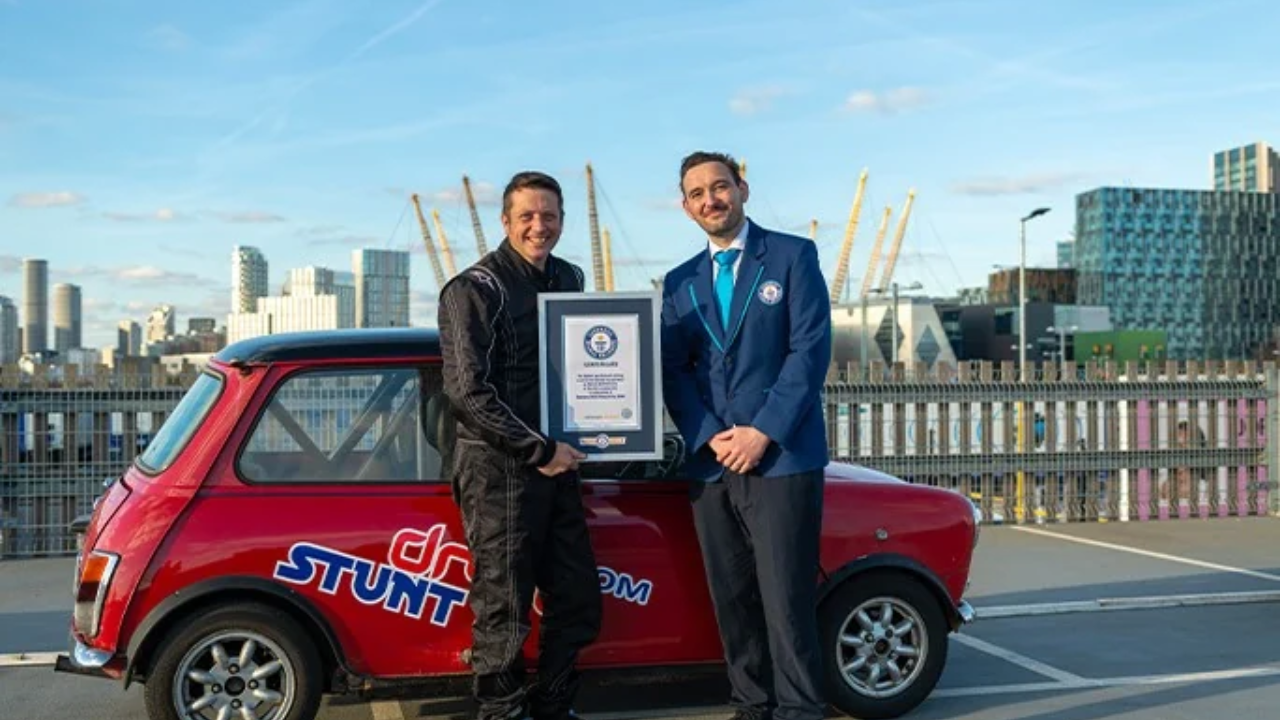
Grease doesn't wash off easy when it has sat under your fingernails for forty years. It settles into the fine lines of your palms like a map of every engine you have ever breathed back to life.
If you stood inside that quiet garage on a crisp morning, you wouldn't see world records or international headlines right away. You would see tools. Chrome-vanadium wrenches aligned by size, a well-worn stool in the corner, and the sharp, nostalga-laden scent of motor oil mixed with old leather. You would see a father and a son standing side-by-side, their hands carrying the exact same smudge of carbon across the knuckles.
Most people look at a Guinness World Record certificate and see a neat line of typography framing a moment of absurdity. A tally of numbers. A collection of extraordinary metrics designed to spark a passing chuckle over morning coffee. But metrics are hollow vessels. They tell you what happened, yet they remain stubbornly silent about why a man would spend hundreds of hours adjusting a carburetor just to chase a ghost.
When news broke that a father-son duo had shattered world records—crowned by the father’s decision to donate his record-setting Mini Cooper—the internet did what it always does. It swallowed the headline, spat out a few thousand likes, and moved on to the next passing curiosity.
They missed the real story.
The real story isn't about the steel and rubber. It is about what happens when two generations decide to communicate using the only language they both fully understand: mechanical perfection.
The Geometry of Obsession
Consider the classic Mini Cooper. It is not a modern supercar. It does not possess sleek carbon-fiber wings or computerized traction control systems that recalculate physics a thousand times a second. It is a tiny, stubborn box on four small wheels, born out of mid-century British austerity.
To make a car like that do something record-breaking takes more than engineering. It takes a willingness to surrender your weekends to frustration.
Think about the sheer scale of the commitment. Hours bleed into days. You start at dawn, fine-tuning an engine block while the rest of the neighborhood sleeps. The cold concrete floor eats at your lower back. Your eyes ache under the buzz of harsh fluorescent lights.
Why do it?
Because inside that garage, the noise of the outside world stops. There are no algorithmic notifications, no relentless emails, no societal anxieties. There is only a physical problem with a physical solution. If the timing belt slips, you don't blame external factors; you grab a socket wrench and fix it.
For a father watching his son grow into adulthood, that garage becomes a sanctuary. As kids grow up, the natural distance widens. Conversations become shorter. Schedules clash. Life gets noisy. But when you hand your child a torque wrench and point to a cylinder head, you don't need small talk. The work speaks.
The son learns the dad's rhythm. The dad learns to trust the son's hands. Together, they turn raw mechanical drag into pure momentum.
Steel, Sweat, and the Weight of Giving It Away
Breaking the record was supposed to be the climax. The moment the stopwatch clicked, the clipboard was signed, and the official photos were taken, the journey reached its logical peak.
Then came the turn nobody saw coming.
The father didn't put the record-setting Mini Cooper under a velvet sheet in a temperature-controlled showroom. He didn't list it at an elite auction house to cash in on the viral glory.
He gave it away.
He handed over the keys, donating the very vehicle that carried their names into the record books.
To understand how radical that act is, you have to appreciate what a car like that represents to the person who built it. It isn't just metal. Every dent has a story. Every polished piece of chrome carries the memory of a midnight fix when everything seemed lost. That Mini Cooper was a rolling museum of their shared sweat, their late-night arguments, and their ultimate triumph.
Holding onto things is easy. Ownership is our default setting. We hoard trophies, stack up achievements, and build digital archives of our past wins so the world never forgets we were here. We treat our successes like permanent anchor points.
Giving away the physical centerpiece of your greatest achievement takes a deliberate kind of courage. It requires an understanding that the object was never the point.
The car was just the catalyst. The real build wasn't the engine; it was the bond forged over the engine block.
Imagine standing in the driveway, watching the flatbed tow truck pull away with the vehicle you poured years of your life into. The taillights fade around the corner. The garage behind you suddenly feels vast, empty, and strangely quiet.
A lesser man might feel a pang of loss, a sudden emptiness where pride used to sit. But look closely at the father's face in that moment. There is no regret there. Just a quiet, settled peace.
He kept the only part that actually mattered: the memories of hands covered in grease, working side-by-side with his son, proving that extraordinary things can be built right at home if you care enough to try.
The record belongs to the history books now. The car belongs to its new purpose. But that quiet garage? That belongs to them.