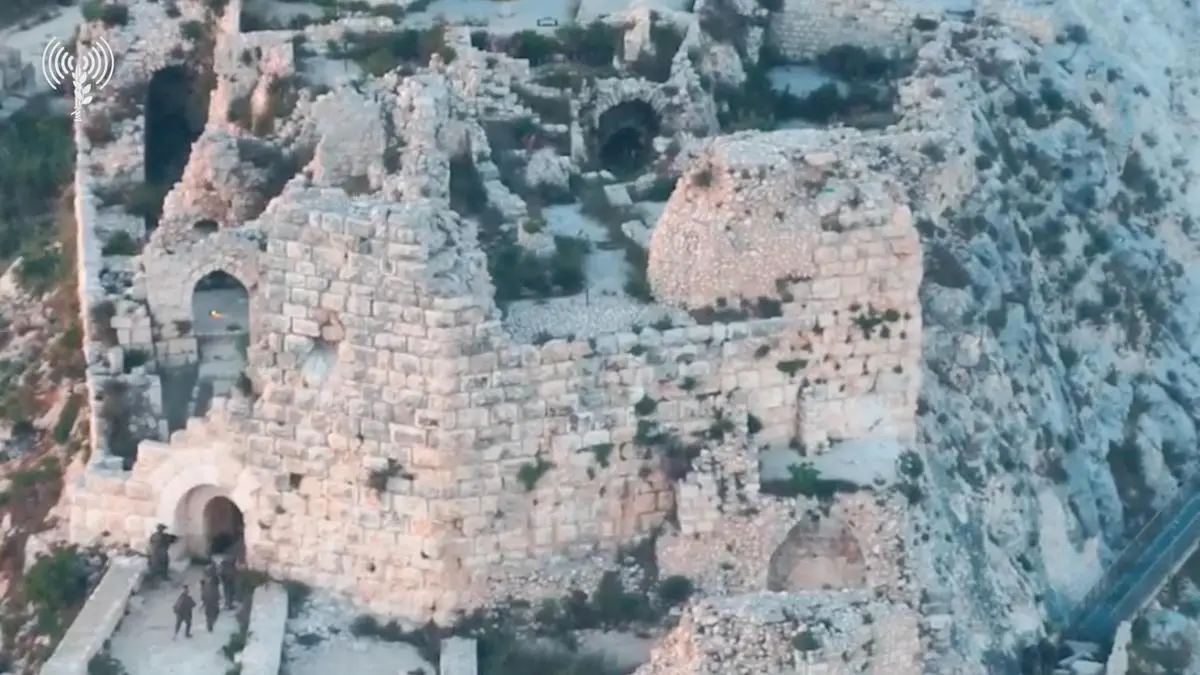
History has a weird way of repeating itself in southern Lebanon. When Israeli troops hoisted their flag over the stone ruins of Beaufort Castle, it wasn't just another tactical update from a grinding conflict. It was a massive psychological milestone. Standing high on a craggy ridge overlooking the Litani River, this 900-year-old Crusader fortress has once again become the epicenter of a major war.
This isn't a minor border skirmish. The push into the Beaufort Ridge and the nearby Suluki Valley marks the deepest ground advance by the Israel Defense Forces (IDF) into Lebanese territory in 26 years. Not since the year 2000, when Israel wrapped up its grueling 18-year occupation of the southern "security zone," have its soldiers held these specific high grounds.
The move shatters any lingering illusions about the durability of recent diplomatic agreements. Despite a nominal US-brokered ceasefire that supposedly went into effect on April 17, the reality on the ground looks vastly different. The latest Israel-Hezbollah war exploded on March 2 following a joint US-Israeli strike on Iran, and things have only escalated since. By capturing the fortress, Israel signaled that its current objectives go far beyond securing the immediate border.
The Obsession with the Beautiful Fortress
To understand why military planners are fixated on this specific outcrop of rock, you have to look at the geography. Built by Crusaders in the 12th century and named Beaufort (French for "beautiful fortress"), the site is known locally as Qalaat al-Shaqif. The name comes from an old Syriac word describing a steep, rocky area. It's a natural military fortress.
Perched nearly 2,300 feet above sea level, Beaufort serves as a natural lookout. Even in an era dominated by high-tech drone surveillance and satellite imaging, physical elevation matters. From these ancient walls, lookouts get a completely unobstructed, panoramic view that covers wide stretches of northern Israel's Galilee region and huge swaths of southern Lebanon.
- 12th Century: Crusaders fortify the ridge to guard the realm.
- Late 20th Century: The Palestine Liberation Organization (PLO) converts the ruins into a heavily armed bunker to launch rockets into northern Israel.
- 1982: Israeli forces, led by then-Defense Minister Ariel Sharon, capture the site in a bloody assault that became a defining symbol of the First Lebanon War.
- 2000: Israel retreats under intense pressure from a growing Hezbollah, blowing up their modern concrete bunkers inside the castle walls before leaving.
For the next quarter-century, the castle stood as a monument to Lebanese resistance. Tourists walked the partially restored grounds, and UNESCO eventually granted enhanced protection status to the site in 2024. Now, the Golani Brigade's colors are flying over the battlements once again.
Correcting Past Mistakes or Image Victory
The political reaction inside Israel reveals exactly what this capture represents. Defense Minister Israel Katz quickly linked the moment to Israel's national memory, noting that the flag had returned to the peaks overlooking Galilee towns. Far-right Finance Minister Bezalel Smotrich went even further. He explicitly called the return to Beaufort a correction of "old national sins," referring to the historic withdrawals from Lebanon in 2000 and Gaza in 2005.
But not everyone buys the strategic brilliance of this move.
Some military analysts argue that holding the castle is more about optics than true tactical necessity. Because modern warfare relies so heavily on mobile drone networks and precision missiles, standing on a static mountain peak makes soldiers incredibly vulnerable targets. Hezbollah remains very much intact, and a flag on a historic wall doesn't automatically change the underlying mathematics of the conflict. Instead, critics view the advance as a calculated move to project an image of clear military triumph to a frustrated domestic public.
The Human Toll North of the Litani
While politicians debate the strategic value, the immediate consequence for ordinary civilians is an escalating humanitarian crisis. Israeli troops have crossed the Litani River, pushing far past the old de-facto boundaries. They're sitting just five kilometers from Nabatiyeh, a critical economic and cultural hub in southern Lebanon.
The Lebanese government, led by Prime Minister Nawaf Salam, has blasted the advance, accusing Israel of executing a scorched-earth campaign designed to displace entire populations permanently. The IDF has issued sweeping evacuation orders extending up to the Zahrani River, driving more civilians out of their homes. Since the war reignited in March, the Lebanese Health Ministry reports that over 3,371 people have been killed, with more than 1.2 million citizens forced to flee.
The fighting has completely gridlocked diplomatic backchannels. While direct negotiations between Israel and Lebanon sputter along in Washington, Israeli commanders seem determined to inflict maximum damage on Hezbollah infrastructure before any international agreement forces a halt.
If you're tracking the wider geopolitical fallout of this conflict, watch how things play out around Nabatiyeh and Tyre over the coming days. The capture of Beaufort Castle proves that the old rules of engagement are gone, and a long-term Israeli security presence in southern Lebanon is back on the table. Keep a close eye on regional diplomatic statements, as this deep push will likely harden Tehran's stance in separate, broader truce talks with Washington.
For a deeper look into how the capture of this historic site fits into the broader modern conflict, check out this France 24 report on the Beaufort Castle capture. It offers valuable on-the-ground context regarding the new evacuation orders and the symbolic weight of the military advance.