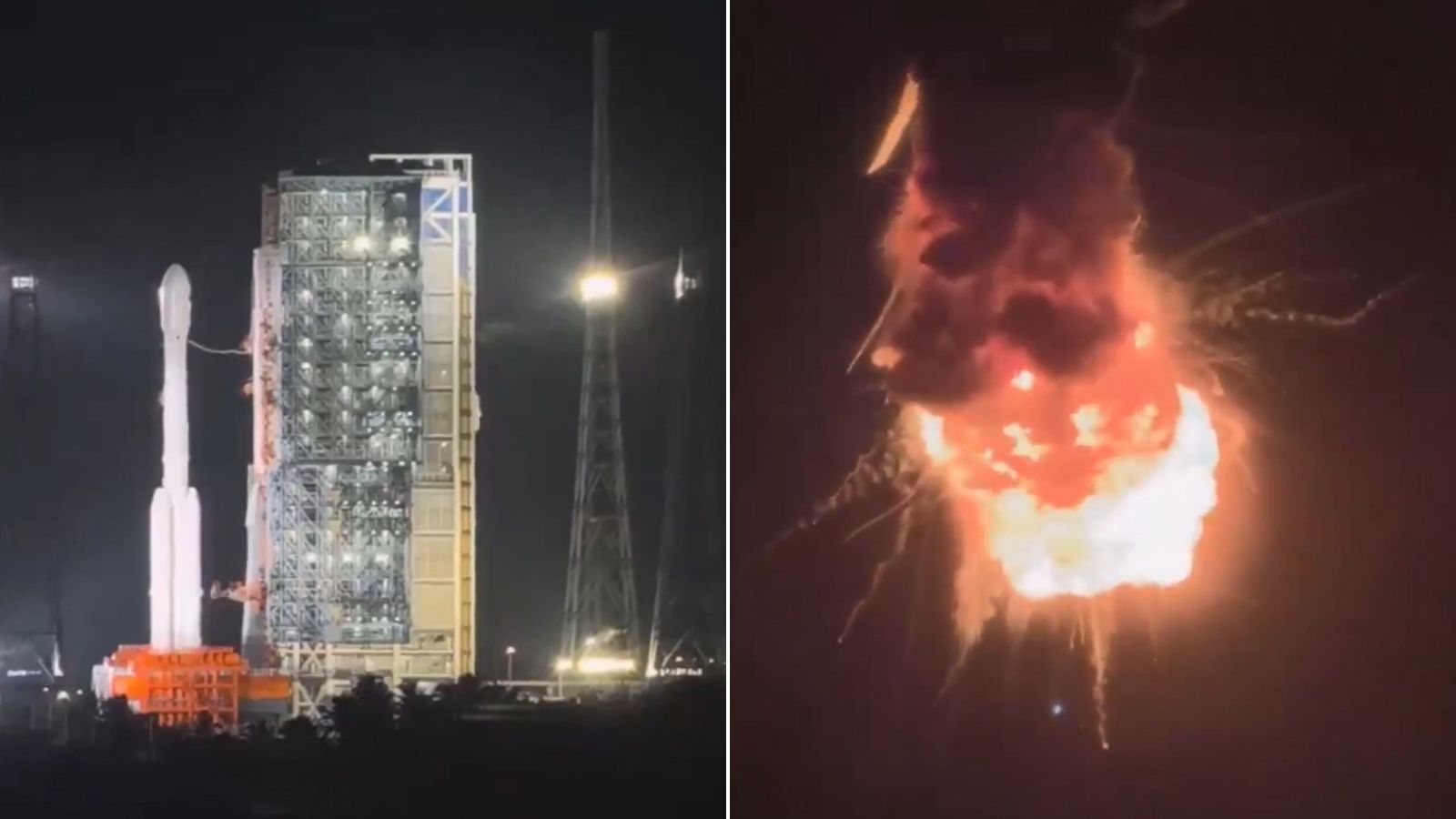
The catastrophic in-flight break-up of a Long March 7A launch vehicle 85 seconds after clearing the pad at the Wenchang Space Launch Site marks a critical juncture for state-owned aerospace manufacturing. Carrying the ChinaSat-4B communications satellite into geostationary transfer orbit, the three-stage liquid-fueled rocket disintegrated well before the scheduled separation of its four liquid strap-on boosters and kerolox core stage. Analyzing this structural failure requires moving past superficial descriptions of an in-flight anomaly and examining the mechanical, thermal, and dynamic stressors operating during the max-Q ascent phase.
The Kinematics of Early Ascent Failure
Flight telemetry from the initial 90 seconds of a medium-lift vehicle trajectory is governed by severe aerodynamic loading and maximum dynamic pressure profiles. At T+85 seconds, the Long March 7A was traversing the regime where aerodynamic drag forces compound structural bending moments.
Optical tracking and long-wave infrared data captured by independent observers indicate a structural separation or containment failure near the upper interface of the core stage prior to booster jettison. Two primary failure mechanisms drive an event of this nature during early-stage ascent:
- Pneumatic and Structural Instability: Uncontained oscillations or Pogo suppression failure within the liquid oxygen and kerosene feed lines can trigger high-frequency longitudinal vibrations, overstressing structural intertanks.
- Aerodynamic Shear Exceedance: Localized buckling of the airframe skin due to unanticipated thermal expansion or manufacturing micro-defects under maximum dynamic pressure.
Because the vehicle was operating at a relatively low altitude and velocity when the flight termination system engaged or structural disintegration occurred, debris dispersal remained localized over the South China Sea. This eliminates orbital debris persistence but confirms total vehicle and payload write-off.
Architectural Constraints of the Long March Variant Family
The Long March 7A occupies a vital replacement niche within the national launch manifest, transitioning geostationary missions away from older, hypergolic propellant architectures like the Long March 3B toward cleaner kerolox and cryogenic combinations. The rocket integrates a modified cryogenic upper stage derived from the 3B series atop a core stage and four boosters inherited from the baseline Long March 7 architecture.
This hybrid pedigree introduces inherent system complexity. Cross-coupling a mature upper stage with a medium-lift core requires specialized interstage adapters designed to manage disparate thermal coefficients and thrust vector loads. When structural failure manifests in the lower or middle segments prior to stage separation, investigators must audit the propagation of vibrational harmonics across these transition interfaces.
Manufacturing cadence serves as an additional variable. The Long March 7A has flown multiple successful missions since its maiden flight failure in March 2020, steadily increasing its operational tempo. Rapid production scaling often introduces variance in non-destructive evaluation protocols for welded joints and composite structures, shifting the statistical probability of material fatigue during high-stress atmospheric flight.
Systemic Ripple Effects Across National Launch Cadence
While the immediate impact is isolated to the loss of the ChinaSat-4B communications asset and the grounding of the 7A fleet pending telemetry review, the broader logistical implications extend across separate vehicle families. National space planners rely on modular engine sharing across different variants.
If the failure investigation isolates the root cause to core-stage propulsion control, turbopump assemblies, or shared avionics software, the review scope widens. However, heavy-lift architectures utilized for upcoming lunar exploration programs operate on distinct propulsion configurations, insulating deep-space timelines from immediate disruption.
The investigation board will prioritize three distinct data streams to reconstruct the final seconds of flight:
- High-Frequency Telemetry Logs: Real-time pressure transducers within the main engine thrust chambers and propellant tanks.
- Kinematic Tracking Data: Radar and optical trajectory plotting to isolate the exact microsecond of structural breach.
- Metallurgical Recovery: Analysis of washed-ashore debris fragments to determine whether failure initiated from fatigue, burn-through, or over-pressure.
Re-establishing flight clearance hinges entirely on isolating the variance between expected mathematical models of airframe stress and the empirical reality captured during the ascent sequence.
Operational Remediation Protocol
Institute an immediate dual-path audit across all active assembly lines for intermediate-class core stages, separating non-destructive testing of structural welds from avionics closed-loop control software verification before clearing any subsequent high-orbit vehicle for integration.