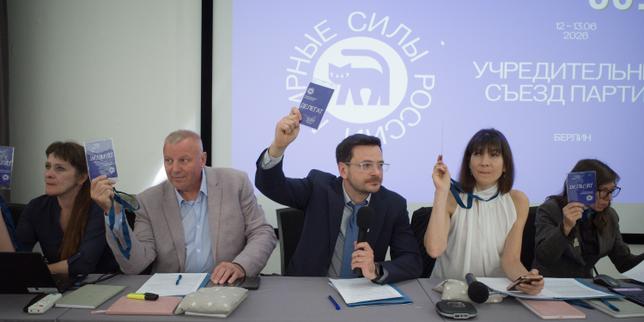
The coffee in Berlin tastes different when you know a sniper could be watching the cafe window. It is too bright. Too safe. For the men and women who recently sat in the penal colonies of Siberia, the clean streets of Western Europe do not feel like freedom. They feel like an intermission.
Ilia Iachine understands this sensory dissonance better than most. Not long ago, he was wearing the coarse uniform of a Russian prisoner, isolated from the world for the crime of speaking the truth about the war in Ukraine. Today, he walks through European capitals, a free man by geopolitical coincidence, expelled during a historic prisoner swap. But his mind remains anchored to the concrete blocks of Moscow.
Political exile is a historically predictable tragedy. It is a slow, suffocating dissolution. Throughout history, when dissidents are pushed beyond their nation’s borders, they usually fall into a familiar trap. They squabble over microscopic ideological differences. They form committees that issue press releases no one reads. They become ghosts, haunting foreign talk shows while the regime back home tightens its grip, safe in the knowledge that the threat has been successfully exported.
Vladimir Putin counts on this fragmentation. He relies on it. By thrusting his most vocal critics into the West, he expects them to dissolve into the background noise of global democracy.
But Iachine refuses to fade. Instead of accepting the quiet life of a decorated political relic, he is attempting the impossible. He is building a new political party from the outside looking in, trying to forge a unified front out of a notoriously fractured diaspora.
The Cold Geometry of Defiance
To understand the weight of what Iachine is attempting, you have to look at the wreckage of the Russian opposition over the last decade. It is a story written in blood and prison sentences. Boris Nemtsov was shot dead on a bridge within sight of the Kremlin. Alexei Navalny survived a chemical poisoning only to perish in an Arctic penal colony.
Those who survived were faced with a brutal calculus: stay and be silenced in a cage, or leave and risk being silenced by irrelevance.
When Iachine was arrested in 2022, he chose the cage. He explicitly stated that an opposition leader must share the fate of his people. His subsequent release in the August 2024 prisoner exchange was not a victory he sought; it was a forced deportation disguised as a humanitarian gesture. The Kremlin did not want him dead yet; they wanted him gone. They wanted him irrelevant.
Consider the psychological whiplash. One day you are waking up to the metallic clang of a prison door, rationing stale bread, and watching your health deteriorate under the deliberate neglect of a state apparatus. The next, you are thrust into a press conference under the soft lights of a Western auditorium, handed a microphone, and expected to articulate a vision for a country that just locked you away.
The temptation to rest is immense. The urge to simply breathe non-toxic air and enjoy the company of friends is almost overwhelming.
Yet, within months of his release, Iachine began traveling. Not for tourism, but for mobilization. He recognized a terrifying truth that many in the West overlook: the Russian diaspora is currently massive, affluent, angry, and completely leaderless.
Since the invasion of Ukraine, hundreds of thousands of engineers, journalists, artists, and academics have fled Russia. They fill the cafes of Tbilisi, the tech hubs of Yerevan, and the apartments of Berlin. They represent the missing future of Russia. But up until now, they have existed as isolated particles, floating in the ether of emigration, consumed by survival guilt and bureaucratic nightmare of visa applications.
Iachine’s initiative is designed to act as a magnet for these scattered particles. He is not just creating an organization; he is trying to construct a legitimate government-in-exile that cannot be ignored by Western leaders or dismissed by the citizens left behind in Moscow.
The Architecture of the Fragmented Mirror
The primary obstacle to this grand vision is not Putin’s secret service, though the threat of polonium or a sudden fall from a window is always present. The real enemy is internal division.
The Russian opposition has historically behaved like a mirror dropped on a hardwood floor. It is shattered into a thousand brilliant, sharp, but utterly disconnected pieces. You have the institutional remnants of Navalny’s Anti-Corruption Foundation, who possess immense digital reach but often guard their autonomy fiercely. You have wealthy oligarchs turned critics, who view the struggle through a financial and geopolitical lens. And you have the grassroots activists, skeptical of anyone claiming to speak for the whole.
Iachine’s unique leverage is his lack of arrogance. In a political subculture dominated by massive egos, he has earned a rare currency: moral authority.
He did not run away when the war started. He stayed, knowing exactly what would happen to him. That act of sacrifice gives him a mandate that cannot be manufactured by slick public relations or Western funding. When he speaks to a room full of cynical exiles in Prague or Paris, they listen because they know he was willing to die for the principles he is now asking them to organize around.
His strategy focuses on three distinct pillars.
First, creating a legal and logistical infrastructure for the diaspora. This means helping exiles maintain their cultural and political identity without assimilating into total silence. It means organizing structured networks that can provide mutual aid, legal defense, and independent media financing.
Second, maintaining a digital bridge back into Russia. The Kremlin has built a digital iron curtain, blocking independent websites and criminalizing the simple act of liking an anti-war post. Iachine’s party aims to utilize sophisticated tech networks to bypass censorship, feeding unfiltered news directly to the millions of Russians who are quietly terrified of their own government but see no alternative.
Third, creating a unified diplomatic voice. When Western leaders discuss sanctions, post-war reconstruction, or immigration policies, they rarely have a single, cohesive Russian entity to negotiate with. Iachine wants to change that. He wants to ensure that the world understands that Putin is not Russia, and Russia is not Putin.
The Invisible Stakeholders
Let us step away from the political theory for a moment and look at a hypothetical reality, one that plays out in thousands of ordinary apartments across Europe and Russia every single day.
Imagine a 26-year-old software engineer from Saint Petersburg. Let's call him Dmitry. Dmitry fled across the border to Georgia in late 2022 to avoid being drafted into a war he despised. He left behind his parents, his apartment, and his dog. Today, he works remotely for a European tech firm. On paper, he is safe. He pays his rent, he drinks craft beer, he goes to the gym.
But beneath the surface, Dmitry is hollow. He feels like a traitor to his Ukrainian friends because of his passport. He feels like a coward to his family back home because he ran away. He spends his evenings scrolling through Telegram channels, watching his country slide further into a dark, nationalistic fever dream. He wants to help, but he doesn't know how. Sending money to the Ukrainian military could land his parents in a Russian prison. Speaking out online risks his ability to ever see his mother again.
Dmitry is the invisible stake in Iachine’s gamble.
If Iachine’s party remains just another talking shop for intellectual elites, Dmitry will eventually stop looking at the news. He will change his last name, master English or German, and completely sever his ties to his homeland. Russia will permanently lose another brilliant mind, and Putin’s victory over the future will be absolute.
But if Iachine can give Dmitry a meaningful way to participate—a way to vote in shadow elections, a way to securely contribute to underground distribution networks, a way to feel part of a legitimate, moving historical force—then the regime back home has a massive problem. Suddenly, they are not just dealing with a few loud voices in Berlin. They are dealing with an organized, highly competent, resource-rich nation outside the borders, working systematically to undermine the tyranny within.
This is the emotional core of the movement. It is the battle against despair. The ultimate weapon of the modern authoritarian state is not violence; it is the manufacturing of hopelessness. When people believe nothing can change, they stop trying. Iachine’s true mission is the systematic destruction of that hopelessness.
The Shadow of the Kremlin’s Reach
The danger of this enterprise cannot be overstated. The Russian state does not stop hunting its enemies at the border control checkpoints.
In recent years, we have seen dissidents attacked with hammers in Vilnius, poisoned in Salisbury, and shot in Berlin parks. The European cities that host these new political movements are not sanctuaries; they are front lines. Every meeting Iachine organizes, every server his party secures, every bank account they open is a target for state-sponsored cyber warfare and physical espionage.
There is a palpable tension in these circles. When you enter a room where these activists meet, the phones are left in another room, or placed inside signal-blocking pouches. People look at the door when it opens. The conversations are urgent, spoken in rapid, quiet Russian, punctuated by the sharp smoke of cigarettes.
It is a terrifying way to live. It requires a specific kind of psychological resilience to know that your name is on a list in a building in Moscow, and that your elimination would be celebrated as a victory by the most powerful men in your home country.
Yet, when you observe Iachine in these environments, there is no panic. There is an eerie, focused calm. Prison either breaks a man completely or burns away all his superficial anxieties, leaving behind something dense and unbreakable. Iachine walks through these high-stakes rooms with the easy demeanor of a man who has already faced the worst his enemies could throw at him and walked out the other side.
The doubt, however, remains. Can a party born in exile ever truly claim power in a country that has been systematically cleansed of democratic institutions? History is a harsh judge on this matter. For every Vladimir Lenin who returned in a sealed train to seize a collapsing empire, there are a thousand forgotten democrats who died in London or Paris boarding houses, writing manifestos that were eventually thrown in the trash.
Iachine knows these odds. He is a student of history. He understands that the probability of failure is high. But he also understands that doing nothing guarantees failure.
The Unwritten Ending
The success of this new opposition movement will not be measured by traditional electoral victories. There are no free elections coming in Russia anytime soon. The success will be measured in the quiet preservation of alternative ideas.
It will be measured by the leaflet passed hand-to-hand in a factory in the Urals, printed from a file downloaded via an opposition network. It will be measured by the tech worker in Lisbon who decides to write code for a secure communication platform rather than a mobile game. It will be measured by the slow, steady erosion of the fear that currently keeps millions of Russians silent.
The regime looks monolithic from the outside. Huge military parades, absolute control over television, ninety-percent electoral victories manufactured by administrative decree. But monoliths are brittle. They do not bend when the pressure changes; they crack. And when they crack, the collapse happens with terrifying speed.
When that day comes, the country will need an alternative. It will need leaders who have spent the years of darkness preparing, organizing, and building the structures of a modern state. It will need people who can step into the vacuum before the old system simply reconstitutes itself under a new dictator.
That is what Ilia Iachine is building in the gray light of European exile. It is an insurance policy for the soul of his country.
The meeting in the cafe ends. The laptops are closed. The activists disperse into the Berlin drizzle, disappearing into the crowd of tourists and commuters. They look like everyone else. But they carry an invisible weight, a heavy, burning piece of a country they had to leave behind, waiting for the moment they can bring it home.


