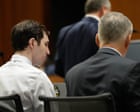
The preliminary hearing of Tyler James Robinson in Provo, Utah, establishes a clear framework for how prosecutors intend to secure a capital conviction for the assassination of political activist Charlie Kirk. Rather than relying on a single piece of incriminating evidence, the state has built a multi-layered evidentiary matrix designed to prove premeditation, spatial positioning, and physical attribution. The state's strategy relies on intersecting surveillance logs, forensic biology, and recovered written admissions to eliminate alternative hypotheses of innocence.
A critical assessment of the preliminary hearing reveals three fundamental pillars supporting the prosecution's case, alongside the structural vulnerabilities the defense intends to exploit as the matter moves toward trial.
The Timeline of Premeditation and Behavioral Shift
The state's narrative of intent depends on a precise chronological mapping of Robinson's movements on September 10, 2025, at Utah Valley University (UVU). Former State Bureau of Investigation Agent David Hull detailed this sequence using campus surveillance networks, establishing what the prosecution terms a behavioral pattern of reconnaissance.
The chronology operates across three distinct operational phases:
- The Reconnaissance Phase (08:29 – 12:00 MDT): Robinson arrived on campus roughly four hours prior to the shooting in a gray Dodge Challenger. During this window, he walked the campus grounds in casual attire—shorts and a T-shirt—and purchased a meal at a campus Chick-fil-A. Crucially, investigators documented that Robinson made direct contact with representatives of Kirk's organization, Turning Point USA, at the open-air amphitheater where the speaking event was scheduled to occur. This interaction establishes early, physical proximity to the target zone and directly counters any defense narrative of random or impulsive presence.
- The Tactical Disguise Phase (12:00 – 12:15 MDT): Surveillance footage shows a distinct change in operational posture. Robinson left the immediate area and returned wearing a dark baseball cap, large sunglasses, and a black shirt featuring a United States flag or eagle motif. This rapid wardrobe change provides the legal foundation for premeditation, indicating a conscious effort to alter his visual signature before executing the strike.
- The Execution Phase (12:15 – 12:23 MDT): The final phase tracks Robinson's physical approach to the firing position. Surveillance footage captures the suspect entering the Losee Center from the southeast side and ascending an adjacent exterior stairwell. At approximately 12:15 p.m., the individual climbed over a public walkway safety railing directly onto the gravel roof of the building.
The video evidence documents the suspect crouching low, sprinting across the roof area, and assuming a prone position facing the amphitheater where Kirk began speaking at 12:11 p.m. At exactly 12:23:30 p.m., a single round was fired, striking Kirk in the neck from a distance of approximately 142 yards (130 meters).
Spatial Mechanics and Ballistic Positioning
The physical geography of the UVU campus dictates the ballistic reality of the homicide. Former UVU Police Officer Christopher Bagley testified to the immediate post-incident sweep of the high-ground structures. His findings establish the structural framework of the shooting position, which he described in court as a "sniper pad."
The spatial mechanics of the crime scene involve a direct line of sight from the gravel roof of the Losee Center to the open-air stage below. Physical impressions found in the gravel roof material match the dimensions of a shooter lying prone on their stomach. This specific physical footprint corroborates the surveillance video showing the suspect entering the roof and adopting a stable shooting posture.
The timeline of the suspect's retreat further reinforces the spatial logic of the prosecution. Immediately following the discharge at 12:23 p.m., video footage shows the individual rising from the prone position, running back across the roof, lowering himself down from the structure, and fleeing the campus perimeter on foot.
The weapon itself was discovered during a secondary sweep on the morning of September 11, hidden within a wooded area adjacent to the campus grounds. Investigators recovered a Mauser 98 bolt-action rifle wrapped inside a towel. The weapon contained a single spent shell casing in the chamber, aligning perfectly with the singular acoustic profile and ballistic trauma reported at the scene.
The Forensic Attribution Matrix
To tie Tyler Robinson to the physical evidence, the prosecution introduced DNA analysis and digital admissions, forming an attribution matrix designed to isolate the defendant as the sole logical actor.
The biological evidence centers on multiple items recovered from the roof and the secondary disposal site:
- The Screwdriver: Collected from the rooftop perch at the Losee Center, the tool yielded an autosomal DNA profile. FBI DNA analyst Amanda Bakker testified that Robinson was included as a contributor to the genetic material found on the item.
- The Towel and Rifle: The towel used to conceal the Mauser 98 rifle contained a complex mixture of DNA. Forensic testing identified two primary contributors: Tyler Robinson and his roommate, Lance Twiggs.
The defense has signaled its intent to target the limitations of transfer DNA technology. During cross-examination, defense attorneys emphasized that the presence of an individual's DNA on an object does not inherently confirm physical contact, nor does it establish a timeline for when the biological material was deposited. Given that federal guidelines prohibit analysts from claiming "absolute identification" or "scientific certainty," the defense will attempt to leverage the inherent probabilistic nature of mixed DNA profiles to introduce reasonable doubt.
Digital and Written Documentation of Intent
The prosecution seeks to bridge the gap between physical presence and criminal culpability through explicit statements of intent recovered during the hours following the shooting. These statements supply the subjective component required for an aggravated murder charge under Utah law.
The state introduced a handwritten note recovered from the residence Robinson shared with his roommate. The text explicitly states an intent to act: "I had the opportunity to take out Charlie Kirk and I'm going to take it." This is paired with an outbound text message sent by Robinson stating he targeted Kirk because he "had enough of his hatred."
The defense attempted to block the admission of external political context, specifically a statement from Turning Point USA board member David Englehardt outlining the traditional values of the organization. The defense argued that such statements do not illuminate Robinson's specific state of mind and risk turning the judicial proceeding into a referendum on the intersection of religion and politics. However, Judge Tony Graf provisionally admitted the statement, recognizing its relevance to the state's pursuit of sentence enhancements based on the targeted nature of the political assassination.
Law Enforcement Anomalies and Tactical Blindspots
A core vulnerability in the state's narrative lies in the operational timeline and initial missteps executed by law enforcement agencies during the first 24 hours of the investigation. The defense will likely weaponize these inconsistencies to challenge the integrity of the scene management.
The initial response was characterized by significant communication failures. Minutes after the shooting, UVU authorities incorrectly announced a suspect was in custody. This misinformation was amplified hours later when state officials and FBI Director Kash Patel publicly stated that the subject was detained, only to walk back the announcements when the individual in question was cleared and released.
The defense highlighted other anomalies during the preliminary hearing:
- The Unrelated Bullet: A live round discovered at an alternate location on campus was initially logged into evidence. Under cross-examination, investigators admitted the bullet belonged to a responding law enforcement officer who had cleared their weapon at the scene, revealing a lack of strict containment protocols in the immediate aftermath of the event.
- The Backpack Handgun: A secondary firearm—a handgun inside a backpack—was also recovered within the campus perimeter. The presence of secondary weapons and unrelated tactical movements by law enforcement will be leveraged by the defense to suggest a chaotic environment where cross-contamination of physical evidence was a distinct operational risk.
The Strategic Trajectory Toward Trial
The preliminary hearing serves a binary purpose: it acts as a baseline screening mechanism for Judge Tony Graf to determine if probable cause exists, while providing a public blueprint of the upcoming trial strategies.
The state has successfully established a high-density chain of evidence combining continuous video tracking, physical impressions at the sniper nest, biological markers on the tools of the crime, and explicit written confessions. To counter this, the defense is optimizing a multi-pronged strategy that avoids a direct denial of presence, focusing instead on the mechanics of the evidence collection.
The defense strategy will focus heavily on challenging the DNA transfer protocols, capitalizing on the initial multi-agency communication failures, and attempting to decouple the political ideology of Turning Point USA from the legal definition of criminal intent. Because the state is actively pursuing the death penalty, the prosecution must maintain an airtight chain of custody and an unassailable chronological model. The inclusion of the surveillance video showing the suspect scaling the railing and adopting the prone posture forms the baseline anchor of the state's case, forcing the defense to fight an uphill battle centered almost entirely on technical forensic vulnerabilities.