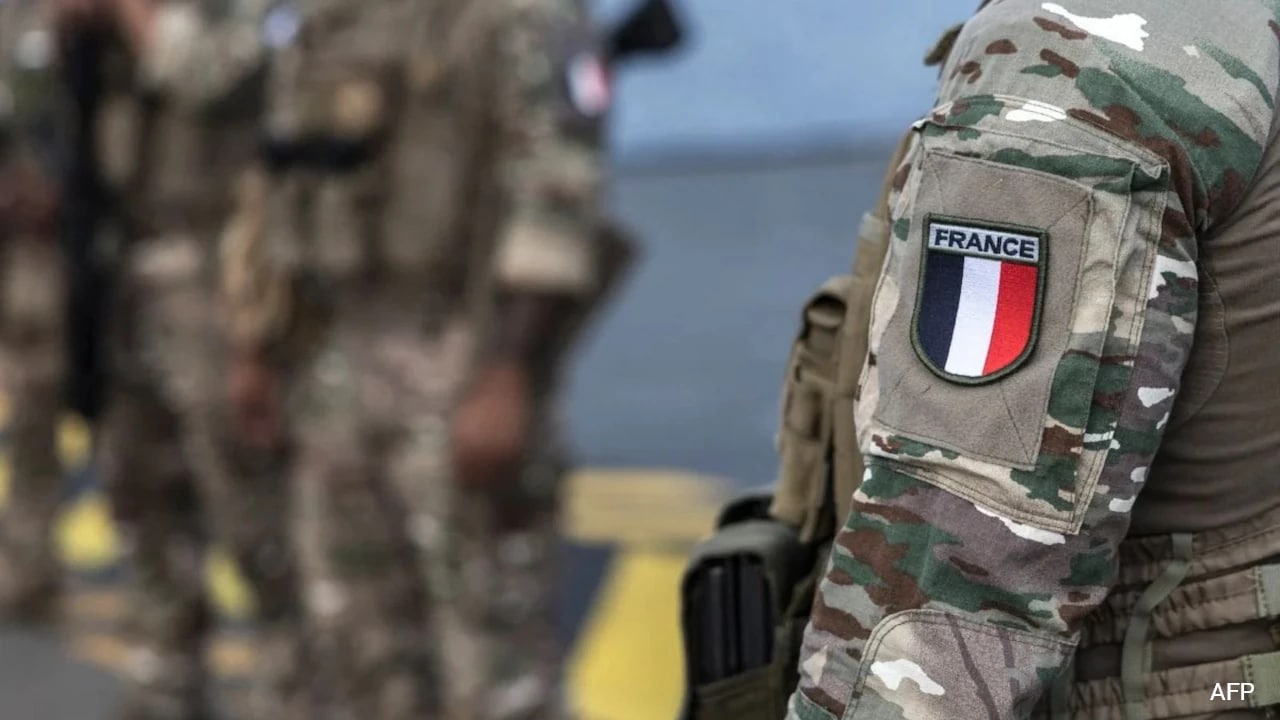
Mainstream defense journalism has a fatal addiction to binary thinking.
Either a NATO nation is formally at war with Russia, or it isn't. Either a uniform with a French tricolor patch is standing in a muddy trench outside Pokrovsk, or Paris is telling the whole truth when it dismisses Moscow’s claims as "absurd."
That lazy consensus makes for easy headlines. It also blinds you to how modern proxy warfare actually works.
When the Russian Foreign Intelligence Service (SVR) drops a press release claiming France is preparing a 2,000-strong contingent for Ukraine, and the French Ministry of the Armed Forces immediately fires back calling it a disinformation campaign, retail news consumers pick a side based on their geopolitical tribe. Both sides of that argument are missing the mechanics of grey-zone escalation.
If you are waiting for an official declaration of troop deployment—complete with televised press conferences and battalions marching across the Polish border—you are fighting the last war. By the time a conventional army officially arrives in a modern conflict, the decisive operational groundwork has already been laid in the shadows for years.
The Semantic Trap of "Deployment"
To understand why Paris can issue a categorical denial with a straight face while Moscow’s intelligence apparatus screams about NATO intervention, you have to look at the legal and military definitions of deployment.
In strict military doctrine, a deployment refers to the strategic movement of formed, active-duty military units into a theater of operations under a formal chain of command. Under that narrow definition, France is telling the truth. The 2nd Foreign Infantry Regiment is not currently conducting platoon-level assaults in the Donbas.
Here is the nuance the headlines skip: modern high-intensity warfare doesn't require active-duty infantry battalions to achieve tactical parity. It requires technicians, targeteers, intelligence analysts, and deniable contractors.
I have spent over a decade watching defense ministries and private military contractors (PMCs) navigate the blurry legal boundaries of foreign interventions from the Sahel to Eastern Europe. Whenever a Western capital issues a blanket denial about "troops on the ground," they are almost always leaning on a strict bureaucratic technicality. They aren't lying; they are using lawyer-speak to obscure the reality of force multiplication.
Consider the hardware France has already sent to Kyiv:
- CAESAR self-propelled howitzers requiring complex ballistics software updates.
- SCALP-EG long-range cruise missiles that demand precision terrain-contour matching data.
- SAMP/T air defense systems operating on encrypted NATO-standard tactical data links.
These are not cold-war rifles you hand to a conscript with a laminated instruction manual. Every time a SCALP-EG missile threads the needle through Russian air defenses to hit a hardened bunker in Crimea, someone has to feed that weapon system high-resolution satellite telemetry and electronic warfare mapping.
Does a Ukrainian pilot press the release button? Yes. Does a French military advisor or defense contractor sitting in a secure facility—either in Poland or inside Ukraine under diplomatic cover—help build the targeting package? History and basic operational necessity suggest the answer is almost certainly yes.
Strategic Ambiguity Is Not a Gaffe
Remember when French President Emmanuel Macron floated the idea of sending Western troops to Ukraine, sending Berlin and Washington into a full-blown diplomatic panic?
Pundits immediately labeled it a reckless verbal stumble. They claimed Macron was isolated, desperate for relevance, and playing directly into Vladimir Putin’s hands by validating Kremlin propaganda about a wider NATO war.
That interpretation completely misunderstands French strategic culture.
Since the days of Charles de Gaulle, French nuclear and defense doctrine has relied heavily on calculated ambiguity. Unlike the United States, which prefers massive, transparent displays of deterrence—parking carrier strike groups off a coast and broadcasting every move—Paris prefers to keep adversaries guessing where its red lines actually sit.
For two years, Western leaders did Vladimir Putin an enormous favor. They publicly announced, over and over again, exactly what they would not do. No jets. No long-range missiles. No main battle tanks. No troops.
In strategy, telling your opponent your exact self-imposed limits is suicidal. It allows the adversary to calculate risk with zero uncertainty. Russia knew precisely how far it could push escalatory boundaries without triggering a direct NATO response.
By introducing the possibility of French troops—and then aggressively denying specific Russian claims while refusing to rule out future options—Paris shattered Moscow’s risk calculus. Russia now has to allocate intelligence, surveillance, and reconnaissance (ISR) assets to hunt for French logistics hubs, second-guess whether specific strikes were coordinated by NATO officers, and hold reserve forces back just in case.
You don't need 2,000 French legionnaires in a trench to tie down a Russian brigade. You just need the Kremlin to believe they might show up.
Why Moscow Fabricates the Numbers
If France is relying on ambiguity, why does Russia keep publishing specific, easily debunked numbers about French casualties and troop deployments?
In early 2024, the Russian Defense Ministry claimed it killed 60 "French mercenaries" in a precision strike on Kharkiv. Later, SVR Director Sergey Naryshkin claimed Paris was preparing a 2,000-troop contingent. Paris easily swatted both claims down because Russia couldn't produce a single dog tag, passport, or body.
When an intelligence agency puts out numbers that fail basic open-source intelligence (OSINT) verification, they aren't trying to fool Western defense analysts. They know we know the numbers are inflated.
Moscow’s narrative serves three distinct, domestic and regional purposes:
- Explaining Battlefield Friction: The Russian military cannot admit to its domestic audience that a smaller, Western-equipped Ukrainian force is inflicting staggering casualties on the Russian army. Framing the conflict as a direct war against French, British, and Polish regular troops makes a grinding, bloody stalemate palatable to the Russian public.
- Information Saturation: By flooding the zone with exaggerated claims of NATO deployments, the Kremlin creates cognitive fatigue. When actual, smaller-scale Western advisory missions eventually come to light, the public has already tuned out the noise.
- Splitting the Western Coalition: Moscow knows that voters in Berlin, Rome, and Washington are terrified of World War III. Every time the Kremlin accuses Paris of secretly deploying troops, it forces German Chancellor Olaf Scholz or U.S. officials to publicly distance themselves from France, exposing fractures in NATO unity.
The Grey-Zone Reality Nobody Wants to Admit
If you want to understand what is actually happening on the ground in Ukraine right now, stop looking for uniformed infantry divisions and start looking at the shadow architecture of modern warfare.
Imagine a scenario where a Western European nation wants to maximize its military impact in Ukraine without triggering Article 5 of the NATO treaty or sparking mass protests at home. How do you execute that?
You use a tiered deployment model:
| Tier | Personnel Type | Legal Status | Primary Function |
|---|---|---|---|
| Tier 1 | Embassy Defense Attachés | Diplomatic Immunity | High-level strategic liaison and intelligence sharing in Kyiv. |
| Tier 2 | Active-Duty Specialists | Temporary Duty (TDY) | Maintenance, cyber defense, and electronic warfare training away from the zero line. |
| Tier 3 | Private Contractors | Civilian / Corporate | Heavy vehicle repair, drone software integration, and logistics management. |
| Tier 4 | Foreign Volunteers | Ukrainian Military Contract | Direct frontline combat under the International Legion banner. |
Notice that none of these tiers constitute a "French military deployment" in the traditional sense. Yet collectively, they deliver the exact same operational output: Western tactical intelligence, Western logistical sustainment, and Western weapons maintenance operating inside Ukrainian borders.
We saw this exact playbook in Vietnam in the early 1960s, in Afghanistan in the 1980s, and across the Middle East for the last twenty years. Superpowers rarely collide head-on at the start of a conflict. They collide through advisors, technicians, and deniable cutouts.
There is a massive downside to this contrarian reality, and defense hawks hate admitting it: grey-zone escalation has no clear off-ramp.
When armies fight openly, treaties, ceasefires, and prisoner exchanges follow established rules of war. When nations wage war through deniable specialists, contractors, and intelligence cutouts, both sides lose control of the escalation ladder. If a Russian hypersonic missile strikes a maintenance depot in Lviv and kills twelve French defense contractors working for a private aerospace firm, what happens next?
Paris cannot invoke NATO’s collective defense clause for private citizens working in a war zone. Yet the domestic political fallout in France would be volcanic. The pressure to retaliate asymmetrically—perhaps by feeding Ukraine targeting data to sink a major Russian naval asset—becomes immense.
That is the real danger. Not a sudden invasion of Ukraine by the French Foreign Legion, but a slow, opaque creep of Western personnel into the blast radius of Russian long-range fires.
Are French Troops Fighting in Ukraine Right Now?
Let’s cut through the diplomatic spin and answer the question directly.
If you mean formed units of the French Army fighting under the French flag: No. Russia’s claim of a 2,000-man expeditionary force is pure psychological warfare designed for domestic consumption.
If you mean French citizens with military backgrounds fighting on the front lines: Yes. Hundreds of Western volunteers, including former French soldiers, have signed contracts with the Ukrainian Armed Forces. They are legally Ukrainian soldiers, paid by Kyiv, and fighting without official backing from Paris.
If you mean active-duty French military personnel operating inside Ukraine in advisory, intelligence, or technical capacities: Almost certainly. Former German Chancellor Olaf Scholz accidentally let this cat out of the bag when explaining why Germany wouldn't send Taurus cruise missiles to Ukraine. He explicitly noted that British and French personnel were already on the ground in Ukraine helping manage Storm Shadow and SCALP targeting—a comment that infuriated London and Paris precisely because it violated the unspoken rule of operational silence.
How to Read Geopolitical Denial Like an Insider
The next time a defense ministry calls an adversary's intelligence claim "absurd," don't take the bait. Stop reading the press release as a statement of objective fact and start reading it as a weaponized piece of statecraft.
If you want to track where this conflict is actually heading, ignore the loud press conferences and watch three concrete indicators instead:
- Defense Industry Joint Ventures: Watch where European arms manufacturers like KNDS (the Franco-German defense giant) are building physical repair facilities. When a company announces it is opening a maintenance hub inside Ukraine rather than in Poland, you can guarantee Western technical personnel—and the security forces required to protect them—are following right behind.
- ISR Flight Patterns: Open-source flight trackers regularly pick up French Air Force Boeing E-3F Sentry AWACS planes and Dassault Falcon electronic intelligence aircraft flying orbits over the Black Sea and eastern Romania. When those flight paths shift closer to the Ukrainian border, operational coordination is spiking.
- Sudden Shifts in Ukrainian Strike Precision: When Ukraine suddenly develops the capability to bypass newly deployed Russian electronic warfare jamming systems overnight, that software patch didn't materialize out of thin air. It came from Western signals intelligence teams analyzing Russian emissions in real time.
Stop asking whether France is going to send troops to Ukraine. The uniforms are already redundant. The software, the targeting data, the logistics chains, and the technicians keeping them alive are already in the fight.



