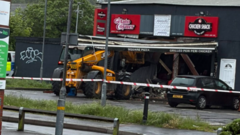
A multi-ton JCB telehandler gets hotwired on a remote farm in the dead of night. It rumbles down narrow country lanes, completely unnoticed, until it crashes through the brick facade of a local takeaway or convenience store. The headlines write themselves. They always focus on the sensational damage, the audacity of the thieves, and the shattered local business left in the wake.
The media treats these incidents like freak occurrences. They view them as unpredictable acts of chaos.
They are wrong.
This is not a story about rising rural crime or desperate local thugs. It is a story about a systemic failure in heavy equipment security and a willful blindness by asset owners. For decades, the construction and agricultural sectors have treated massive, destructive pieces of machinery with the same casual security mindset you might apply to a lawnmower.
We need to stop looking at the ruined storefronts. We need to start looking at the ignition switches.
The Myth of the Unstoppable Heavy Machinery Thief
When a JCB or a Caterpillar machine is driven through a wall, the standard industry response is a collective shrug. Property owners assume that if a criminal wants to steal a heavy asset, they will find a way.
This passive consensus is lazy. It is also entirely inaccurate.
I have spent years auditing supply chains and physical security protocols for industrial operations. I have seen companies watch a $100,000 asset roll off a site because nobody wanted to spend $500 on a secondary immobilizer. The harsh reality is that agricultural and construction equipment remains absurdly easy to steal.
Many older models, and even some surprisingly modern ones, still rely on universal keys. A single key can unlock and start an entire generation of telehandlers or excavators from the same manufacturer. Thieves do not need complex hacking tools. They do not need to bypass sophisticated electronic networks. They just need a standard key they bought online for five dollars, or a basic understanding of how to bridge a starter motor on a machine left in an unlit field.
When a farm owner leaves a multi-ton weapon parked next to a low hedge with the ignition system exposed, they are not just a victim of theft. They are an unwitting accomplice to the property destruction that follows.
Dismantling the Premium Security Illusion
Manufacturers will tell you they offer advanced security packages. They talk about GPS tracking, geofencing, and digital fleet management.
Do not fall for the marketing brochure.
Most factory-installed GPS tracking systems are trivial to defeat. A cheap, battery-powered jammer ordered from overseas can easily block the cellular and GPS frequencies used by standard telematics units. Thieves know exactly where these factory units are installed. They can rip them out within two minutes of gaining access to the cab.
The Reality of Geofencing: Geofencing only tells you that your machine has already left the property. It does not stop the machine from moving. By the time an automated text alert wakes a farmer up at 3:00 AM, the JCB is already halfway through the front of a post office five miles away.
True security requires layered, physical disruption. It means installing aftermarket digital immobilizers that require a unique PIN code or an encrypted proximity token before the fuel pump will even engage. It means installing hidden, secondary battery isolation switches in locations that cannot be guessed in thirty seconds.
If a thief cannot start the engine within sixty seconds, they move on. They want an easy target, not a mechanics lesson in the dark.
The Financial Delusion of "Insurance Will Cover It"
There is a dangerous mindset among many fleet operators and farmers that insurance premiums abstract away the risk. They assume that because the machine is covered, the ultimate cost of theft is negligible.
This is a massive financial miscalculation.
Let us look at the real math behind a heavy equipment theft:
| Cost Type | Covered by Insurance? | Real-World Business Impact |
|---|---|---|
| Asset Replacement | Yes (Minus Deductible) | Long lead times for new machinery cause project delays. |
| Premium Hikes | No | A single major theft can double or triple future insurance costs. |
| Collateral Liability | Varies | Legal battles over negligence if the machine caused severe public harm. |
| Operational Downtime | No | Lost productivity while waiting for a replacement machine to arrive. |
When your stolen machine is used to destroy a local business, your brand value evaporates. The community does not just blame the faceless thieves; they remember whose machine demolished their favorite weekend spot. The regulatory scrutiny that follows can halt operations for weeks.
Why the Current Response to Rural Crime is Flawed
Whenever these high-profile ram-raids happen, local authorities and trade unions immediately call for more police patrols in rural areas.
This is asking the wrong question entirely.
The police cannot patrol every square mile of farmland. They cannot stand guard over every isolated barn or construction site. Expecting taxpayers to fund a continuous security detail for private heavy equipment is absurd.
The responsibility must shift entirely to the asset owners and the manufacturers. We need to treat heavy machinery with the same level of digital and physical security that we apply to modern passenger vehicles. You cannot easily hotwire a modern hatchback without the encrypted key fob communicating with the engine control unit. Why should a machine capable of leveling a building be any different?
Implementing a Zero-Trust Asset Protocol
If you want to protect your assets and prevent your equipment from becoming a battering ram, you must adopt a zero-trust framework for physical security.
- Ditch the Factory Key: Retrofit every single piece of mobile plant equipment with an independent, keypad-based ignition lock. If the operator does not enter a five-digit code, the starter motor stays dead.
- Physical Defenses Matter: Never park high-risk assets like telehandlers or excavators near the perimeter of a property. Block them in with passive obstacles—dead weights, heavy concrete blocks, or other non-mobile machinery.
- Decouple the Hydraulics: When parking a machine for the night, drop the boom completely, ground the bucket, and dump the hydraulic pressure. A machine with its wheels off the ground or its arms locked in an awkward position is far harder to move quickly.
This approach requires extra effort. It adds friction to the daily routine of your operators. It forces people to change how they work.
But friction is exactly what deters criminals.
Stop waiting for the manufacturing sector to fix this problem out of the goodness of their hearts. Stop waiting for rural police forces to miraculously double their headcount. Take control of your own machinery, secure the ignition systems properly, and stop providing the criminal underworld with the free heavy artillery they use to tear down our communities.