The mainstream travel press is currently executing a flawless masterclass in setting people up for massive disappointment.
As the countdown ticks closer to the August 12, 2026 total solar eclipse across Spain, a predictable wave of identical, lazy itineraries has flooded the internet. They all repeat the same copy-pasted recommendations: book a beachfront hotel in Mallorca, find a romantic cliffside in Galicia, or head to the historic plazas of Valencia and Bilbao.
It sounds idyllic. It is also an absolute logistical trap.
If you follow the generic advice to park yourself on a Mediterranean beach or a rugged Atlantic cliffside, you are highly likely to stare at a wall of maritime fog, a haze-filled horizon, or a giant mountain range blocking the sun entirely.
The 2026 eclipse is not the 2024 American eclipse. The mechanics are completely different, the geometry is brutal, and the conventional wisdom is dead wrong. Here is the actual data-driven reality of what it takes to catch totality in Spain without getting burned by the geometry of the solar system.
The Sunset Illusion and the Geometry Problem
Every travel blogger pushing coastal destinations is ignoring a fundamental astronomical metric: solar altitude.
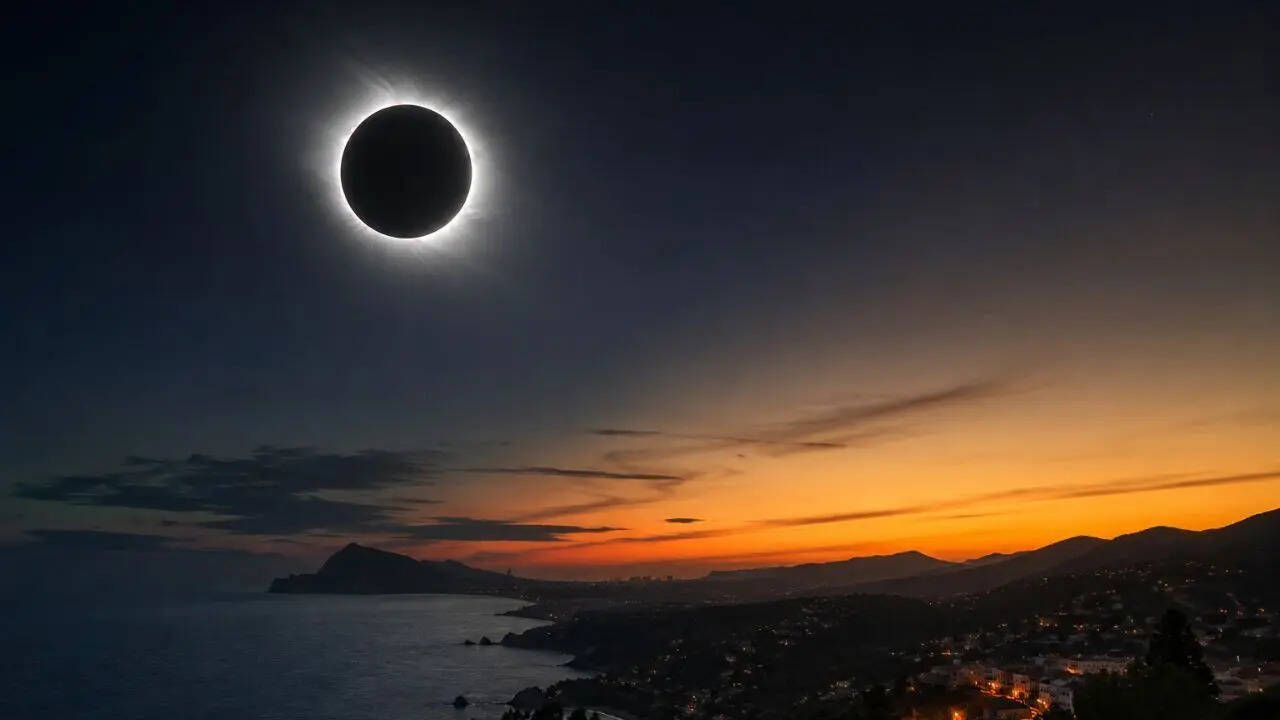
On August 12, 2026, the path of totality sweeps from the northwest coast of Spain down to the Mediterranean and the Balearic Islands. But because this event occurs late in the evening, the sun will be incredibly low in the sky.
In Galicia, where the shadow first touches the mainland, the sun will sit roughly 11 to 12 degrees above the western horizon during totality. By the time the shadow reaches Valencia and Mallorca, the sun will be a mere 2 degrees above the horizon.
Imagine holding your fist out at arm's length against the horizon. That represents roughly 10 degrees. In Mallorca, the eclipsed sun will be lower than a fraction of your knuckles.
Solar Altitude at Totality (August 12, 2026)
===================================================
Location             Altitude Above Horizon
---------------------------------------------------
A Coruña (Galicia)   ~11.5°
Burgos (Castile)     ~7.0°
Valencia             ~4.4°
Palma (Mallorca)     ~2.1°
===================================================
When the sun is only 2 to 4 degrees off the ground, the slightest obstruction ruins everything. A two-story hotel, a row of palm trees, a distant hill, or even the natural curvature of a headland will block your view.
Worse, human vision must pierce through the thickest, dirtiest layer of the atmosphere when looking directly at the horizon. This is called atmospheric extinction. Dust, humidity, and coastal haze will severely degrade the clarity of the solar corona. If you are standing on a beach in Mallorca looking at a sun 2 degrees above the water, a thin layer of marine haze on the horizon—invisible during the day—will completely erase the eclipse.
The Costly Myth of the Romantic Coastline
Let’s dismantle the specific locations the glossy brochures are pushing.
The Galicia Mistake
Travel guides point to Cape Finisterre or Praia das Catedrais because they face the ocean. They note that Galicia gets the highest solar altitude. What they fail to mention is the historical meteorological data.
Northern and northwestern Spain are notoriously humid and prone to the mar de nubes (sea of clouds). Satellite cloud-cover data collected over the last two decades shows that Galicia has a 50% to 60% average chance of cloud cover in mid-August evening hours. The Atlantic ocean air hits the warm land, cools rapidly as the sun goes down, and creates thick coastal fog right at the exact hour of totality.
The Mallorca Trap
Mallorca sits right on the edge of the southern limit of the path of totality. Not only is the sun practically touching the water, but the duration of totality drops significantly the closer you get to the edge of the path.
In Palma, you will get barely over a minute of totality, assuming the sea haze doesn't swallow the 2-degree view. You are paying premium island high-season prices for the worst viewing geometry on the peninsula.
The Inland Solution
To actually see the corona, you have to abandon the coast and head to the high, dry, unglamorous interior. You need altitude to get above the dense surface air, and you need flat, unobstructed western horizons. Spain is the second most mountainous country in Europe; finding a flat western horizon is remarkably difficult unless you know where to look.
The smart money is on the northern high plateau of the Iberian Peninsula: the Meseta Central, specifically within the autonomous community of Castile and León.
Why the Meseta Central Beats the Coast
-----------------------------------------------------------------
1. Low Humidity: Minimal risk of evening marine fog or low haze.
2. Flat Horizons: Massive agricultural plains with zero obstructions.
3. Higher Elevation: Thinner air means less atmospheric distortion.
4. Better Logistics: Easy highway access to pivot if clouds form.
Areas around Palencia, Burgos, and Valladolid offer wide-open, flat agricultural fields where the wheat has already been harvested by August. The horizon is a straight line. The solar altitude here is around 7 to 9 degrees—low, but perfectly manageable if you have miles of flat ground in front of you.
More importantly, the cloud-cover probability drops drastically to less than 30% in these interior plains compared to the damp northern coast.
The High-Altitude Alternative
If you want absolute insurance against low-level clouds, you don't go to a beach; you go to the mountains, but you must position yourself on a western-facing slope with a drop-off view.
The Javalambre Astronomical Observatory region in Teruel or the high plains of Soria offer elevated vistas where the air is exceptionally dry. The key here is checking your sightlines beforehand using topographical mapping software. If you are in a valley facing west toward a mountain peak, you will watch the shadow eat the sun before totality even begins. You must be on the ridge looking down over the western plains.
Tactical Operations for August 12
If you are serious about witnessing this event, stop looking at hotel bookings and start looking at car rentals and road networks.
The single biggest mistake eclipse-chasers make is staying anchored to a fixed hotel reservation. Weather patterns shift. A localized thermal low can bring unexpected cloud banks over the northern plateau 48 hours before the event.
The ultimate strategy is flexibility.
- Base yourself in an interior hub: Cities like Valladolid, Burgos, or Zaragoza have excellent highway infrastructure (the A-62, A-1, and AP-68).
- Monitor satellite imagery: Six hours before totality, look at real-time visible satellite channels to see where convective clouds or high cirrus are forming.
- Be ready to drive: If Burgos is cloudy, the highway system allows you to shoot west toward Palencia or southeast toward the plains of Aragon within two hours.
If you tie yourself to a luxury resort booking in Mallorca or a coastal villa in San Sebastián, you are gambling your entire experience on a single roll of the meteorological dice.
Ditch the beach towel. Buy a good pair of solar glasses, rent a reliable vehicle, and prepare to spend the evening of August 12 standing in a dusty, empty wheat field in the middle of Castile. It won't look great on an Instagram vacation reel, but when the sky turns pitch black and the silver corona flashes into view against a deep twilight horizon, you will realize why the beach crowds saw nothing but gray mist.