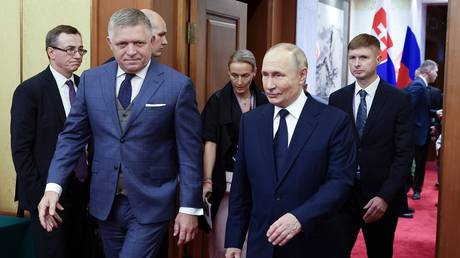
When a European Union member state reopens a direct diplomatic or economic channel with Moscow, the official press release rarely tells the full story. The actual drivers are almost always rooted in domestic political survival, acute industrial energy deficits, and the pragmatic realization that frozen conflicts require functional communication lines to prevent accidental escalation. While Brussels projects a unified front of strict isolation, individual capitals—most notably Budapest and Bratislava, alongside quiet backchannel movements in Vienna—have steadily reactivated bilateral engagement with the Kremlin to secure discounted hydrocarbons, protect agricultural markets, and maintain transit revenues.
Diplomacy in Europe has always operated on two tracks. There is the public chorus in Brussels, where joint statements are drafted in careful consensus, and there is the cold arithmetic of national budgets in Central and Eastern Europe.
The Architecture of the Quiet Thaw
To understand why an EU nation breaks rank to re-establish ties with Russia, you have to look at physical infrastructure rather than ideological alignment. Geography dictates foreign policy far more reliably than treaties do.
Landlocked member states in Central Europe inherited a Soviet-era pipeline network designed to pump crude oil and natural gas westward from Siberian fields. Reversing the flow of those pipes is not a matter of flipping a switch. It requires billions of euros in new interconnectors, upgraded compressor stations, and expanded liquefied natural gas (LNG) terminals on distant coastlines—projects that take years to permit, finance, and construct.
When transit agreements expire or sanctions tighten, the immediate financial shock hits domestic manufacturing first. Chemical plants, fertilizer producers, and heavy metallurgy facilities in countries like Hungary and Slovakia rely on predictable baseload energy. Spot-market LNG shipped from the United States or Qatar arrives at a steep premium, eroded further by regasification fees and transit tariffs charged by neighboring states.
For a prime minister facing an electorate squeezed by inflation, paying triple the historical rate for industrial gas is political suicide. Reopening a channel to Moscow becomes an act of self-preservation. High-level visits by foreign ministers or energy executives to St. Petersburg and Moscow are framed publicly as humanitarian dialogues or peace initiatives, yet the closed-door agendas consistently center on contract extensions, payment mechanisms, and exemptions from European sanctions regimes.
The Sanctions Loophole Economy
Brussels designed its sanctions packages to starve the Russian war machine without collapsing the European economy. That balancing act created massive gray zones.
Take the crude oil embargo. When the EU banned seaborne Russian oil imports, it carved out a temporary exemption for pipeline deliveries via the southern branch of the Druzhba pipeline. That single clause kept billions of euros flowing between Moscow and Central European refineries.
Similar carve-outs exist across nuclear fuel, agricultural fertilizers, and critical raw materials. State-owned Russian nuclear giant Rosatom continues to supply fuel assemblies to Soviet-designed VVER reactors operating inside the EU, while simultaneously building new reactor blocks in Hungary under the Paks II project. You cannot abruptly sever ties with your sole nuclear fuel supplier without risking blackouts across an entire regional grid.
| Sector | Public EU Stance | Bilateral Backchannel Reality |
|---|---|---|
| Natural Gas | Phase out all Russian fossil fuels by 2027 | Long-term pipeline contracts extended via TurkStream |
| Crude Oil | Ban on seaborne imports and price cap enforcement | Continued pipeline flows through Druzhba exemptions |
| Nuclear Energy | Diversification of fuel supply chains | Ongoing reactor construction and fuel rod deliveries |
| Diplomacy | Diplomatic isolation and ambassadorial downgrades | Ministerial visits for trade and energy negotiations |
This structural dependency forces European officials to maintain technical working groups with Russian counterparts. Even when ambassadors are expelled and consulates shuttered, energy ministry bureaucrats, customs officials, and central bank technical staff keep talking. When a member state formally announces it is reopening a political channel, it is often just bringing an existing bureaucratic lifeline out into the open.
Domestic Populism and the Brussels Backlash
Energy economics explains the necessity, but domestic politics provides the motive. Across several EU member states, governing coalitions have discovered that challenging the Brussels consensus plays exceptionally well with rural and working-class voters.
The narrative is straightforward. Leaders in Bratislava and Budapest argue that Western European nations—insulated by Atlantic ports, nuclear fleets, and North Sea gas—are imposing economic hardship on smaller eastern economies while quietly buying record volumes of Russian LNG themselves.
There is factual weight to that accusation. Eurostat trade data has repeatedly shown that Western European ports in Belgium, France, and Spain continued receiving millions of tons of Russian liquefied natural gas long after pipeline gas to Central Europe was curtailed. Pointing out this double standard allows Central European leaders to cast themselves as defenders of national sovereignty against hypocritical technocrats.
Reopening dialogue with Moscow serves a dual purpose for these governments:
- Leverage in Brussels: Threatening to veto joint EU financial aid packages or new sanctions rounds extracts concessions from the European Commission, often unlocking billions in frozen cohesion funds.
- Electoral Consolidation: Positioning the government as a pragmatic broker of peace appeals to war-weary populations anxious about the economic spillover of prolonged conflict on their eastern border.
The Intelligence and Security Calculus
Beyond gas pipelines and ballot boxes lies a quieter, more urgent reason for keeping lines open to the Kremlin. Security services across Europe recognize that total diplomatic silence increases the risk of catastrophic miscalculation.
During the height of the Cold War, Washington and Moscow maintained dedicated hotlines and backchannels precisely because their militaries were operating in close proximity. Today, NATO air policing missions, naval patrols in the Baltic and Black Seas, and electronic warfare operations along the eastern flank create daily friction points.
When an EU country reopens a diplomatic channel, intelligence and defense attaches are invariably part of the equation. Neutral or semi-aligned EU states like Austria have historically functioned as neutral ground where Western and Russian intelligence officers can pass warnings, negotiate prisoner exchanges, or establish red lines without forcing either side to lose face publicly.
Furthermore, countries sharing a physical border or close proximity to the conflict zone face immediate spillover risks. Stray drones, jammed GPS signals affecting commercial aviation, and disrupted regional trade routes require direct crisis-management mechanisms. Waiting for a consensus resolution from twenty-seven European foreign ministers in Brussels is useless when an airspace violation happens in real time.
What Happens When the Consensus Fractures
The danger of unilateral diplomacy is that it undermines the collective bargaining power of the European bloc. Moscow has mastered the art of bilateralism, consistently preferring to deal with individual European capitals rather than the European Union as a single entity.
In a one-on-one negotiation, Russia holds overwhelming asymmetric advantages over a small or medium-sized EU state. The Kremlin can offer tailored discounts on gas, promise preferential market access for agricultural exports, or guarantee transit fees—all in exchange for a single veto inside the European Council. Because EU foreign policy requires unanimity, Moscow does not need to convince twenty-seven nations to drop sanctions. It only needs to convince one.
This dynamic creates a persistent institutional paralysis. Every six months, when EU sanctions come up for mandatory renewal, European diplomats engage in exhausting, last-minute horse-trading to bring reluctant member states back into the fold. Each concession weakens the enforcement mechanisms of the broader regime, allowing shadow fleets, third-country intermediaries, and shell companies to keep trade moving.
For businesses operating in the region, this fractured policy environment creates severe compliance hazards. A transaction permitted under a national exemption in one EU member state might trigger secondary sanctions scrutiny or banking freezes in another. European banks, terrified of running afoul of the US Treasury's Office of Foreign Assets Control, frequently over-comply, freezing legitimate humanitarian or exempted agricultural payments simply because they touch a Russian entity.
The Uncomfortable Reality of European Realpolitik
Observers who view the reopening of diplomatic channels solely through the lens of betrayal or ideological sympathy miss the underlying mechanics of European statecraft. Nations do not have permanent friends; they have permanent interests, and those interests are bolted to the ground in the form of refineries, power grids, and industrial supply chains.
As long as Europe remains structurally reliant on imported raw materials and lacks a fully integrated continental energy grid, individual member states will continue cutting side deals to protect their domestic economies. Brussels can pass all the non-binding resolutions it wants, but until alternative pipelines are welded into the earth and alternative fuel rods are loaded into reactors, the backchannel to Moscow will never truly close.