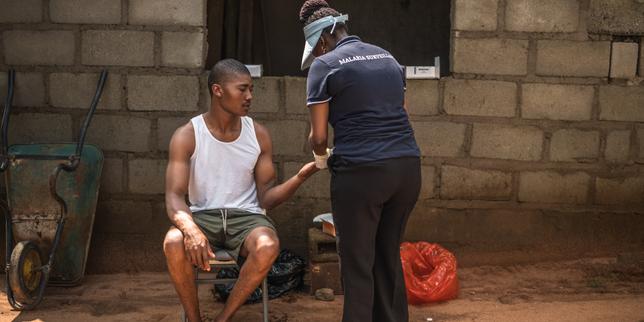
Eswatini is currently engaged in a high-stakes medical pursuit to become the first mainland African nation to eliminate malaria. This is not about broad-brush spraying or general awareness campaigns anymore. The strategy has shifted into a surgical, case-by-case manhunt. Every single positive test triggers a rapid response team that descends on a village within 48 hours to screen neighbors and treat asymptomatic carriers. While the world looks at massive regional outbreaks, this tiny kingdom is proving that the final stage of eradication is actually a data-driven intelligence operation.
The Kingdom of Eswatini, formerly Swaziland, has seen its malaria cases plummet from tens of thousands in the 1990s to just a few hundred annual incidents today. But that final stretch—the "last mile"—is notoriously the most difficult part of any public health journey. When a disease becomes rare, political will often fades, funding dries up, and the population loses its "malaria literacy," leading to a dangerous resurgence. Eswatini is fighting that complacency with a surveillance system that treats a single mosquito bite as a national security threat.
The Surveillance Net
Eswatini’s success hinges on a concept called Active Case Detection. In most countries, malaria control is passive; a patient feels sick, goes to a clinic, gets pills, and goes home. In Eswatini, that clinic visit is just the starting gun. Once a case is confirmed, the National Malaria Programme (NMP) uses GPS coordinates to track exactly where that person lives.
Within two days, a team of "surveillance officers" arrives at the patient's home. They don't just check the family. They test everyone within a 500-meter radius. This is because the Anopheles mosquito—the primary vector for the parasite—usually doesn't fly much further than that during its short life. By clearing the parasite from every human in that small circle, the NMP effectively starves the local mosquito population of their "reservoir." If the mosquito bites someone, there is no parasite to pick up and pass on.
This level of detail requires an incredible amount of logistical coordination. It means having enough rapid diagnostic tests (RDTs) available in remote areas and a workforce that can move across difficult terrain at a moment's notice. It is a grind. It is expensive. But it is the only way to move from "control" to "elimination."
The Shadow of Imported Cases
Even if Eswatini cures every person within its borders, it remains at the mercy of its neighbors. This is the brutal reality of geography. Eswatini shares long, porous borders with South Africa and Mozambique. While South Africa is also chasing elimination, Mozambique remains a high-burden country where malaria is endemic and widespread.
Migrant workers, traders, and families visiting relatives frequently cross these borders. A person can be bitten in Maputo, feel fine while crossing the border into Eswatini, and then become a "walking reservoir" for the disease. Data from the last few years shows that a significant percentage of Eswatini’s cases are "imported"—meaning the infection originated outside the country.
To combat this, the kingdom has set up border screening posts. They offer free testing to anyone entering from high-risk areas. However, you cannot force everyone to take a blood test. This creates a permanent leak in the system. As long as the parasite exists in the region, Eswatini must maintain its expensive surveillance apparatus at full tilt. The moment they relax, one imported case can spark a localized outbreak that undoes a decade of work.
The Biological Arms Race
The tools used to fight malaria are starting to fail across the continent. This is a quiet crisis that industry analysts have been tracking for years. For decades, we relied on two main pillars: Long-Lasting Insecticidal Nets (LLINs) and Indoor Residual Spraying (IRS).
The problem is evolution.
Mosquitoes are developing resistance to the pyrethroids—the cheap, effective chemicals used to coat bed nets. In some parts of Africa, mosquitoes can now land on a treated net and survive. Simultaneously, the Plasmodium falciparum parasite itself is evolving. In parts of Southeast Asia, and increasingly in Africa, we are seeing drug-resistant malaria. If the frontline treatments like Artemisinin-based Combination Therapy (ACT) stop working, the Eswatini model of "test and treat" falls apart.
Eswatini has stayed ahead of this by rotating the chemicals used in their spraying programs. They use different classes of insecticides to prevent the local mosquito population from building up a tolerance. They are also utilizing more sensitive diagnostic tools. Some people carry such a low level of the parasite in their blood that a standard RDT won't pick it up. These "sub-patent" infections are invisible but still infectious. Eswatini is increasingly looking toward highly sensitive molecular testing to find these hidden carriers.
The Problem with Success
There is a psychological trap in disease elimination. When people stop seeing their neighbors die of malaria, they stop using bed nets. They stop allowing spray teams into their homes because the smell of the chemicals is annoying and the threat of the disease feels distant.
Health workers in Eswatini often encounter "refusal fatigue." A homeowner might ask why they should have their walls sprayed when they haven't seen a malaria case in five years. This is where the mission shifts from medicine to sociology. The NMP spends a massive amount of energy on Social and Behavior Change Communication. They have to convince a healthy population to keep acting like they are in the middle of an epidemic.
The Economic Equation
Elimination is not just a health goal; it is a business decision. Malaria is a massive drain on the GDP of African nations. It causes absenteeism in schools, lowers productivity in the agricultural sector, and deters foreign investment. Eswatini’s push for zero cases is an attempt to de-risk its economy.
However, the cost per case increases exponentially as you approach zero.
When you have 100,000 cases, treating one person is cheap. When you have only 10 cases left, finding those 10 people requires a national network of labs, vehicles, and satellites. The "cost per case" looks absurd on a balance sheet. International donors often prefer to put their money where the "burden" is highest—meaning countries with millions of cases. Eswatini finds itself in a strange position where its success makes it less attractive for traditional aid.
The government has had to step up its domestic funding to fill these gaps. They are betting that the long-term savings of not having to run a malaria program at all will eventually outweigh the massive current cost of hunting down the last few parasites.
The Vector Shift
Climate change is rewriting the rules of where mosquitoes can live. Historically, malaria in Eswatini was confined to the lowveld—the hotter, lower-elevation areas. The highveld was too cool for the Anopheles mosquito to thrive.
That is changing.
Rising temperatures are allowing mosquitoes to move into higher altitudes and stay active for longer periods of the year. This expands the "receptive" area of the country. A village that was once naturally protected by its climate is now vulnerable. This means the NMP cannot just focus on the traditional "malaria zones." They have to monitor the entire country.
Furthermore, the arrival of Anopheles stephensi in Africa—a mosquito species that thrives in urban environments and is resistant to many common insecticides—poses a new threat. While not yet a major factor in Eswatini, its spread across the continent is a looming shadow over every elimination program.
Tactical Reality on the Ground
If you follow a surveillance team in the Lubombo region, you see the reality of this war. It is not a lab-coat affair. It involves driving 4x4 vehicles through mud, hiking to homesteads that aren't on any map, and painstakingly explaining the need for a finger-prick blood test to a skeptical elder.
The data is managed through a digital platform. Officers use tablets to upload case data in real-time. This allows the central office in Mbabane to see a "heat map" of infections as they happen. If three cases pop up in a single week in a previously "cleared" area, it’s flagged as a potential outbreak. This is the Integrated Malaria Information System. It turns a health crisis into a data management task.
But data is only as good as the people collecting it. Eswatini’s real secret weapon is its network of Rural Health Motives (RHMs). These are community members, mostly women, who act as the link between the village and the formal health system. They know who is traveling, who is sick, and who is hiding a fever. Without this grassroots trust, the high-tech satellites and GPS trackers would be useless.
The Risk of the Zero
The term "elimination" is often used interchangeably with "eradication," but they are different. Eradication is global (like Smallpox). Elimination is local. If Eswatini reaches zero, it will be a monumental achievement, but it will not be a permanent one.
The country will enter a phase called Prevention of Re-introduction. This is a permanent state of vigilance. It means Eswatini can never truly "get rid" of its malaria program. They will always need the border screens, the rapid response teams, and the lab capacity.
The danger is that once the "Zero Malaria" certificate is issued by the World Health Organization, the budget will be slashed. We saw this in other parts of the world in the 1960s. Countries that reached near-elimination diverted funds to other priorities, only to see malaria return with a vengeance, often killing more people because the population had lost its natural immunity.
Eswatini is currently the laboratory for the rest of mainland Africa. If they can prove that a landlocked country with high-burden neighbors can maintain a "Zero" status, it provides a blueprint for the entire Southern African Development Community (SADC). If they fail, it suggests that elimination might be impossible without a simultaneous, region-wide collapse of the parasite.
The fight is currently in a stalemate. The kingdom has the tech, the strategy, and the will. But the parasite has the biology, the neighbors, and the clock.
Success in Eswatini depends on the understanding that the "last mile" is actually a permanent marathon. There is no finish line where the kingdom can simply stop looking. The price of a malaria-free Eswatini is eternal surveillance. Every fever must be questioned. Every mosquito must be considered a carrier. Every border crossing is a potential breach.
The Kingdom isn't just trying to kill a disease; it's trying to build a fortress of data against a microscopic enemy that never sleeps.
Stop thinking of malaria as a medical problem and start seeing it as a logistical one.


