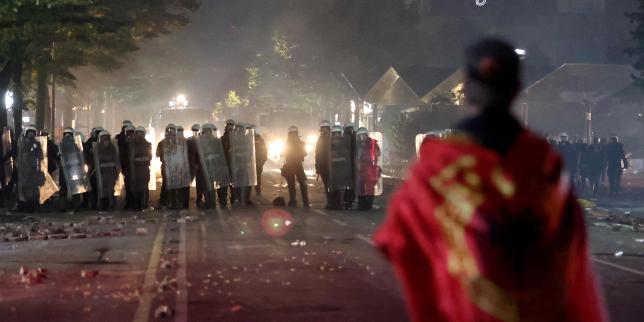
Conventional breaking news treats multi-day street clashes in Tirana as a sequence of isolated skirmishes between demonstrators and police. That framing misses the underlying equilibrium shift: once anti-government protests cross from localized grievances into repeated kinetic confrontations, every state countermeasure alters the cost-benefit calculus of both crowds and authorities. Analyzing the Albanian protest wave through structural mechanisms—rather than daily headcounts alone—explains why demonstrations persist despite heavy policing and official pushback.
To move beyond surface-level reporting on street unrest in Tirana, this analysis maps the core mechanics driving escalation and de-escalation in 2026. It separates verified public reporting from analytical hypotheses, examines how grievances broaden into systemic challenges against Prime Minister Edi Rama's government, and outlines practical risk-assessment logic for observers operating in or tracking the environment. Recently making news lately: Why European Anger Over Russia at the G20 Misses the Real Power Shift.
Deconstructing Standard Protest Coverage
Standard wire dispatches and headlines—such as reports tracking a second day of demonstrations against the authorities and renewed clashes with police in Tirana—typically rely on an event-log structure. They tally injuries, arrests, damaged property, and official condemnations, then pair those figures with brief street reactions or government statements.
That approach has three analytical blind spots: Additional details regarding the matter are covered by Reuters.
- Static framing of a dynamic system: Treating a second or subsequent day of clashes as a repetition of day one ignores how crowd composition, police tactics, and public tolerance adapt after each encounter.
- Conflation of triggers and root causes: A specific flashpoint—such as contested land or coastal development disputes earlier in 2026 or student grievances over education costs and governance—is often treated as the entirety of the conflict rather than a catalyst acting on pre-existing frustration.
- Asymmetric treatment of state claims: Official rhetoric blaming "foreign hands" or framing unrest purely as an attempt to seize power by force is frequently quoted without testing its strategic function.
In political economy and collective-action theory (notably Mancur Olson's logic of collective action and Thomas Schelling's threshold models), protests grow when individual participation costs drop relative to perceived inaction costs, or when visible defiance lowers the perceived risk of joining others. A purely descriptive account records the smoke without mapping the pressure valves.
The Three Pillars of Protest Escalation
Understanding why demonstrations in Albania have stretched across months of shifting intensity—from localized disputes and the "Flamingo" mobilization earlier in 2026 to student-led protests and sharp clashes in Tirana and other cities—requires separating the movement into three structural pillars.
1. Grievance Stacking and Issue Convergence
Isolated grievances rarely sustain multi-day urban friction on their own. Escalation occurs when distinct complaints stack onto the same focal point in the capital. Public reporting across 2026 points to overlapping pressures: disputes over land and major tourism or real-estate projects, student frustration over education costs and institutional responsiveness, broader complaints regarding corruption and governance after more than a decade in power, and anger over perceived heavy-handedness by security forces or private guards.
When separate constituencies—students, local residents, urban activists, and opposition-aligned crowds—converge on central boulevards and ministries in Tirana, the protest shifts from a single-issue petition to a generalized test of state authority. Hypothesis: Even when initial demands are narrow or material, prolonged friction converts specific policy disputes into a binary legitimacy contest ("resignation" versus "order").
2. The Coercive Feedback Loop
Police deployment is meant to restore public order and clear key arteries, yet force carries a non-linear side effect. When crowd-control measures—such as tear gas, water cannons, mass arrests, administrative fines, or contested use of force—are perceived by participants or bystanders as disproportionate, coercion can manufacture new grievances faster than it deters street presence.
This creates a two-sided feedback loop:
- Tactical hardening: A small subset of confrontational demonstrators uses rocks, fireworks, barricades, or property damage, giving authorities grounds for broader crackdowns and fines.
- Legitimacy friction: Detentions, injuries, and allegations of excessive force—especially when scrutinized by domestic critics, international observers, or EU institutions—raise the reputational cost of policing for an administration focused on European integration benchmarks.
Hypothesis: If administrative penalties and arrests are applied broadly without clear distinction between peaceful marchers and violent actors, moderate participants may either withdraw out of fear or radicalize against the state apparatus itself.
3. Narrative Contestation and Institutional Signaling
Street clashes are waged simultaneously on pavement and in information channels. Governments routinely frame prolonged unrest as externally instigated destabilization, unlawful disruption, or an assault on democratic norms and EU accession prospects. Protest organizers and critics counter with narratives of institutional capture, responsiveness failures, and civil liberties.
Public offers of dialogue—or symbolic gestures rejected outright by demonstrators—illustrate how trust deficits shape outcomes. When protesters view institutional outreach as performative rather than substantive, rejection becomes a signal of solidarity rather than a failure of communication.
Cause-and-Effect Chains Standard Reporting Misses
A rigorous breakdown traces second- and third-order effects that do not appear in a single day's casualty or arrest tally:
- Road closures and commercial disruption to political leverage: Blocking major thoroughfares in Tirana imposes immediate friction on commuters, businesses, and municipal services. That disruption pressures the government to act quickly, but it can also alienate neutral residents if prolonged without clear political traction.
- Escalation from capital to periphery: When protests spread beyond Tirana toward university towns or regional centers, policing resources face spatial dispersion. Even smaller secondary actions force central planners to allocate attention across multiple nodes.
- Legal and financial deterrence versus martyr dynamics: Fines, criminal charges, and court measures increase tangible personal costs for demonstrators. Yet high arrest counts can also energize legal-aid networks, student solidarity, and diaspora mobilization abroad.
- Symbolic calendar effects: National dates—such as late-November independence and liberation anniversaries—act as natural coordination points where historical memory amplifies political symbolism.
Operational Playbook for Tracking and Navigating Unrest
Practitioners—whether risk analysts, business operators, journalists, or civic observers—need a structured workflow rather than headline chasing when monitoring multi-day demonstrations.
Step 1: Separate Verified Indicators from Claims
Anchor tracking on verifiable operational facts: confirmed locations, transit corridors affected, official ministry figures on injuries or fines, court orders, and documented statements from institutions. Treat unverified social media claims and high-level political characterizations ("foreign hands," "revolution") as data points about framing, not ground-truth proof of cause.
Step 2: Map Spatial and Temporal Bottlenecks
Track movement around high-signal nodes in Tirana—government buildings, ministries, main boulevards, and university campuses—alongside dates with heightened symbolic weight. Identify whether activity is concentrated in a single evening window or expanding into daytime blockades and multi-city actions.
Step 3: Monitor the Coercive-to-Political Ratio
Watch how the state pairs physical containment with political or legal moves. Purely kinetic containment without a political off-ramp tends to sustain simmering tension, whereas credible accountability measures or targeted de-escalation can alter crowd incentives—though outcomes remain contingent on mutual trust.
Step 4: Enforce Operational Precautions on the Ground
For anyone operating near demonstrations in an urban center:
- Avoid areas immediately surrounding ministries, police cordons, or active barricades once dispersal warnings begin.
- Plan transit buffers well ahead of scheduled marches or symbolic dates, as sudden rerouting and roadblocks can stall vehicles rapidly.
- Maintain independent verification channels and clear exit routes rather than relying on real-time crowd movement.
Limitations and Analytical Blind Spots
No framework eliminates uncertainty during live civil unrest. Exact crowd sizes, internal decision-making inside protest networks, and unpublicized deliberations within government or law enforcement are rarely transparent in real time. Furthermore, reporting lag means initial injury, arrest, or property-damage figures are frequently revised as hospitals, police directories, and courts update records.
A disciplined analyst treats early numbers as provisional floors or ceilings rather than final truths, and avoids projecting a single trajectory—whether rapid collapse or indefinite escalation—when small tactical shifts can reverse momentum.
Strategic Play for Decision-Makers
For organizations, policymakers, or analysts assessing the trajectory of Tirana's protest cycle, the highest-value move is to build a two-track monitoring model that pairs street-level friction indicators with institutional legitimacy signals. Track physical flashpoints and legal enforcement measures to manage immediate operational risk, while watching whether grievances remain fragmented or coalesce around unified leadership and broader public sympathy—because sustained political change in contested environments hinges less on the volume of a single day's clash than on whether the center of gravity shifts among previously uncommitted citizens.