Executive declarations that frame street violence as an existential threat to the Republic rarely calm crowds; instead, they convert localized economic grievances into a high-stakes contest over state legitimacy. When President Emmanuel Macron pledged in October 2026 to hold accountable those who "sought to bring down the Republic" following nationwide demonstrations and rioting, standard event coverage treated the speech as a straightforward law-and-order pledge. A structural analysis shows something more complex: executive framing, fiscal constraints, protest bans, and pre-election positioning interact inside a feedback loop that shapes both street behavior and electoral alignments.
Conventional breaking-news reporting catalogues visible incidents—burned vehicles, shattered storefronts, tear gas deployment, arrest totals, and partisan soundbites—without separating structural triggers from tactical catalysts. This analytical framework maps the underlying logic of the coverage and reconstructs the unrest around five operational mechanisms: the Coalition Convergence Mechanism, the Attribution and Escalation Loop, the State Cost Function of Unrest, the Restriction-Legitimacy Trade-off, and the Pre-Electoral Polarization Multiplier.
Deconstructing Standard Coverage and Its Blind Spots
Typical dispatch journalism around major French demonstrations follows a predictable sequence: outline the immediate spark (cost-of-living pressures or school blockades), summarize the clashes and property damage, quote the president's sternest warning alongside opposition rebuttals, and log the arrest count. That structure is useful for fast situational awareness, yet it leaves three analytical gaps.
- Conflation of distinct actor groups: Grouping peaceful marchers, student strikers, union members, radical far-left factions, and opportunistic looters under a single narrative obscures how different incentives operate inside the same urban space.
- Static treatment of executive rhetoric: Treating "bring down the Republic" merely as a tough slogan misses how elevating criminal vandalism and street clashes into an existential regime threat raises the perceived stakes for both militants and critics of the state.
- Under-specified fiscal and institutional constraints: Mentioning high public debt or upcoming presidential elections as background color does not explain why the government cannot simply buy off grievances with broad subsidies or education spending hikes.
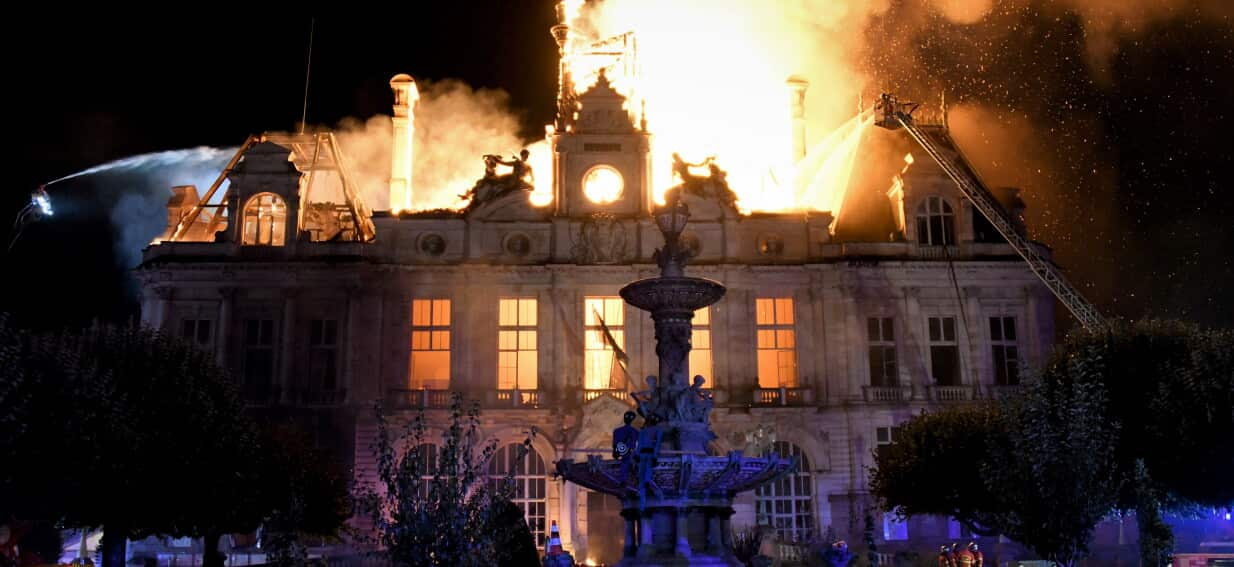
Distinguishing verified reporting from analytical interpretation keeps the diagnosis disciplined. Known facts include nationwide demonstrations and clashes in October 2026 involving cost-of-living grievances and student protests, severe property damage—including arson at public buildings such as Limoges's city hall and looting across commercial corridors—thousands of arrests across the unrest cycle, municipal and executive moves to ban certain demonstrations, and opposition pushback ahead of next spring's presidential election. Educated hypotheses include the specific causal pathways linking crowd composition to riot ignition, the behavioral effects of protest bans on crowd dispersal versus radicalization, and how voters reallocate support between rival political poles in the months before a national vote.
The Coalition Convergence Mechanism
Large-scale French protests gain momentum when separate grievances overlap on the calendar. When secondary-school blockades over education conditions and funding converge with broader demonstrations over living costs, fuel prices, and union or yellow-vest mobilization, total street volume rises while coordination drops.
In a multi-coalition crowd, participants do not share a single objective function:
- Grievance-driven demonstrators seek visible pressure on wages, purchasing power, or school resources, relying on mass presence and symbolic disruption.
- Insurrectionist or radical factions treat clashes with security forces and attacks on public symbols as ends in themselves or as catalysts for broader confrontation.
- Opportunistic delinquents and looters exploit crowd density, diverted police units, and smoke or chaos to steal merchandise or vandalize property at lower personal detection risk.
Because French authorities and participants themselves have noted that the vast majority of marchers are not there to loot or burn buildings, crowd size acts as a masking variable. Larger crowds stretch police perimeters across more intersections and commercial streets, creating blind spots where small, mobile groups can break windows, light fires, or strip stores before containment units arrive.
Consider a central square where a peaceful march winds down into late afternoon. As legitimate demonstrators disperse or linger near monuments, smaller pockets of masked actors and opportunistic thieves stay behind. When riot police deploy tear gas or water cannons to clear a flashpoint, spatial compression pushes bystanders, teenagers, and militants into the same narrow streets—turning perimeter control into a close-quarters confrontation.
The Attribution and Escalation Loop
When violence erupts, executive language faces a classic signaling dilemma. If a government minimizes disorder, it risks looking weak or detached from citizens who feel unsafe in their own neighborhoods. If it casts street violence as an attempt to bring down the Republic and blames radical far-left factions alongside criminals, it projects resolve—but alters the political dynamics of the conflict.
The escalation loop operates through four sequential links:
- Securitization of the dispute: Framing rioting as an assault on the Republic elevates an economic and administrative crisis into a constitutional test, making compromise look like capitulation.
- Asymmetric attribution: Targeting "insurrectionist elements from radical far-left groups" and "delinquents" isolates violent actors rhetorically, yet leaves broad swaths of non-violent protesters feeling lumped into a suspect environment—especially when police tactics or bans sweep up peaceful demonstrators.
- Tactical friction on the ground: Intense clashes, arrests, and disputed injuries from crowd-control munitions generate counter-narratives about police excess, pulling moderate sympathizers from passive grievance into active opposition to policing methods.
- Rhetorical hardening: High-stakes warnings prompt sharp counter-claims from opposition leaders—accusing the executive of provocation, mismanagement, or exhaustion—which reinforces crowd resolve rather than dissipating it.
Framing street disorder as a bid to topple the Republic raises the symbolic stakes for every actor on the street without adding a single euro to household budgets or public schools.
The State Cost Function of Unrest
Why can't an administration simply diffuse cost-of-living and student unrest through immediate spending concessions? Because public finance imposes a hard constraint on crisis management. With national debt elevated near 119 percent of GDP, fiscal space for broad-based subsidies, tax cuts, or major education budget increases is tightly bounded.
From an operational standpoint, the state faces a three-part cost function during sustained civil unrest:
- Direct security and judicial costs: Mobilizing tens of thousands of police and gendarmes, running transit closures and station checks, processing thousands of arrests, and fast-tracking prosecutions consume immediate administrative and budgetary capacity.
- Physical and commercial destruction costs: Damage to municipal buildings, heritage structures, police compounds, transit infrastructure, and roughly 1,500 retail and trade businesses inflicts hundreds of millions of euros in direct losses while eroding local tax bases and investor confidence.
- Policy-credibility costs: Conceding major fiscal outlays under street pressure signals that extraparliamentary disruption outperforms ordinary legislative bargaining, inviting repeat mobilization whenever budgets tighten.
That trade-off explains why governments lean on policing, judicial accountability, and targeted consultations rather than sweeping fiscal reversal. Yet relying primarily on containment carries a hidden cost: every day of visible street disorder and commercial loss taxes real economic activity while doing nothing to lower household fuel or living costs.
The Restriction-Legitimacy Trade-off
Banning "illegitimate" demonstrations or halting marches in specific cities is a standard administrative lever to prevent a repeat of large-scale looting and arson. In operational terms, authorities trade short-term perimeter control against medium-term procedural legitimacy.
When a ban succeeds, it clears predictable assembly points, reduces the number of simultaneous flashpoints, and allows police to focus on weapon checks and perimeter security. However, administrative bans face four practical failure modes in a contentious protest environment:
- Displacement rather than elimination: Crowds can shift to unauthorized times, decentralized neighborhoods, or symbolic dates—such as Halloween-themed gatherings or sit-ins near public buildings—forcing police into reactive dispersal rather than managed routing.
- Judicial and legal friction: Courts can overturn blanket or poorly tailored bans, creating mixed signals between executive directives, municipal prefectures, and local police execution.
- Martyrdom and grievance amplification: Every clash or severe injury occurring under a ban becomes stronger evidence for critics that the state is curbing the right to protest rather than merely stopping arsonists.
- Loss of crowd self-policing: Formal protest organizers and unions often help de-escalate tension when marches are authorized; banning gatherings can weaken organized marshals while leaving unorganized or radical actors active.
This trade-off is not a flaw unique to any single official; it is an inherent property of crowd control in democracies where freedom of assembly and public order are both constitutionally protected values.
The Pre-Electoral Polarization Multiplier
Timing magnifies every move. With a presidential election roughly six months away, street unrest operates as a polarization multiplier that rewards centrifugal political actors while squeezing a centrist incumbent.
Each major faction reads the crisis through its own electoral incentives:
- The centrist executive must project firmness against disorder and protect property while acknowledging economic grievances—a narrow line that risks alienating protesters who feel unheard and critics who see the state as reactive.
- The far left channels anger over living costs, austerity, and policing into a critique of government policy and authority, attempting to convert street mobilization into anti-incumbent momentum while distancing itself from looting.
- The far right points to arson, damaged landmarks, and disorder as proof of institutional decay and state weakness, pressing border and law-and-order themes regardless of whether official investigations tie the specific rioting to immigration.
Even international commentary—such as foreign leaders mocking French instability or tying unrest to borders—feeds domestic polarization by turning French streets into a proxy battleground over national sovereignty and competence.
Operational Playbook for Crisis Stabilization and Boundary Conditions
Managing an escalation cycle like France's requires separating crowd containment, rhetorical discipline, and grievance decompression so that one does not sabotage the others. A rigorous crisis-management sequence follows five steps:
- Decouple regime rhetoric from criminal prosecution: Reserve existential constitutional language for genuine institutional threats, and keep focus sharp on identifiable offenses—arson, looting, assault on officers, and property destruction—backed by transparent evidence and due process.
- Use surgical perimeters instead of sweeping bans: Target high-risk commercial zones and repeat flashpoints with clear, legally defensible rules rather than broad bans that invite court reversals or turn peaceful marchers into rule-breakers.
- Protect de-escalation channels for non-violent groups: Maintain open, structured channels with student representatives, unions, and local mayors so grievances over school conditions and daily costs have a non-violent release valve.
- Enforce strict discipline on crowd-control munitions: Audit riot-control weapons and rules of engagement tightly; preventable severe injuries inflame crowds faster than almost any policy dispute.
- Pair containment with low-fiscal-cost relief: Where macro debt limits broad spending increases, prioritize targeted administrative relief, faster local permitting/repair support for damaged small businesses, and concrete school-level operational fixes that cost less than across-the-board outlays.
Boundary conditions and limitations: No sequence of messaging or tactical policing can resolve structural affordability pressures overnight when public debt constrains fiscal room and political trust is already strained. Furthermore, when bad-faith actors deliberately seek confrontation ahead of an election, even disciplined statecraft can only contain escalation rather than eliminate all friction.
The decisive strategic play for the government over the coming weeks is selective de-escalation through surgical policing paired with visible, low-cost institutional responsiveness: isolate and prosecute arsonists and looters with procedural rigor, avoid overbroad protest bans that unify moderates with radicals, and deliver fast, concrete administrative fixes on school conditions and local business recovery while keeping macro-fiscal commitments strictly disciplined.