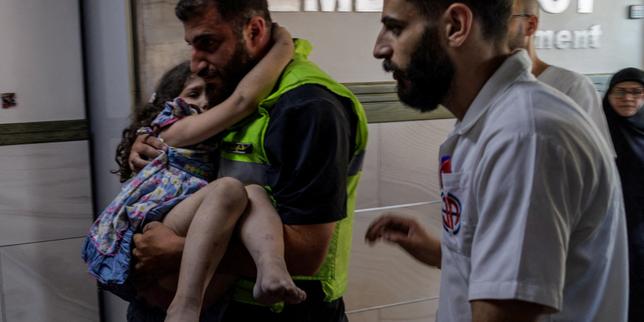
The airstrikes keep falling. The death toll keeps climbing. Lebanese officials report at least 28 people lost their lives in the latest round of Israeli bombardments, a number that represents more than just a statistic. It shows a rapid, destructive shift in a conflict that has broken past its old boundaries. People watching this conflict unfold want to know one thing. Is there a way out, or are we watching the start of a prolonged war with no clear end point?
The truth is grim. This isn't a sudden misunderstanding. It is the result of months of intensifying friction along the border, a calculated expansion of military objectives, and a total failure of international diplomacy. The immediate focus has shifted decisively north, leaving millions of civilians caught in the crossfire of a high-tech air campaign.
Understanding this conflict requires looking past the daily headlines of strikes and sirens. You have to look at the strategic motivations driving both sides, the staggering human cost, and why the current international tools to stop the fighting are completely broken.
The Reality of the Israeli Bombardments in Lebanon
The military strategy behind the current aerial campaign is straightforward but devastating. Israeli commanders state they are targeting weapon caches, command centers, and launch sites hidden within civilian areas. But when heavy munitions hit densely populated towns, the fallout is inevitable. Entire apartment blocks crumble. Families are buried under concrete. The reported 28 deaths in the recent strikes are part of a massive upward trajectory in casualties that has overwhelmed Lebanon's fragile medical infrastructure.
Living under an active air campaign means constant terror. Reconnaissance drones buzz overhead day and night, a mechanical hum that signals impending destruction. Entire neighborhoods receive evacuation orders via social media or text message, giving families mere minutes to gather their lives and run. Many don't have cars. Some have nowhere to go.
The strikes aren't limited to the southern border zone anymore. Bombs are falling deep inside Lebanese territory, hitting parts of Beirut and the Bekaa Valley. This geographic expansion shows that the goal isn't just to push opposing fighters back a few miles. It is an attempt to systematically dismantle an entire military infrastructure, regardless of how deeply integrated it is into civilian society.
Why the Northern Front Erupted
For nearly a year, the border between Israel and Lebanon saw daily, controlled exchanges of fire. It was a violent routine, but it followed unspoken rules. Both sides kept their strikes within a certain geographic depth to avoid a full-scale clash. That delicate balance is gone.
The political pressure inside Israel changed the calculus completely. Tens of thousands of Israeli citizens were forced to evacuate their homes in the north due to constant rocket fire. No government can allow a permanent internal displacement of its population without facing a massive political crisis at home. The official position shifted from containment to a mandatory reset of security conditions along the border.
On the other side, the armed group operating in southern Lebanon tied its actions directly to the ongoing war in Gaza. They positioned themselves as a support front, promising to stop firing only when a ceasefire was reached in the south. This created an intractable diplomatic knot. Because the Gaza negotiations remained stuck in an endless loop of failed talks, the northern front became a ticking time bomb.
The Human Toll Behind the News Cycle
Statistics fail to capture the sheer panic of a displacement crisis. Hundreds of thousands of Lebanese citizens are moving north toward Beirut or fleeing across the border into Syria. Schools have been converted into makeshift shelters. Classrooms are packed with families sleeping on thin mats, lacking adequate food, clean water, or sanitation.
The economic timing couldn't be worse. Lebanon was already suffering from one of the worst financial collapses in modern history. Its currency is nearly worthless, its banks are bankrupt, and the central government lacks the resources to manage a massive humanitarian disaster. Hospitals are running low on surgical supplies and fuel for generators.
When you look at the destruction of basic infrastructure, the long-term outlook is even darker. Roads are torn up. Water pumping stations are offline. Electricity networks, already failing before the strikes, are completely dark in major parts of the country. Rebuilding these areas will take years, and the money to do it simply doesn't exist.
The Complete Collapse of Diplomatic Leverage
The international response to the rising death toll has followed a familiar, ineffective script. There are expressions of deep concern, calls for restraint, and urgent meetings at the United Nations. None of it matters on the ground.
United Nations Resolution 1701, which ended the 2006 war, was supposed to prevent this exact scenario. It mandated that no armed groups should operate between the Litani River and the Israeli border except for the Lebanese army and UN peacekeepers. That resolution was never fully implemented. Armed groups built a massive network of tunnels and launch sites right under the nose of the international community, while Israeli jets routinely violated Lebanese airspace for reconnaissance.
Now, that diplomatic framework is a ghost. Western diplomats fly between regional capitals trying to broker temporary pauses, but their arguments lack teeth. Washington provides the weapons fueling the air campaign, which undercuts its position as an impartial mediator. Regional powers offer rhetorical support but are unwilling or unable to force a real policy shift.
Navigating the Dangerous Path Forward
If you are trying to understand where this crisis goes next, look at the logistical realities rather than political speeches. Air campaigns alone rarely achieve total political victory. They cause immense destruction and degrade military capabilities, but they don't permanently alter border security without a physical presence on the ground.
The threat of a full ground invasion remains the most dangerous variable. Moving troops across the border changes the nature of the war entirely. It turns an asymmetric air war into a brutal war of attrition in difficult, mountainous terrain. It also increases the risk of drawing other regional actors into a broader conflict, something international diplomats are desperately trying to avoid.
For those tracking this crisis or trying to support humanitarian relief efforts, focus on verified data from independent agencies on the ground. Follow updates from medical organizations like the International Committee of the Red Cross or local disaster management units. Watch for shifts in geographic targeting, particularly strikes near vital infrastructure like the Beirut airport or international transit routes. These indicators reveal whether the conflict is stabilizing or preparing for another violent expansion. Pay close attention to the displacement numbers in northern Lebanon, as the capacity of these regions to absorb millions of fleeing civilians is already at a breaking point.