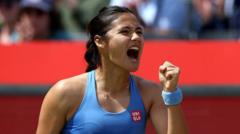
The British tennis press is currently hyperventilating over Emma Raducanu powering into the final at Queen’s. They are calling it a clinical masterclass. They are calling it the return of the ruthless prodigy. They are telling you that the 2021 US Open champion has finally cracked the code on grass, stabilized her game, and is ready to tear through the Wimbledon draw.
They are lying to you.
More accurately, they are lying to themselves because the alternative—admitting that a fleeting run at a warm-up event is an unreliable metric for long-term Grand Slam success—is too terrifying for domestic tennis revenues to bear.
Let’s dismantle the lazy consensus before the ink dries on the tournament programs. Winning matches at a grass-court tune-up like Queen’s or Nottingham is not a harbinger of a new era of dominance. It is a highly specific, context-dependent event that tells us almost nothing about Raducanu's readiness to survive seven grueling rounds at SW19. The media wants a narrative of redemption. The data, however, points to something entirely different: a masterclass in capitalizing on a highly specialized surface while the rest of the tour is still transitioning from the brutal clay of Roland Garros.
The Grass Court Distortion Effect
To understand why this run is a beautiful mirage, you have to understand the mechanics of the modern grass season. The transition from the slow, high-bouncing clay of Paris to the slick, low-skidding grass of London happens in a blink. It is the most violent surface shift in professional sports.
During this brief window, players with flat, linear groundstrokes and compact take-backs have an astronomical advantage. Raducanu possesses exactly this technical profile. Her strokes are clean, her timing is naturally sharp, and she thrives when the ball stays low.
But here is the catch that the mainstream pundits ignore: early-week grass tournaments do not replicate the physical or psychological reality of the second week of a Grand Slam.
- The Baseline Degradation: In the first week of any grass tournament, the courts are pristine. The ball skids consistently. By week two at Wimbledon, the baseline transforms into dusty, uneven dirt. The bounces become erratic. The true test of a champion on grass is not how they play when the surface is a billiard table; it’s how they adjust when the court turns into a public park patch of mud.
- The Depth of Field: Let’s be brutally honest about the draws at these warm-up events. Half the top 20 are resting their bodies after grueling French Open runs. The other half are treating these matches as glorified practice sessions to find their footing. Beating a string of opponents who are actively avoiding injury does not make you ruthless. It makes you available.
I have spent years analyzing tour data and watching sports marketing machines pump millions of dollars into hype cycles. I know exactly how this story ends. A young player strings together three clean matches on a surface that hides their movement flaws, the press declares them a favorite, the pressure multiplies by a factor of ten, and the inevitable structural collapse happens under the roof on Centre Court.
Dismantling The "Ruthless" Narrative
The public loves a binary narrative. Either a player is washed up, or they are back. Right now, the consensus is screaming that Raducanu is back.
Let’s look at the actual tactical reality of her recent matches. Her opponents have consistently failed to exploit her primary vulnerability: lateral movement on the dead run. On a slick, fresh grass court, if you don't force Raducanu to defend out of the corners, her striking looks pristine.
"True ruthlessness in tennis isn't hitting clean winners when you're comfortable. It's winning when your forehand is misfiring and your opponent is targeting your second serve for three straight hours."
Raducanu’s career since that historic night in New York has been defined not by a lack of talent, but by a lack of physical durability and tactical flexibility. Winning matches at Queen's does not magically cure structural wrist issues or back vulnerabilities. In fact, it increases the mileage on a body that has historically struggled to sustain back-to-back weeks of high-intensity competition.
The Flawed Questions People Also Ask
Whenever a British player wins consecutive matches in June, the search engines light up with predictable queries. The premises behind these questions are almost always broken.
Is Emma Raducanu ready to win Wimbledon again?
This question assumes she won Wimbledon in the first place. She won the US Open as a qualifier—an anomaly that we will likely never see again in our lifetimes. Expecting her to replicate that specific lightning-in-a-bottle run on a completely different surface, under immense domestic pressure, is delusional. A realistic goal is reaching the second week. Framing anything less as a failure is exactly what destroys a player's confidence.
Has she finally found the right coach?
The media is obsessed with Raducanu’s coaching carousel, treating every new appointment like a holy grail. The reality is that at the elite level, a coach can only tweak marginal percentages. The constant chopping and changing isn't a search for tactical wisdom; it’s a symptom of an entourage trying to solve internal competitive anxiety with external structural fixes. Success will come from stability, not from finding a mythical guru who holds the secret to her forehand.
The Commercial Trap of British Tennis
We cannot talk about Raducanu without talking about the commercial ecosystem surrounding her. British tennis desperate for a superstar. Ever since Andy Murray’s hips became a national tragedy, the Lawn Tennis Association and domestic sponsors have been starved for a highly marketable icon.
This desperation creates an unhealthy feedback loop. A single win at Queen's is amplified until it sounds like a Wimbledon title. Sponsors activate campaigns. Newspapers print pull-out sections. The player is insulated from reality by a wall of sycophants and corporate handlers who need the gravy train to keep rolling.
Consider the downside of this contrarian view: yes, treating this run with cold skepticism feels cynical. It robs fans of the joy of the moment. But the alternative is far more damaging. By overhyping a fragile recovery, the public sets up an inevitable backlash when she faces a seasoned, dirt-and-grass specialist like Aryna Sabalenka or Elena Rybakina in a Grand Slam environment where nobody cares about local media narratives.
The Blueprint For Long-Term Survival
If Raducanu wants to turn this flash-in-the-pan grass run into a sustainable career trajectory, she needs to ignore every single headline written about her this week. She needs to reject the "ruthless" label entirely.
True career longevity on the WTA Tour requires a brutal acceptance of your own limitations.
- Skip the Hype, Manage the Load: The temptation will be to play every warm-up event, soak up the wildcards, and chase the ranking points. Don't. The body cannot handle it yet.
- Develop an Ugly Game: Clean ball-striking is beautiful when you are winning 6-2, 6-2. But Grand Slams are won in the dirt. She must learn to win matches when she is playing poorly, using heavy topspin, slice, and tactical deceleration.
- De-escalate the Media Obligations: If an interview doesn't directly contribute to physical recovery or tactical preparation between June and July, it shouldn't happen. Period.
Stop looking at the scoreboard at Queen’s and assuming the puzzle is solved. The courts are green, the sun is out, and the home crowd is loud. It is the easiest time of the year to look like a superstar.
The real test isn’t whether you can power your way into a warm-up final when the grass is fresh and the pressure is zero. The test is whether you can stand on a balding, slippery baseline three weeks from now, down a set and a break, with a hostile crowd and a body that hurts, and find a way to scratch out a win. Everything else is just marketing. Use this tournament to enjoy the aesthetics of clean tennis, but do not mistake a well-timed exhibition for the resurrection of a contender.